
About this article
This article is the first installment of the “Appendix” category in the Architecture Crash Course for the Generative-AI Era series, covering the anti-pattern catalog.
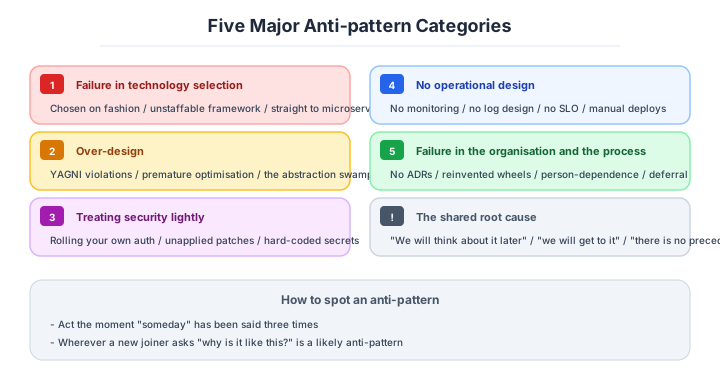
The “common misconceptions” and “common failures” from each article are reorganized here as a cross-domain reverse-lookup catalog. The architect’s job is more about avoiding fatal mistakes than picking the perfect option, so this article is designed as a “notice it before you’re stuck” early-warning device. When something feels off, look up the matching category here.
A full list of all Appendix articles is available at the following page.
Before you read this
This article collects anti-patterns from across the whole series, so vocabulary from every category turns up. If IT vocabulary is unfamiliar, reading the primer "How a Web Service Works" first makes it far easier to follow. You can also look anything up in the glossary as you read.
What are anti-patterns, anyway?
Think of traffic-accident cause patterns. “Distracted driving,” “speeding,” “running a stop sign” — accident causes are not new every time; the same patterns repeat over and over. Knowing the patterns lets you spot danger and dodge it in advance.
Anti-patterns are the architecture version of an accident-cause catalog. They categorize “design decisions you must not make” that have been observed repeatedly in past projects — a collective body of wisdom for not repeating the same mistakes.
Without knowing anti-patterns, you step on the same landmines others have already stepped on. Avoiding fatal mistakes is at least as important as pursuing the right design.
Why you need to learn anti-patterns
Avoiding “fatal mistakes” is more effective than memorizing the right answers
Architecture choices are infinite, but fatal-mistake patterns are finite and repeat. Memorizing every correct answer is impossible, but holding on to “never do this” dramatically raises the quality of design reviews.
”Plausible-sounding decisions” are the most dangerous
Many anti-patterns look rational at first glance. “Microservices scale better,” “NoSQL is faster,” “the latest tech is more productive” — each can be right or wrong depending on context. Learning anti-patterns builds the habit of checking preconditions.
They function as a team’s shared vocabulary
When you can call out “that’s a Golden Hammer” or “we’re turning into a Big Ball of Mud” by pattern name, design reviews and discussions become vastly more efficient. Sharing abstract concerns through concrete archetypes raises the entire team’s design capability.
Architecture-wide traps
Decision-making mistakes common across all domains. Less about specific tech selection, more about posture toward design. These show up in nearly every failed project.
| Anti-pattern | Symptom | Prescription |
|---|---|---|
| Over-engineering (YAGNI violation) | Massive unused features, layers, abstractions | Build only what current requirements need |
| Jumping on the latest tech | Information thin, easy to get stuck | Prefer options with 2-3 years of operational track record |
| Reinventing the wheel | Building what an existing product covers | Lean on standard libraries / SaaS |
| No documentation of decisions | Nobody remembers “why we picked this” | Write ADRs |
| Conclusions without benchmarks | Decided by “feels faster” | Always measure first |
“Documented rationale” beats “technically correct” in long-term operations.
Infrastructure / deployment traps
Typical mis-selections around cloud, servers, and networking. The root cause is often “just copying a megacorp.” Misjudging your scale and phase is fatal.
| Anti-pattern | Symptom | Prescription |
|---|---|---|
| Pointless multi-cloud | IAM, monitoring, IaC duplicated, ops doubled | Lean on a single cloud |
| Adopting K8s without need | Ops time eats dev time | ECS Fargate / Cloud Run is enough |
| Premature microservices | Bog down in distributed transactions and network boundaries | Start monolith, split when actually needed |
| Manual setup without IaC | Environment drift, not reproducible | Manage all resources via Terraform / CDK |
| RDS not in private subnet | DB exposed to public network | Always private subnet |
Doing “AWS Certified-grade” design at a startup melts away product-development time.
Data traps
Typical mis-selections in datastore selection and database operations. Unlike applications, data cannot be rebuilt, so failures here echo for five years.
| Anti-pattern | Symptom | Prescription |
|---|---|---|
| Running analytical queries on the production DB | Customer-perceived speed degrades | Separate OLTP and OLAP early; build a DWH (Data Warehouse) |
| Escape into schemaless DBs | Stuck for AI use and analytics later | PostgreSQL + schema definitions |
| Master data fragmented per department | Customer duplicates, integration impossible | Build MDM |
| Overwrite-update without history | No audit trail, ML modeling stalls | History tables or Event Sourcing |
| No data quality checks | Inconsistent data poisons analytics | Automate with dbt tests / Great Expectations |
| Backup-restore never validated | Restore fails on actual disaster | Quarterly restore drills |
Failures in data architecture are about 5x heavier than failures in application architecture — because rebuilding is not an option.
Application traps
Typical errors in code design, modularization, and error handling. They run in the short term, so they’re easy to miss, and slowly suffocate maintainability over months and years.
| Anti-pattern | Symptom | Prescription |
|---|---|---|
| God classes / God functions | Thousands of lines per file, unclear responsibility | Single Responsibility Principle |
| Business logic in stored procedures | DB migration impossible, hard to test | Push logic into the application |
Swallowing errors (catch { }) | Failures don’t surface, deepen | Log + rethrow, or explicit handling |
Meaningless naming (data, util, manager) | Code intent unreadable | Name in domain terms |
| All static methods | Untestable, no DI possible | DI container or constructor injection |
| Methods returning null | Missed null checks at call sites | Optional / Result types |
“Working but unmaintainable code” is the act of forcing technical debt onto everyone but yourself.
Frontend traps
Frontend-specific mis-selections and implementation errors. Many of these directly hit security and performance, affecting user trust.
| Anti-pattern | Symptom | Prescription |
|---|---|---|
| Storing JWT in localStorage | Single XSS leaks the token | HttpOnly Cookie + BFF |
| CSR for an SEO-critical site | Doesn’t index in search | Use SSR / SSG / ISR |
| Hand-rolled auth cookies | Vulnerability breeding ground | Delegate to Clerk / Auth.js / Auth0 |
| In-house CSS design system | Hard to hire, learning cost wasted | Tailwind + shadcn/ui |
| Serving images unoptimized | LCP destroyed, Core Web Vitals tank | CDN transform + WebP / AVIF |
| Raw React without a meta-framework | Hand-rolled routing, SSR, build | Use Next.js / Astro |
Frontend anti-patterns are directly visible to users, so the cost is high.
Security traps
The defining feature of typical security architecture errors is that they are not recoverable. Once data leaks, no after-the-fact mitigation puts it back.
| Anti-pattern | Symptom | Prescription |
|---|---|---|
| Building auth in-house | Holes in password reset, MFA, etc. | Delegate to Auth0 / Cognito / Clerk |
| Optional MFA | Single password leak, instantly compromised | Mandatory for all users |
| Password-only auth | One phishing hit and you’re done | Standardize Passkey support |
| Logging PII in plaintext | Violates data protection law | PII masking + audit |
| Committing secrets to Git | Leak -> high bills, legal risk | Vault / Secret Manager + pre-commit hook |
| Still allowing TLS 1.0 / 1.1 | Audit-failing | TLS 1.3 mandatory, 1.2 minimum |
| Trusting “inside the VPN” (perimeter model) | Internal compromise propagates everywhere | Zero Trust, authenticate every request |
Security costs 100x more after an incident than during initial setup. Standard equipment from day one.
Monitoring / operations traps
Anti-patterns that surface in operations. Things “appear to be working” for a long time, then erupt all at once during an incident.
| Anti-pattern | Symptom | Prescription |
|---|---|---|
| Alerts firing but nobody watching | Major incidents discovered late | PagerDuty + on-call rotation |
| Operating without SLOs | Cannot discuss quality numerically | Declare 99.9% availability etc. |
| Logs not structured | Search and aggregation impossible | Standardize JSON structured logs |
| No runbook | New hires panic during night incidents | Document procedures for common failures |
| Skipping postmortems | Same incident keeps repeating | Always record cause and countermeasure post-incident |
| Direct SSH fixes in production | Changes not reproducible, not auditable | Only via CI/CD pipeline |
“Running” and “observable” are not the same thing. What’s not visualized may as well not exist.
Process / organization traps
Anti-patterns at the decision-making and org-running level — upstream of any tech choice. Trying to solve these with technology fails. They have to be treated as people problems.
| Anti-pattern | Symptom | Prescription |
|---|---|---|
| No documentation of architectural decisions | Nobody can answer “why?” | Write ADRs |
| Architect operates in isolation | Idealistic decisions disconnected from reality | Decide together with implementers |
| Ignoring Conway’s Law | System boundaries don’t match org structure | Reverse-engineer design from team structure |
| Vendor handoff with no understanding | Nobody internally understands the internals | Buyer must understand the architecture |
| Big-bang rewrite project | Years and millions wasted on failure | Strangler Fig phased migration |
| ”We won’t know until we try” drift | Cannot estimate, cannot evaluate risk | Enforce PoC -> implementation order |
The most common failure mode, oddly, is getting the tech right but losing on process.
AI-era specific traps
Anti-patterns that have surfaced recently, around AI-driven development and AI-as-default operations. These need a viewpoint that classical design doesn’t have, and accumulate as debt if you don’t recognize them.
| Anti-pattern | Symptom | Prescription |
|---|---|---|
| Adopting an in-house framework that AI can’t write | AI productivity boost doesn’t apply | Lean on mainstream frameworks (Next.js, Django, etc.) |
| Schemaless JSON storage | AI cannot infer the data structure | Make types and schemas explicit |
| GUI-operation-dependent tools | Cannot delegate operation to AI | Choose tools operable via CLI / API / IaC |
| No data catalog | RAG and AI agents cannot infer semantics | Maintain metadata and descriptions |
| Deploying AI-generated code without review | Vulnerabilities and bugs into production | Don’t skip the regular review/test cycle |
| No vector DB support | Cannot bolt RAG on later | Design assuming pgvector / Pinecone |
The AI-era design principle places “can AI fluently write and read this?” at the center of selection.
Major incident damages by anti-pattern
The cost of anti-patterns is a scale that cannot be ignored when measured in dollars. The legendary cases:
| Case | Year | Anti-pattern | Damage / impact |
|---|---|---|---|
| Knight Capital | 2012 | Deploy procedure error (one machine got old code) | $440M lost in 45 minutes, company dissolved |
| Adobe data leak | 2013 | ECB mode + shared password hint | 150M passwords effectively cracked |
| Dyn DNS attack | 2016 | IoT botnet (Mirai) | Twitter / GitHub / Netflix offline for hours, 1.2 Tbps DDoS |
| GitLab DB deletion | 2017 | rm -rf during on-call + all 5 backup methods broken | Restored from 6-hour-old snapshot, 300GB lost |
| Equifax data leak | 2017 | Struts 2 patch left for 2 months | $700M settlement, 147M people leaked |
| Capital One | 2019 | IAM over-privilege + WAF misconfig | $80M fine, 100M records leaked |
| AWS Kinesis outage | 2020 | Streaming foundation as SPOF | us-east-1 long outage, took out the AWS Console |
| SolarWinds | 2020 | Compromise via trusted vendor | 18,000 organizations compromised through legitimate channels |
| Log4Shell | 2021 | No SBOM | World’s Java apps got a zero-day, impact unknown to many |
| Facebook 6h outage | 2021 | BGP misconfig + collocated monitoring | Ad revenue loss > $60M |
| Meta GDPR fine | 2023 | EU citizen data sent to US | EUR 1.2B (~$1.3B) |
| CrowdStrike outage | 2024 | Update error | Windows endpoints worldwide BSODed; airports, banks, hospitals halted |
A single anti-pattern triggering hundreds of millions to billions of dollars in damage is real, recurring history. “Boring operations are the strongest defense” and “design luxury earned only after the hypothesis pays off” are the historical refrains shaping the industry’s intuition.
Common root causes
These anti-patterns share common root causes. Surface symptoms differ but trace back to the same handful of starting points, so naming the root makes prevention easier.
| Root cause | Typical phrase | Countermeasure |
|---|---|---|
| Misjudging scale and phase | ”Google does microservices, so…” | Judge by your own scale |
| Blind faith in newness | ”It’s the latest, so it must be better” | Weight information density and operational track record |
| ”Build it ourselves to learn" | "It’ll be educational, so we’ll DIY” | Don’t learn in production |
| Short-term view | ”It just needs to work right now” | Evaluate the 5-year debt |
| Abandoning documentation | ”Read the code” | Leave reasoning in ADRs |
90% of anti-patterns reduce to getting scale and phase wrong or skipping documentation.
Looking back at burning projects, the failure causes are remarkably similar. “We wanted to use new tech,” “We wanted it to look cool,” “We wanted to learn” — designs born from these three motives almost always break down somewhere. By contrast, the “boring but it works” designs frequently keep humming for five years. Half of the architect’s job is fighting your own desires, and the other half is finding the courage to accept being boring. Blind faith that “new technology is better” leaves you stranded during an incident, with thin information and no operational track record behind the choice; abandoning documentation on “read the code” means the reasoning has vanished within three years and the same mistakes repeat.
AI decision axes — Anti-patterns creep into the AI’s suggestions too
AI-recommended architectures contain antipatterns
If you ask AI “propose a modern architecture”, it may recommend complex configurations like microservices, Kubernetes, event-driven, and CQRS. This is because the training data contains a high proportion of case-study articles and conference materials from large enterprises, so AI tends to return “idealized answers” without considering the questioner’s context (team size, budget, operational capacity).
If a 10-person team follows AI’s recommendation and splits into microservices, they will repeat the same failures as Segment and Uber described in this article. When receiving proposals from AI, you need the habit of explicitly stating your team size, budget, and operational capacity, then asking back “is anything excessive for this scale?”
AI’s answers change dramatically depending on how you phrase the question. Asking for “the best” or “modern” returns over-engineered answers; asking for “the simplest setup a 5-person team can operate” returns practical answers. Be aware that prompt phrasing directly affects antipattern avoidance.
”AI-delegated” is itself becoming a new antipattern
With the spread of AI coding tools, cases are emerging where review is skipped under the judgment “AI wrote it, so it’s OK.” This is a new form of antipattern. AI-generated code returns statistically plausible patterns, but it does not automatically account for project-specific constraints (consistency with existing DB structure, team naming conventions, security policies, etc.).
Especially dangerous is adopting AI-generated design decisions (DB selection, authentication method, caching strategy, etc.) without rationale, simply because “AI said so.” Design decisions always require a reason for “why this choice was made”, and “AI recommended it” does not qualify as a reason.
If you have the habit of recording decision rationale in ADRs, even AI proposals force you to articulate “why we adopted this”, preventing uncritical adoption.
Author’s note — winners who picked “boring tech”
Stack Overflow is a Q&A site with over 100M monthly hits, and its 2016 published numbers showed it ran on just 9 servers at the time. The stack was extremely conservative — .NET + SQL Server + Redis. No microservices, no NoSQL. CTO David Fullerton has publicly stated “we deliberately choose boring technology”, and it remains a frequent live example of Etsy engineer Dan McKinley’s 2015 essay “Choose Boring Technology.”
By contrast, Uber split into 2,200+ microservices in the mid-2010s and then ran into incident isolation becoming impossible, deteriorating developer experience, and proliferating duplicate functionality. In the 2020s they announced “DOMA” (Domain-Oriented Microservice Architecture), a domain-based reconsolidation. It is frequently cited as “the post-mortem on going to maximum decomposition.” Those who chose boring tech are still humming five years later; those who chased trends are still busy with consolidation projects five years later. This contrast suggests many anti-patterns are the result of paying for personal desires with organizational assets.
Self-check checklist
Use this list to confirm whether your project has stepped into anti-pattern territory. Hitting even one is reason to revisit the relevant reference.
- Switched to microservices, but the team is < 30 people.
- Using K8s, but no dedicated SRE.
- Multi-cloud setup with no clear rationale.
- Running analytical queries on the production DB.
- Hand-rolled auth and session management.
- Storing JWT in localStorage.
- MFA not enforced for all users.
- Logs not structured.
- No SLO defined.
- No ADRs being written.
Summary
This article covered the anti-pattern catalog end-to-end — cross-domain, 9 categories, major-incident damages, common root causes, and a self-check.
Defuse fatal landmines first, match scale, stay boringly consistent, document the rationale. That is the realistic answer to anti-pattern avoidance in 2026.
The next article covers the “best-practice catalog” — the mirror image: the iron-clad first-pick options when in doubt, organized by domain.
Back to series TOC -> ‘Architecture Crash Course for the Generative-AI Era’: How to Read This Book
I hope you’ll read the next article as well.
Also popular with readers
📚 Series: Architecture Crash Course for the Generative-AI Era (93/95)