
About this article
This article is the first deep dive in the “Software Architecture” category of the Architecture Crash Course for the Generative-AI Era series, covering how to choose a programming language.
“The language ties down the framework, and the framework ties down who you can hire.” Once chosen, it binds the project for a decade — a hard-to-undo decision. The article covers the major nine languages (TypeScript, Python, Java, C#, Go, Rust, Ruby, PHP, C/C++) and selection criteria across the four axes of scale, use case, talent market, and AI-generation accuracy.
Before you read this
This article is mostly about development: programs and APIs. If IT vocabulary is unfamiliar, reading the primer "Programs and APIs" first makes it far easier to follow. You can also look anything up in the glossary as you read.
What is programming-language selection in the first place
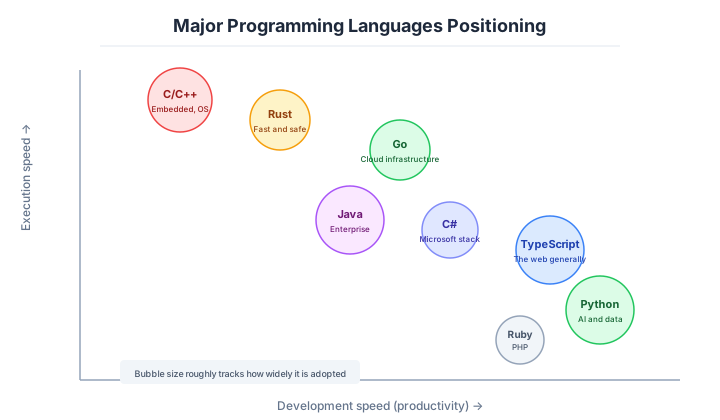
Programming-language selection is “deciding which language to write your system in.”
Imagine learning a foreign language. English (TypeScript / Python) has the most speakers and resources; German (Java) has strict grammar and suits large enterprises; Latin (C / C++) is classical and fast but extremely hard to learn. Once you start writing in a language, all of the team’s talent, libraries, and know-how accumulate around it, and switching to another language later costs as much as “retranslating every paper you’ve ever written.”
Why language selection matters
What happens if language selection is taken lightly? If no one on the market can write that language in 5 years, you can’t hire or hand off — the system becomes technically stranded. Today is the era of picking the right language per use; mixing different languages for frontend and backend is normal.
Language selection is a One-way Door on par with overall structure. Decide it with a 5- and 10-year talent-market view.
Old-school enterprise backend was Java-dominant; today is the era of picking the right language per use. Web systems standardly mix different languages on frontend (browser) and backend (server).
Computers natively understand only machine code. Programming languages are how humans drive them — source code gets translated to machine code by a compiler for execution.
Language selection, like overall structure, is a One-way Door. Decide it with a 5- and 10-year talent-market view.
Execution-style classification
Languages split by execution style into three groups. The style sets the trade-off between processing speed and development speed — the underlying property behind language selection.
| Execution style | Languages | Mechanism |
|---|---|---|
| Compiled | C, C++, Rust, Go | Translated to machine code ahead of time. Fast, but recompile on every change |
| Interpreted | Python, Ruby, PHP | Read and execute line by line. Immediate feedback, but slow |
| JIT | Java, C#, JavaScript | Build intermediate language; compile at runtime. OS-independent and reasonably fast |
Compiled is “production performance,” interpreted is “development cycle speed.” JIT (Just-In-Time compiler — turns into machine code on the fly at runtime) is the middle-ground compromise.
Where the major languages fit
TypeScript — the pick for new web work
TypeScript (2012, Microsoft) adds static typing and OO to JavaScript. Backwards-compatible with JS — existing JS code runs as-is. Compile-time type checks dramatically reduce runtime bugs.
For frontend, all major frameworks (Next.js, React, Vue, Angular) support TS — “TypeScript dominance” is the state. Backend runs on Node.js, Deno, Bun runtimes; especially BFF and microservice adoption is surging. Sharing language and types between frontend and backend has a large team-productivity effect.
| Runtime | Trait |
|---|---|
| Node.js | Most adopted, rich track record and info |
| Deno | Successor by Node.js’s author. Strong on security and TS-native |
| Bun | 2022 high-speed runtime. Node.js compatible, several times faster startup |
For new web projects, frontend and backend on TypeScript is the current default.
JavaScript itself is the substrate underneath it.
JavaScript (1995, Brendan Eich at Netscape, ~10 days) is the browser-side language. Spec is standardized as ECMAScript; complex parts from history persist, but yearly updates evolve it.
The biggest pivot: 2009’s Node.js. JavaScript became a general-purpose language outside the browser, opening “full-stack” with one language for frontend and backend. Event-driven and async I/O make it strong on high-concurrency web servers and AWS Lambda-style serverless.
| Strengths | Weaknesses |
|---|---|
| De facto standard for frontend | Dynamic typing weak at large scale |
| Full-stack with Node.js | Spec complexity from history |
| Largest npm ecosystem | Async syntax is distinctive |
| Abundant learning resources | Lacks type safety |
For backend, almost all projects have moved to TypeScript. Picking raw JS for backend outside small scripts is an obsolete choice.
Python — the de facto standard for AI and data analysis
Python (1991) provides functionality similar to other major languages, with “readability-first design” as the defining trait. Less code than Java or C#, with mandatory indentation-based blocks producing readable code regardless of who writes it.
Strong community, with the richest libraries especially in AI and data science — AI development effectively standardizes on Python. Interpreted, so raw speed is slow; but most libraries it calls are written in C/C++, so actual execution isn’t that slow.
| Strengths | Weaknesses |
|---|---|
| Overwhelming readability | Raw speed is somewhat slow |
| Effective standard in AI / data analysis | Dynamic typing weakens large-scale projects |
| Low learning cost | GIL (Global Interpreter Lock — restricts to one thread at a time) |
| Extremely rich libraries | — |
Main uses: AI / ML / data analysis, general web apps (Django, FastAPI).
In AI / data science, no other language is in serious contention.
Java and C# — the enterprise standards
Java (1996, Sun Microsystems; Oracle since 2010) provides OO, multi-threading, garbage collection, and runs on the JVM (Java Virtual Machine), making it OS-independent with high speed and stability.
Long-dominant in enterprise systems, still active. Updated semi-annually with cloud-optimization features. Spring family is mature, the standard for business app development.
Java carries one licensing trap worth knowing.
Java has two licenses. OpenJDK is free open source like other languages; Oracle JDK commercial use requires per-employee licensing.
The fees are extremely high, calculated including non-developers. A 1,000-employee company pays around $200k/year; 30,000 employees pays around $2.4M/year. Oracle JDK support includes legal protection, support for older versions, and 24/7 phone support — often required by compliance at public-sector and financial firms.
| License | Cost | Main rationale |
|---|---|---|
| OpenJDK | Free (open source) | General use |
| Oracle JDK | Annual license fee (high) | Public sector / financial support requirements |
Companies are migrating to free OpenJDK-compatible Amazon Corretto. Reasons to deliberately pick Oracle JDK are shrinking.
Oracle JDK costs license fees in commercial use. Amazon Corretto / Eclipse Temurin are the alternative defaults.
C# and .NET occupy the same slot on the Microsoft side.
C# (2000, Microsoft) is a cross-platform language with garbage collection and OO. Runs on Windows, Linux, Mac, iOS, Android, etc., though without C/C++ compatibility.
Microsoft maintains it actively with modern features. Excellent affinity with Microsoft products and Azure; broadly used from web apps to enterprise systems. Standard language for the Unity game engine — adopted in many mobile and console titles.
| Strengths | Main uses |
|---|---|
| Excellent fit with Microsoft / Azure | Apps using Microsoft services |
| Good balance of performance and productivity | General web apps (ASP.NET Core) |
| No conspicuous weaknesses | Game development (Unity standard) |
C# is the default candidate where Microsoft services are central.
Go and Rust — cloud-native, and extreme performance
Go (2009, Google) thoroughly pursued simplicity. Just 25 keywords; reachable to business-writing level in a week. Reportedly born from frustration with C++ builds taking 35+ minutes inside Google.
The biggest strength is overwhelming presence in cloud-native. Docker, Kubernetes, Terraform, Prometheus — most modern-infrastructure tools are written in Go. Statically compiled to a single binary and starts fast — strong fit for containers and FaaS, default for microservice API servers.
| Strengths | Weaknesses |
|---|---|
| Low learning cost | Prioritizes simplicity over expressiveness |
| Lightweight concurrency via goroutines | Late generics support (came in 1.18) |
| Single-binary distribution | Fewer OO features |
| Fast startup, fits FaaS / containers | — |
Adoption: Docker / Kubernetes / Terraform / Prometheus / etcd / Google, Uber, Netflix microservices.
For new cloud-native infrastructure, Go is the first candidate.
Rust sits at the extreme end of the same axis.
Rust (announced 2010 by Mozilla; 1.0 in 2015) is a compiled language guaranteeing memory safety. Without garbage collection, “ownership” prevents memory leaks and data races at compile time.
Steep learning curve, but once mastered you get C/C++-class execution speed and modern-language ergonomics. “Replacement candidate for C/C++” adoption is accelerating, ranking high in Stack Overflow’s “most loved language” survey.
| Adoption area | Examples |
|---|---|
| Systems | Linux kernel (parts), Windows component adoption beginning |
| Browsers | Firefox rendering engine (Servo) |
| Web / infrastructure | Cloudflare Workers, Dropbox storage backend |
| WebAssembly | Effective first choice for Wasm targets |
| CLI / tools | Replacements for ripgrep, fd, esbuild |
For new projects where performance and safety are absolute requirements, Rust is the most momentum-rich language now.
Ruby, PHP, C and C++ — the keepers of existing assets
Ruby (1995, Yukihiro Matsumoto) is famous for “Ruby on Rails.” Rails generates feature scaffolding with one command and lets you build web app prototypes fastest by following conventions. Rails itself is heavy, so it’s a poor fit for FaaS (Function as a Service) and microservices; selection opportunities outside web are decreasing.
PHP (1995) was born for web, embedded in HTML to generate dynamic pages — explosively popular. WordPress, powering ~75% of websites globally, is in PHP — still the largest backend language by deployment count. PHP 8+ added JIT and improved typing; Laravel and Symfony are mature.
| Language | Position |
|---|---|
| Ruby on Rails | Strong choice for individuals / small teams launching web apps fastest |
| PHP + Laravel | WordPress projects, small/mid web sites, existing PHP maintenance |
Active new-project selection has decreased, but the legacy is huge so they remain major languages for now.
C and C++ remain where the hardware is close.
C (1972) is one of the earliest programming languages; the simple structure produces extremely fast execution. Lacking automatic memory management and OO, developers handle those manually.
C++ (1983) extends C with memory management and OO under the “zero-overhead principle,” maintaining C-comparable speed. Since 2011, modern features ship every 3 years; still active.
| Strengths | Weaknesses |
|---|---|
| Overwhelming execution speed and stability | No automatic memory management (C) |
| Strong on hardware control | Extremely high learning difficulty |
| Massive library legacy (C++) | Verbose, low readability |
Main uses: embedded, OS / system software, AI library cores (PyTorch, TensorFlow), high-end games (Unreal Engine).
C’s domains are being replaced by Rust at speed. C/C++ won’t disappear due to the legacy footprint, but priority for new projects is dropping.
How to choose — by use case and the talent market
The main selection criteria are these.
Language selection isn’t decided by trend or preference; multiple axes need joint evaluation matched to project requirements. Once chosen, the language binds the project for years, so decide carefully.
- Where the application runs (runtime / OS / cloud)
- Functional and non-functional requirements (performance, concurrency, consistency)
- Implementation effort (framework richness, dev speed)
- Available engineers (in-house skill, external talent market)
With AI-driven (vibe-coding) development spreading, AI compatibility has joined the criteria. Type-rich languages (TypeScript, Rust, Java) let AI infer intent accurately; languages with abundant training data (Python, JavaScript) generate higher-quality code.
A new web application, API-centric and frontend-integrated. TypeScript (Node.js / Bun). Share types between frontend and backend, balance dev speed with type safety. The most balanced current choice.
A new web application at enterprise scale, where robustness comes first. Java / C#. Long operational track record, deep talent market, and mature frameworks (Spring Boot / ASP.NET Core). Still primary candidates in public sector and finance.
High-speed, low-resource servers. Rust / Go. For microservices and container-first, Go wins on startup speed and binary size. Rust comes in if extreme performance and memory safety are required.
AI, machine learning and data analysis. Python only. The library ecosystem is orders of magnitude ahead — practically no other choice. PyTorch, TensorFlow, pandas all assume Python.
The fastest prototype, solo or in a small team. Ruby on Rails / PHP + Laravel. The scaffold command auto-generates the skeleton; one person can launch a web app in a short period.
Embedded work, operating systems and hardware control. C / C++ / Rust. New: Rust is a candidate; existing maintenance still requires C/C++.
Maintaining and extending existing systems. Continue with the existing language. Rewriting in a different language almost never pays.
Against the talent market, the practical ladder looks like this.
Knowing “how many will be writing this in 5 years” in numbers makes selection sharper. Approximate Japanese hiring-market sense as of April 2026:
| Language | Domestic engineer pop | Hiring difficulty | 5-year continuation | Main domain | Suited case |
|---|---|---|---|---|---|
| JavaScript / TypeScript | 500k+ | Low (easiest to hire) | Expanding | Web, mobile, BFF | Web apps wanting type-sharing between front and back |
| Java | 400k+ | Low-mid | Continuing | Enterprise / finance / public | Enterprise systems prioritizing robustness and long-term maintenance |
| Python | 300k+ | Low-mid | Expanding (AI demand) | AI / data / web | Development centering on AI and data analysis |
| PHP | 200k+ | Low | Shrinking | WordPress / legacy | WordPress projects or existing PHP asset maintenance |
| C# / .NET | 150k+ | Mid | Continuing | Unity / Microsoft stack | Azure-centric or Unity game development |
| Go | 50k+ | Mid-high | Expanding | Cloud-native / microservices | Container and microservice infrastructure |
| Ruby | 50k+ | Mid-high | Flat | Rails legacy / startups | Fastest prototype development with a small team |
| Rust | 10k+ | High | Expanding (niche) | Systems / Wasm / infra | Absolute requirements for extreme performance and memory safety |
| Kotlin / Swift | ~50k each | Mid | Continuing | Mobile-only | iOS / Android native app development |
The empirical rule: “adopting a language with under 100k domestic engineers takes 6+ months to hire.” A startup posting “Rust required” sees applications drop 10x. For mid-career enterprise hiring, anything outside the TypeScript / Java / Python big three must be accepted as causing year-scale planning impacts.
Pick by numbers: “how many people will be writing this in 5 years.” Cases of niche-language teams stuck on hiring keep coming.
Three scenarios
If you are building solo or at a startup
At this size TypeScript is the only choice worth making. Sharing types between frontend and backend maximises the productivity of a one-person project, and its AI generation accuracy is in the top class. When AI or data-processing requirements appear, adding Python alongside it covers them. Making a sharp choice such as Rust or Elixir guarantees suffering later, on both hiring and the volume of available information.
If you are a small or mid-size SaaS
TypeScript for the web layer with Go or Python behind it is the realistic pairing. Building on a language with fewer than a hundred thousand engineers in the domestic market means hiring takes more than six months, so at this size the depth of the talent market belongs among the first-class criteria.
If you are a large enterprise
Java and C# remain the picks. Track record, people, mature frameworks and LTS — all four are present, and they hold up over ten years of operation. For maintaining and extending an existing system, continuing in the existing language is the only choice; rewriting in a different one almost never pays off.
AI decision axes — Strength of typing times volume of training data
Once AI-driven development becomes the norm, “AI generation accuracy, type-inference effectiveness, and training-data volume” become additional axes for language selection.
Why typed languages change AI-generation quality
When AI generates code, type information functions as “guardrails for AI.” In languages with explicit types like TypeScript and Go, the compiler rejects the moment AI writes code contradicting the types — meaning AI mistakes can be detected mechanically. In dynamically typed languages like Python and Ruby, type mismatches aren’t caught until runtime, creating risk that AI generation errors slip through tests and reach production.
Python is the exception — its overwhelming training-data volume keeps AI generation accuracy high. Choosing Python for AI/ML remains correct, but for large-scale applications you should assume strict use of type hints (mypy).
Language rewrites don’t pay off even in the AI era
Some think “AI lets us migrate to another language,” but this isn’t realistic. The difficulty of language migration isn’t grammar conversion — it’s replacing the entire ecosystem. Test code, CI config, deploy scripts, operations tooling, team knowledge — all bound to the language, so migration doesn’t end with just code conversion.
When existing assets exist, strengthening typing within the current language (Python → strict mypy, JavaScript → TypeScript migration) is far cheaper than switching languages entirely.
Pitfalls and forbidden moves
Here are the six most dangerous of the typical ways a rewrite or a language change goes wrong.
| Forbidden move | Why it is bad → what to do instead |
|---|---|
| Replacing a language “while rewriting it” — a big-bang rewrite | Netscape lost three years to a rewrite and lost the browser war → staged migration (Strangler Fig) is the only realistic answer |
| Adopting an emerging language for business work “because it is trending” | engineers do not come and you end up migrating during the growth phase → choose on the talent market five years out |
| Going past mid-size on a dynamically typed language | the price of having no types arrives three years later → at scale, use a typed language or enforce type hints strictly |
| Using Oracle JDK commercially without checking the licence | a large invoice arrives, scaled by headcount → use Amazon Corretto or Eclipse Temurin |
| Mixing five or more languages in one project | maintenance staff are spread thin and nobody can see the whole → keep it to two, frontend TypeScript plus one backend language |
| Running a non-LTS language version in production | the runway before security patches stop is short → select LTS as the baseline |
Author’s note — “how many people in Japan write that language?”
When a junior engineer suggests “I want to use this in production” for a niche language they like, the senior architect asks “how many people in Japan write that?” and the proposer falls silent. This scene repeats in many places. The feeling of fun in writing and the management decision of being able to hire successors are different layers.
There are stories of young engineers underestimating Go’s then-niche status, proposing it for production, and going silent when their senior asked “how many on this team can write it after you?” Lesson: “language selection is technical decision and recruiting strategy at once.”
Niche languages should be enjoyed in personal study and validation projects; for production, default to “a language 5 years from now that thousands of people in Japan will still write.” The price of sharp selections is paid by the successor team.
Fun is cost. Talent is asset.
What you must decide — what’s your project’s answer?
Articulate your project’s answer in 1-2 sentences for each:
- Main language (TypeScript / Python / Java / C# / Go / Rust, etc.)
- Runtime / version (default to latest LTS)
- Per-use additional languages (AI in Python, infra in Go, etc.)
- Typing policy (TypeScript
strict, Python type hints depth) - License check (Oracle JDK vs OpenJDK / Corretto, etc.)
- Frameworks paired with the language (Spring / FastAPI / Next.js, etc.)
- 5-10 year talent supply outlook
Recording the decision rationale
Language selection directly affects team composition, hiring, and maintenance cost, so documenting the rationale as an ADR is essential. Here is a concrete example:
| Item | Content |
|---|---|
| Title | Adopt TypeScript as the primary backend language |
| Status | Accepted |
| Context | Selecting a backend language for a new SaaS product. Frontend is already confirmed as React (TypeScript) |
| Decision | Unify the backend on TypeScript (Node.js LTS) as well |
| Rationale | - Type definitions and validation logic can be shared with the frontend, boosting development efficiency - 5 of 6 team members have TypeScript experience, minimizing additional learning cost - The npm ecosystem is rich and AI code-generation accuracy is high |
| Rejected alternatives | Go: no type sharing, increasing schema-sync cost between front and back. Python: weak type safety, more runtime errors at scale |
| Outcome | Adopt a front/back monorepo with a shared package for centralized type definitions |
Even a decision that seems obvious at project start will inevitably spark “why TypeScript and not Go?” when team members rotate a year later. Having “why we chose this” visible at a glance later is the greatest value of an ADR.
Related Articles
Summary
This article covered how to choose a programming language — major-language traits, talent market, AI-era judgment.
Web -> TypeScript, AI / data -> Python, enterprise -> Java/C#, cloud-native -> Go, extreme performance -> Rust. The 2026 split. Niche languages stay in hobby; production leans on the mainstream. That saves both hiring and long-term maintenance.
The next article covers overall structure (monolith vs microservices vs modular monolith).
Back to series TOC -> ‘Architecture Crash Course for the Generative-AI Era’: How to Read This Book
I hope you’ll read the next article as well.
Also popular with readers
📚 Series: Architecture Crash Course for the Generative-AI Era (24/95)