About This Article
This article examines which foreign stocks available on SBI Securities offer the most promising future prospects.
Since the New NISA (Japan’s revised tax-free investment program) launched in January 2024, more people have been venturing into investing.
Many are buying investment trusts linked to index funds like the ACWI or S&P500, but is that really the right choice?
Those products are indeed very stable, but their upside is limited — even when the world or the United States is doing well, the annual gain is just a few percent.
On the other hand, a promising company in a rapidly growing country could see its stock price more than double in a few years.
Of course, that would require a lot of luck, and in general the stable ACWI-type products are what I’d recommend to most people. But this article is aimed at those who want higher performance than that and are wondering which country has the most potential.
As of March 2024, SBI Securities offers stocks from 9 countries. I’ll look at economic growth rates (GDP growth) and stock market trends (index movements) for each country to assess which has the best chance of significant price appreciation going forward.
I hope this article encourages you to consider foreign stocks as one of your investment options.
Foreign Stocks Available on SBI Securities
First, let’s look at what foreign stocks SBI Securities offers.
As you can see on SBI Securities’ official “Foreign Stocks” page, you can buy foreign stocks from the following 9 countries. Below are the approximate number of listed securities available as of March 2024 (based on a search with no filters applied):
- United States (~5,176 issues)
- China (~1,312 issues)
- Thailand (~77 issues)
- Malaysia (~42 issues)
- Singapore (~49 issues)
- Russia (~28 issues) ※ Currently unavailable due to war
- South Korea (~74 issues)
- Vietnam (~290 issues)
- Indonesia (~74 issues)
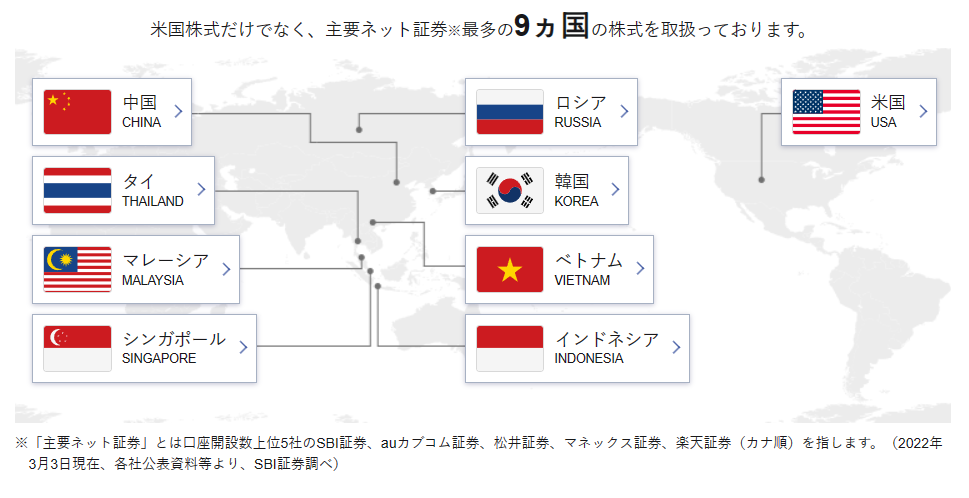
The U.S. has by far the most issues, which is why many people equate “foreign stocks” with “U.S. stocks.”
Incidentally, Japan had approximately 3,900 listed stocks as of March 2024, so the number of U.S. stocks available actually exceeds that.
China is the next largest outside the U.S. The other countries have a limited selection, as you can see from the numbers — but those available tend to be large, reliable companies, so it’s not too restrictive in practice.
That said, if you were hoping to buy small, lesser-known companies in emerging economies as a kind of lottery ticket, that won’t be easy here.
GDP Growth Rates for Available Countries
Now let’s look at each country’s economic growth rate (real GDP growth).
In general, when a company’s performance improves, its stock price tends to rise accordingly. And when a country’s economy is growing strongly, companies within that country tend to benefit as well.
So tracking a country’s long-term GDP growth can give a rough idea of how much its companies are likely to grow.
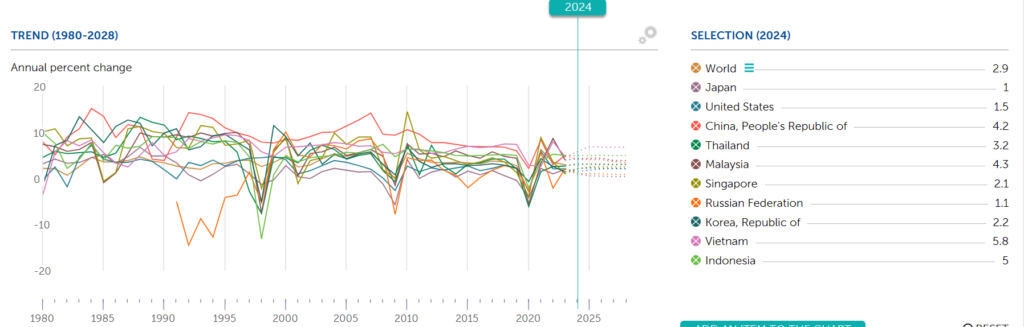
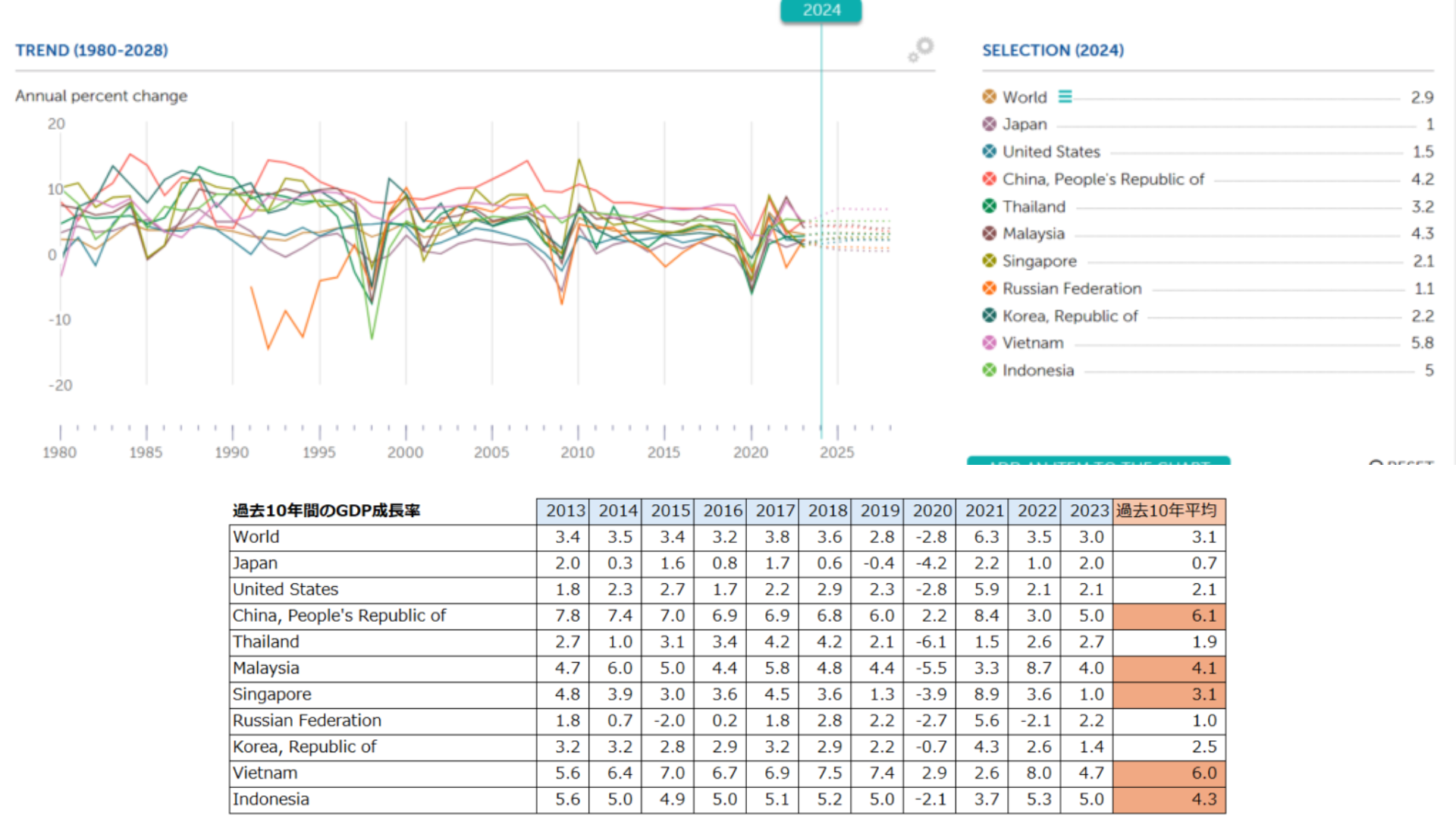
GDP growth rates for the countries available on SBI Securities (real GDP growth rate trends)
World Economic Outlook (October 2023) - Real GDP growth (imf.org)
The chart above compares all 9 countries available on SBI Securities, plus Japan and the world average.
At first glance, most lines move in similar patterns. The only obvious outlier is Russia’s sharp recent decline.
To get a clearer picture, I extracted the last 10 years of data and organized it into a table.
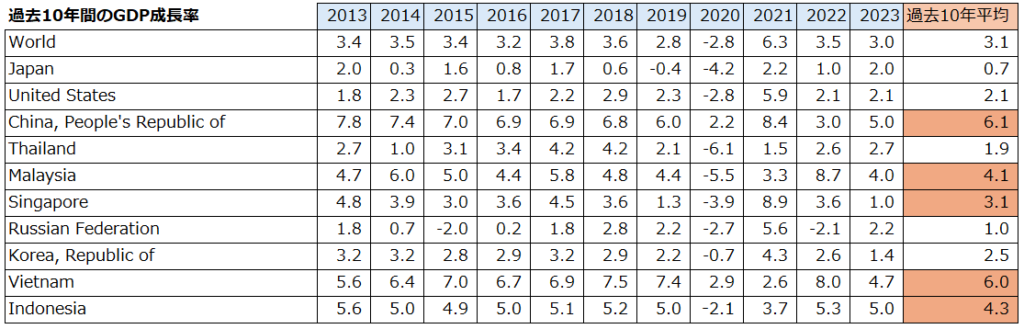
Countries highlighted in the rightmost column (10-year average) are those with economic growth equal to or greater than the world average.
Those countries are: China, Malaysia, Singapore, Vietnam, and Indonesia — five countries that have consistently maintained above-world-average economic growth over the long term.
Surprisingly, the United States’ economic growth rate is not above the world average (even though the U.S. gives an impression of booming growth).
And at the very bottom is Japan — as expected, unfortunately. Japan is performing even below Russia’s war-torn economy in terms of growth, which shows just how economically challenging Japan’s situation is on a global scale.
Based on this, those five countries would be the natural candidates for foreign stock investment — but economic growth and stock market performance don’t always correlate perfectly.
Japan is a perfect example: its economic growth rate is among the lowest, yet its stock market grew enormously over the past decade.
So next, let’s dig deeper by looking at each country’s stock market index trends.
Stock Market Performance by Country
Let’s now look at how each country’s stock market has actually performed.
This tells us which markets have been growing strongly over the long term and which have not.
Even if a country has strong economic growth, investment regulations or an underdeveloped capital market can hold back the stock market.
And if the overall stock market isn’t growing, individual company stocks are less likely to benefit from the broader market tailwind.
Conversely, if a market is growing sharply despite weak economic fundamentals, it may be overheating — which raises investment risk.
Let’s look at the 9 countries on SBI Securities plus Japan, one by one.
Japan
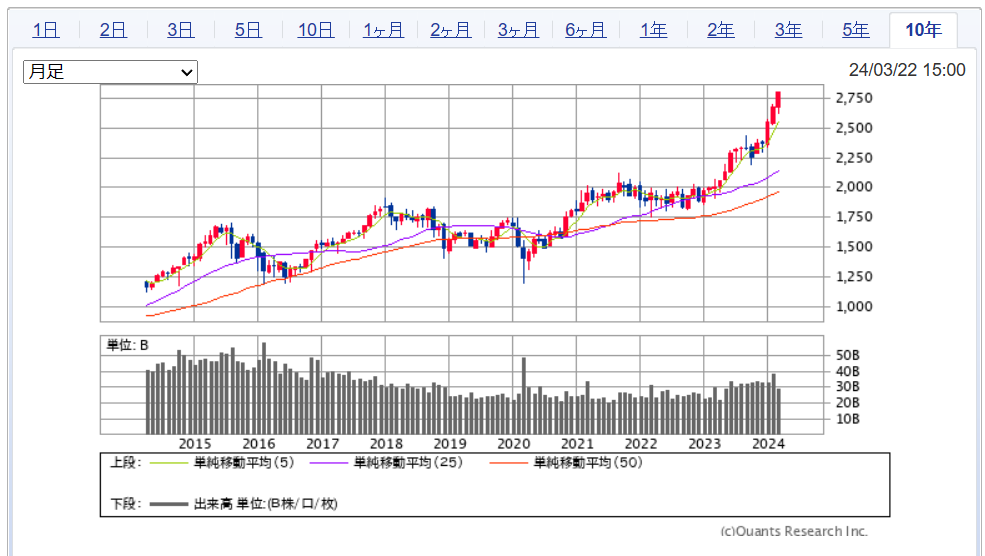
Japan’s stock market performance is tracked using TOPIX (the Nikkei Average is avoided here due to its heavy dependence on specific stocks).
From around 1,200 ten years ago to around 2,800 as of March 2024 — Japan’s stock market roughly 2.3x over 10 years.
Given this growth, most companies’ stock prices have likely at least doubled over the same period.
However, as noted earlier, Japan has the lowest economic growth rate among the countries covered here. The stock market’s sharp rise is thus somewhat anomalous — largely attributable to the Bank of Japan’s ultra-easy monetary policy. The outlook going forward is not particularly bright as the policy exits this era.
United States
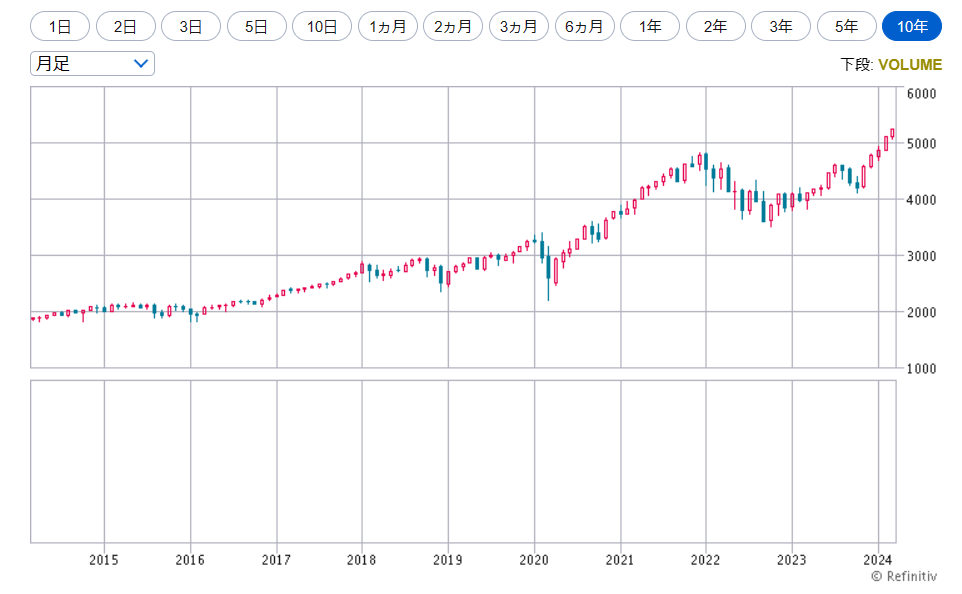
The U.S. stock market is tracked using the S&P 500.
From around 2,000 ten years ago to around 5,200 as of March 2024 — the U.S. market has grown approximately 2.6x over 10 years.
Even accounting for higher U.S. economic growth compared to Japan, this growth rate seems unusually high.
The exact reason is hard to pinpoint, but as the center of global finance and home to many cutting-edge technology companies, the U.S. has attracted concentrated capital from wealthy investors worldwide.
The past decade has been called “the era of U.S. dominance,” but given the wide gap from the real economy, I’m a bit skeptical about whether the next decade will be equally bright.
China
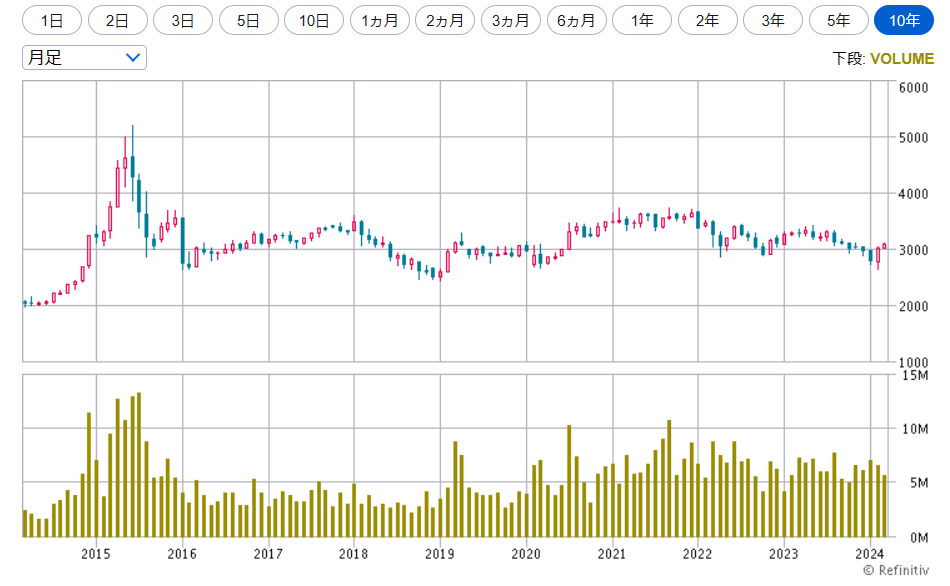
China’s stock market is tracked using the Shanghai Composite Index.
From around 2,000 ten years ago to around 3,050 as of March 2024 — China’s market has grown approximately 1.5x over 10 years.
This seems in line with China’s economic growth rate. Between 2015 and 2016, the index surged above 5,000 before crashing, yet it recovered — a testament to China’s resilience.
China has significant geopolitical risk, though most major countries do these days. If you can tolerate that risk, Chinese stocks’ relatively steady growth makes them a reasonable option.
Thailand
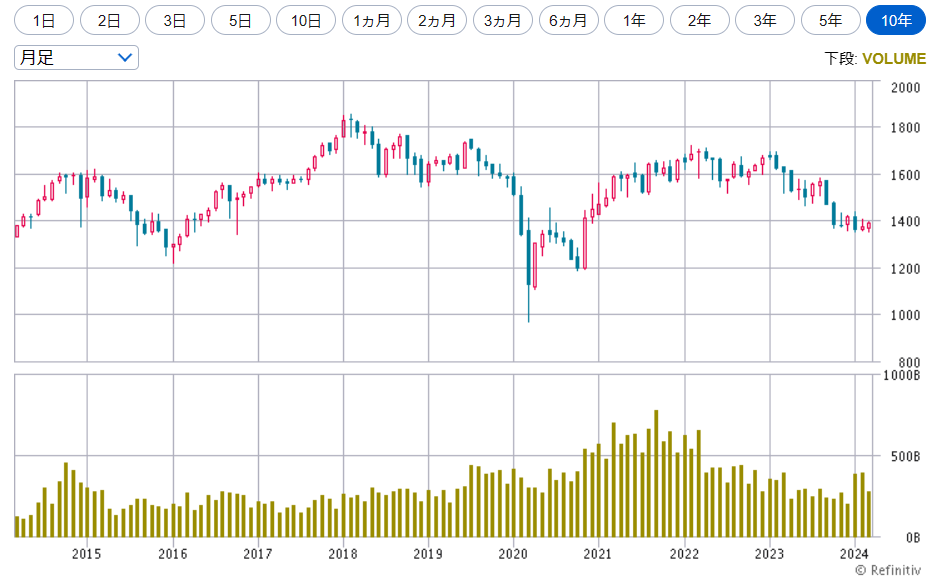
Thailand’s stock market is tracked using the SET Index.
From around the high 1,300s ten years ago to around the high 1,300s as of March 2024 — Thailand’s stock market has shown zero growth over 10 years.
With below-average economic growth as well, there’s little reason to expect improvement going forward. Honestly, I can’t find a compelling case for investing in Thai stocks.
Malaysia
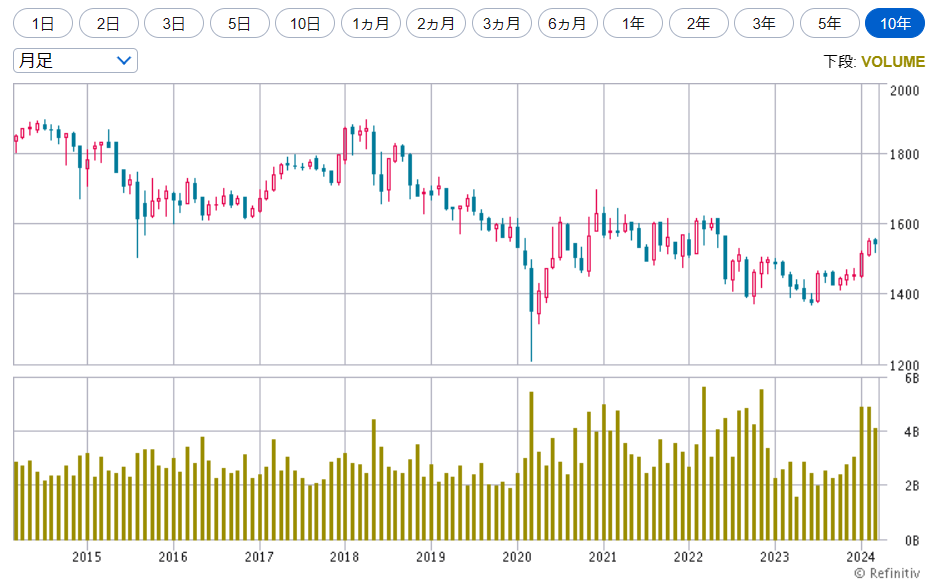
Malaysia’s stock market is tracked using the Kuala Lumpur Composite Index.
From around 1,900 ten years ago to around 1,500 as of March 2024 — Malaysia’s market has actually shrunk by about 0.8x over 10 years.
I’m not an expert on Malaysia, but looking at past news, political instability seems to be the main culprit.
Whether that instability is fully resolved is unclear, but the stock market has shown signs of recovery since the second half of 2023.
Malaysia continued growing economically even through its political troubles, so there’s a possibility that previously undervalued companies will now be re-rated. Just be aware of the geopolitical risk before investing.
Singapore
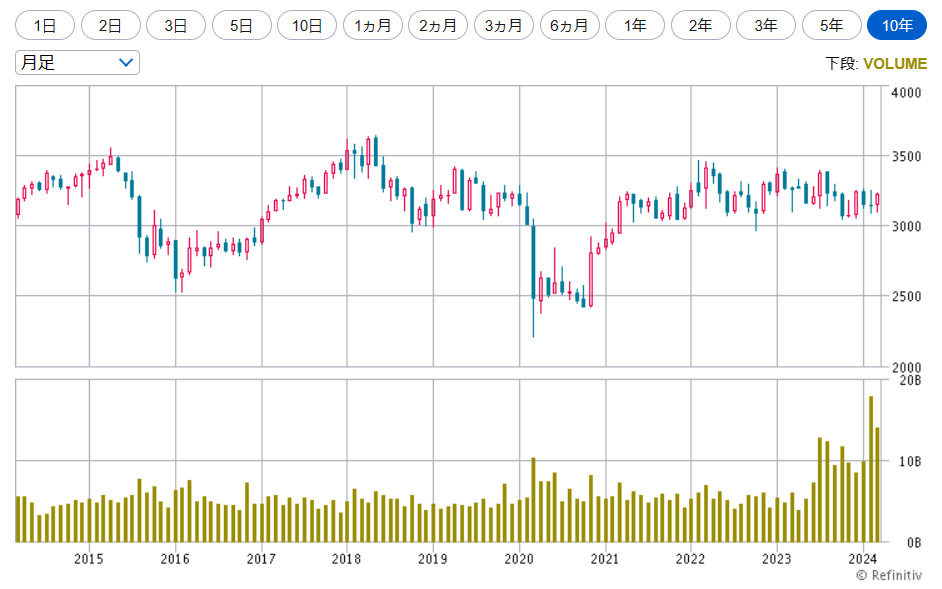
Singapore’s stock market is tracked using the Straits Times Index.
From around 3,200 ten years ago to around 3,200 as of March 2024 — Singapore also shows zero market growth over 10 years.
Economically, Singapore roughly tracks the world average, and it is internationally recognized as a financial hub — yet the index hasn’t budged. This is somewhat puzzling.
Singapore is essentially a city-state (slightly larger than Tokyo), so limited room for company expansion may be a factor. The number of listed companies is also far smaller than other countries.
Singapore doesn’t stand out as an attractive investment destination as a result.
Russia
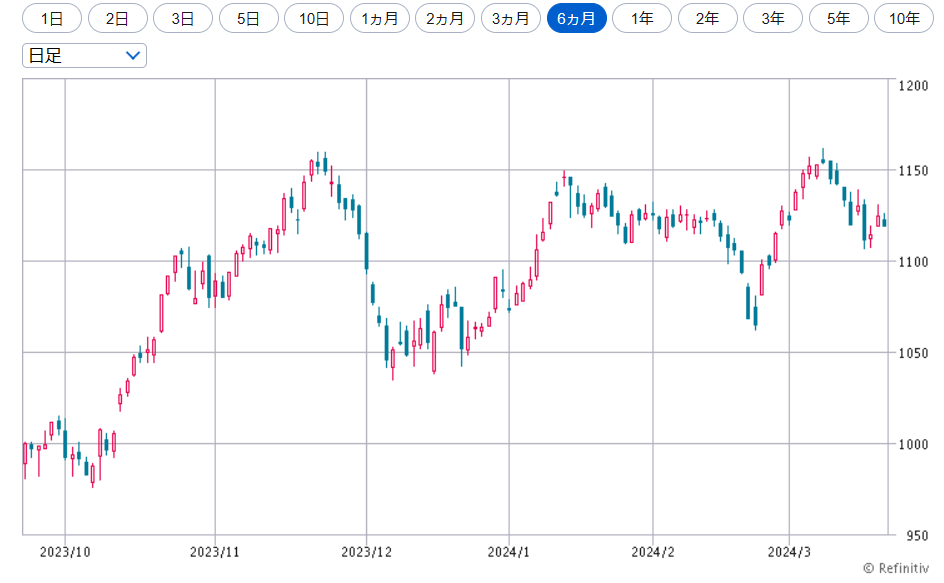
Russia’s stock market is tracked using the RTS Index.
From around 1,000 ten years ago to around 1,100 as of March 2024 — approximately 1.1x over 10 years.
Given the extreme geopolitical risk, weak economic growth, and poor market performance, there is honestly no case for investing. Russian stocks are also currently unavailable for trading due to the war with Ukraine, so I won’t go into further detail.
South Korea
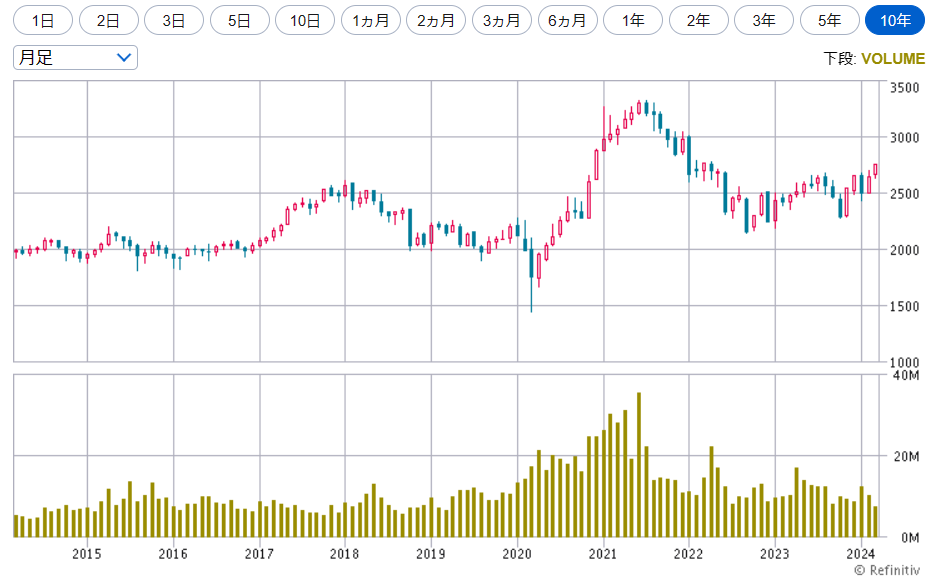
South Korea’s stock market is tracked using the KOSPI Index.
From around 2,000 ten years ago to around 2,700 as of March 2024 — approximately 1.3x over 10 years.
This seems consistent with its economic growth, but 1.3x over a decade is not particularly impressive for an investment target.
The index did temporarily exceed 3,000 in the early 2020s, and if you could time those peaks well, you might do alright. It’s not a total write-off, but it’s hard to argue there’s a compelling reason to invest there.
Vietnam
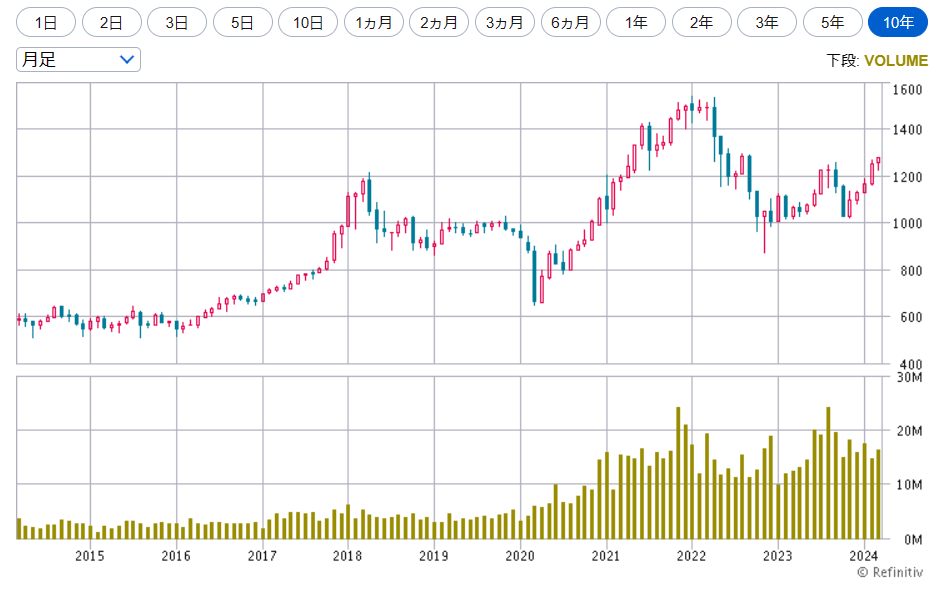
Vietnam’s stock market is tracked using the VN Index.
From around 600 ten years ago to around 1,300 as of March 2024 — approximately 2.1x over 10 years.
Vietnam’s economic growth rate is second only to China, and its stock market growth approaches Japanese and U.S. levels — actually exceeding economic growth in strength.
Vietnam is a communist country like China, but the Communist Party’s grip is not as strong as China’s, and the country gives an impression of relatively stable politics and economics.
Vietnam is also investing heavily in IT, exporting many IT professionals to Japan and elsewhere.
Strong economic growth, strong stock market growth, relatively low geopolitical risk, and a fertile environment for IT and trend-driven companies — Vietnam stands out as the most recommendable foreign stock market among those available.
Indonesia
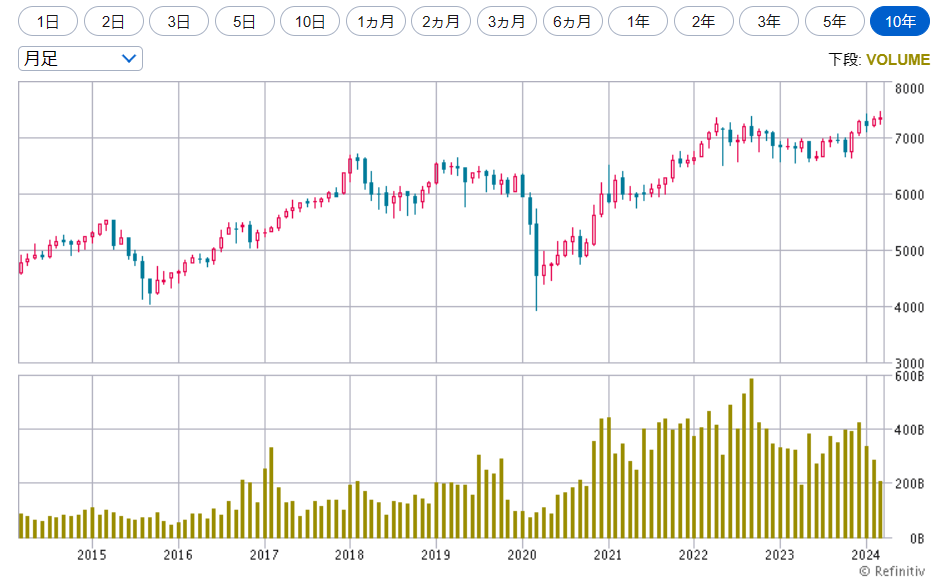
Indonesia’s stock market is tracked using the Jakarta Composite Index.
From around 4,600 ten years ago to around 7,300 as of March 2024 — approximately 1.6x over 10 years.
Above-average economic growth, and a stock market that tracks it reasonably. However, Indonesia is heavily influenced by China, political stability is limited, and the country is in the middle of a nearly 20-year capital relocation project whose impact is uncertain.
(An Indonesian acquaintance told me the government will move, but Jakarta will remain the economic center — so the impact may be limited.)
Summary
Below is a table summarizing what this article found for each country available on SBI Securities.
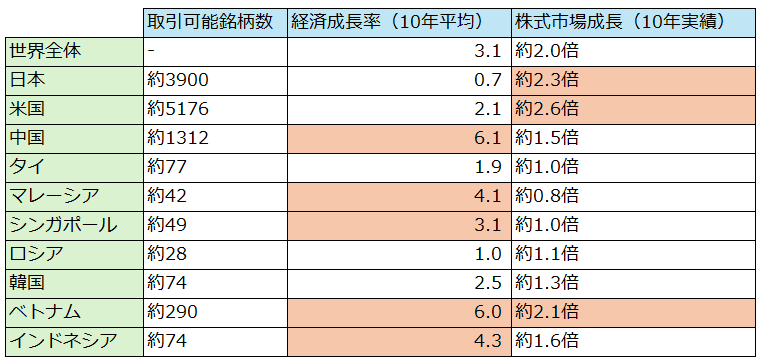
Orange cells indicate values equal to or better than the world average. In terms of economic growth, China, Malaysia, Singapore, Vietnam, and Indonesia all maintained above-average growth over 10 years.
For stock market growth, using MSCI World’s ~2.0x over 10 years as the benchmark, Japan, the United States, and Vietnam exceeded that threshold.
In theory, stock prices should roughly track economic growth, but recently there has been a striking disconnect — especially for Japan and the U.S., whose stock markets have risen far beyond what their economic growth alone would justify.
That doesn’t necessarily mean they’re on the verge of a bubble collapse, but the divergence from other countries is significant.
For short-term gains, Japan and the U.S. still look attractive. But if you’re worried about bubble risk, countries where stock markets more closely reflect economic growth are safer bets.
The top overall recommendation is Vietnam — combining strong economic growth, strong market growth, relatively low geopolitical risk, and a favorable environment for IT and emerging companies.
Runners-up would be China and Indonesia, both of which show high correlation between economic growth and stock market performance.
This article stops here. In future articles, I plan to analyze currency trends relative to the dollar and do a closer look at individual sectors and trending stocks in each country.
I’ve also written about how to start New NISA at SBI Securities — check it out if you’re interested.
How to Open a New NISA Account at SBI Securities - Senko’s Activity Log (en.senkohome.com)

Also popular with readers