Will AI Change the World of Investing?
With ChatGPT and other AI tools now widely available, I’ve been thinking about how these tools might reshape the world of investing.
AI is already being used by investment advisors and similar services — but I haven’t heard stories of anyone handing all their trades to an AI and making a fortune.
Practically speaking, if an AI emerged that could reliably generate big profits, everyone would start using it. Once everyone uses it, price movements would shift away from human-driven patterns — and eventually the edge would disappear.
So while handing everything over to AI may not be realistic, there’s a good chance a gap will open between individual investors who use AI and those who don’t.
The reason: AI is extremely effective as a tool for gathering the information that informs buy and sell decisions.
This article covers practical ways to use ChatGPT — one of the most well-known AI tools — for investing.
Note: The free version of ChatGPT (GPT-3.5) can perform analysis, but it’s less accurate than GPT-4 and has restrictions on file attachments. A paid plan is recommended if possible.
How to Use ChatGPT for Investing
Here are a few practical applications of ChatGPT for investing. There are many more possibilities beyond what’s listed here.
- Analyzing and summarizing earnings reports
- Explaining specialized financial content
- Identifying stocks expected to rise in value
Analyzing and Summarizing Earnings Reports
ChatGPT excels at analyzing and summarizing content you give it. For example, if there’s a stock you’re interested in, try having it analyze the company’s earnings report.
Download the earnings report PDF from the company’s investor relations page (for example, Toyota’s), then attach it to ChatGPT with a request like the one below.
Note: sharing just the URL of a financial report doesn’t work well — you need to download and attach the file directly.
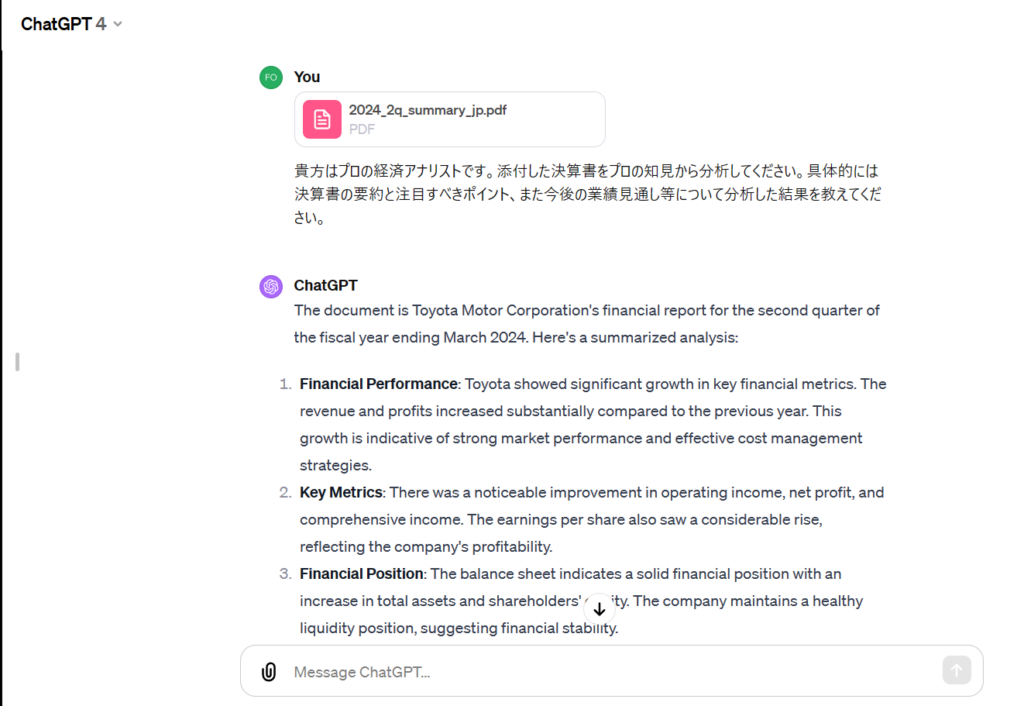
ChatGPT will respond with an analysis. If the output is in English and hard to follow, ask it to respond in English — or your preferred language — and it will adjust accordingly.
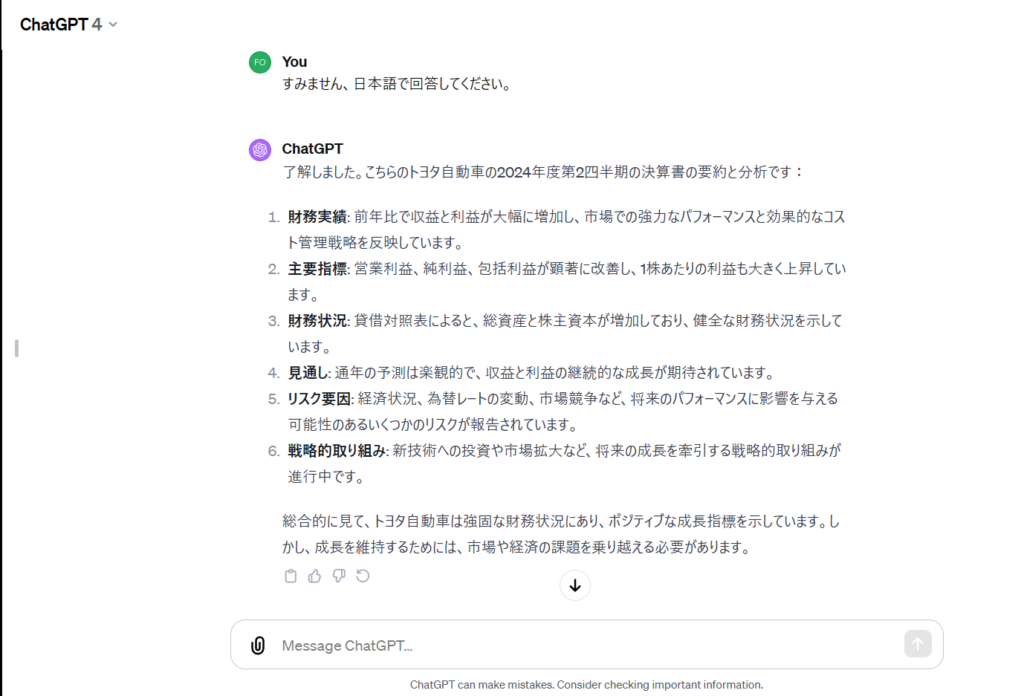
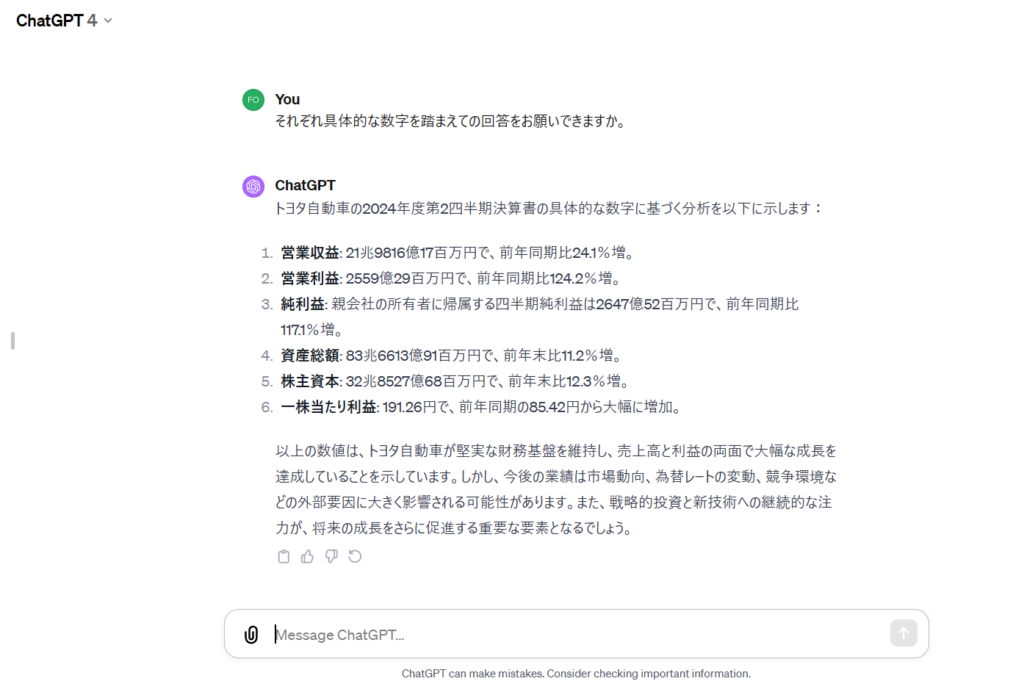
If you want more specific numbers, just ask — it will include them in its response. You can also ask for a comparison against the previous period. Keep asking for what you want to know and let it dig in.
Explaining Specialized Financial Content
Reading an earnings report yourself often means running into terms you don’t recognize.
You can search the web for explanations, but asking ChatGPT directly is often faster and clearer.
For example, if you come across the phrase “change in accounting policy required by IFRS” in a financial statement and aren’t sure what it means, just ask.
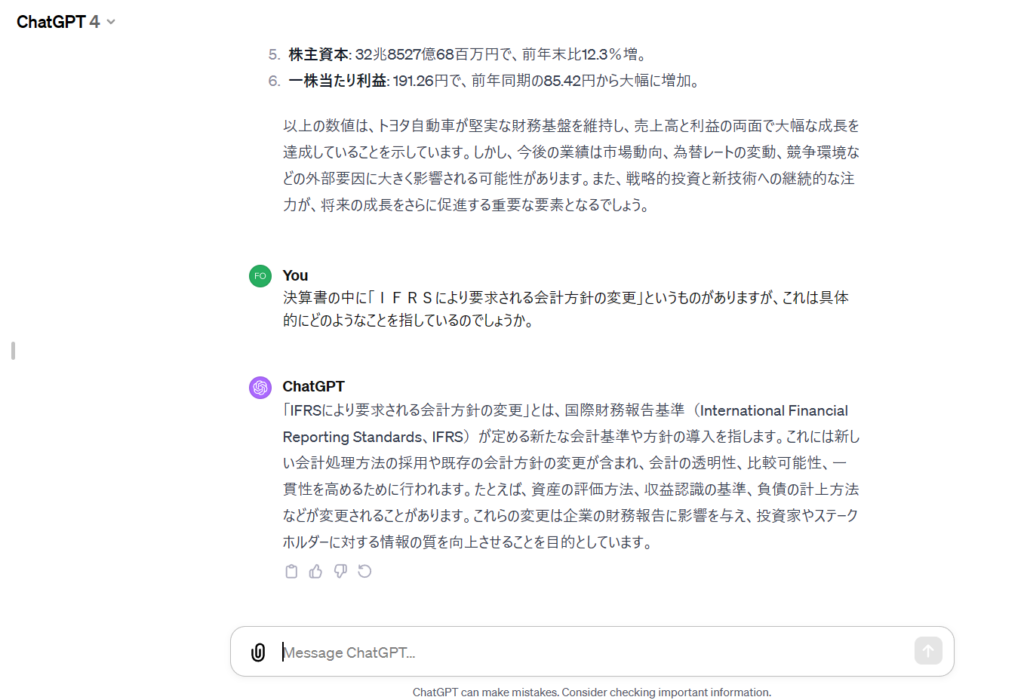
ChatGPT will explain what it means. If you want to go deeper, follow up with more questions — keep asking until you’re satisfied.
Identifying Stocks Expected to Rise in Value
Using ChatGPT or other AI tools to identify specific stock picks requires some care — but let’s try asking it to suggest around 10 stocks likely to rise in 2024.
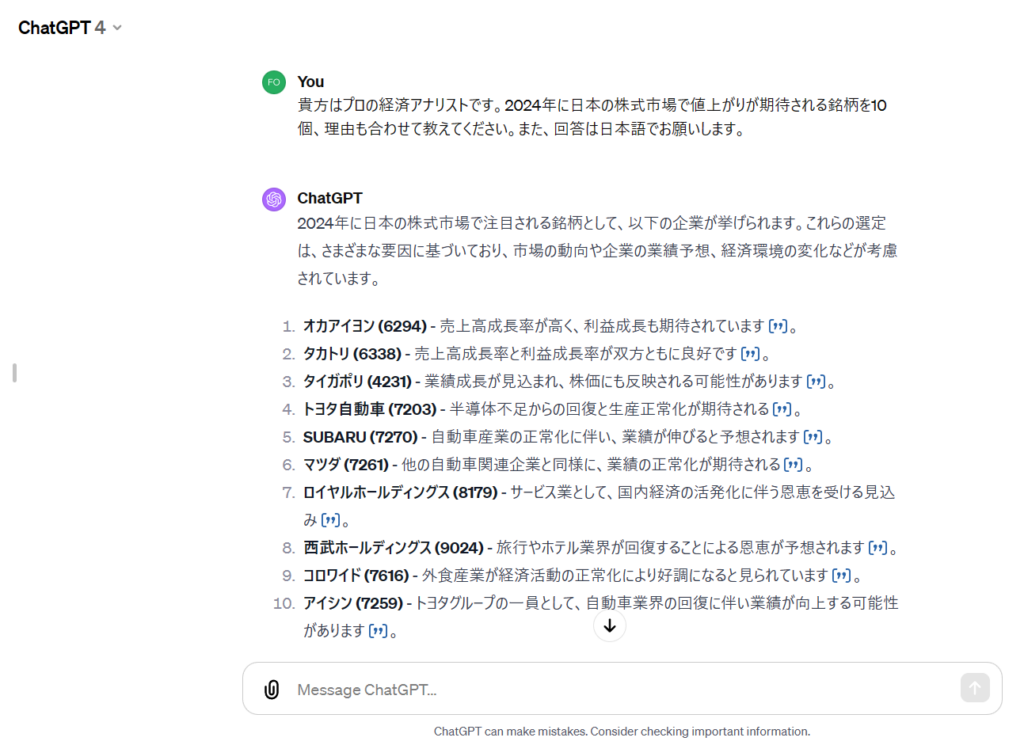
It seems to synthesize information from various sources to give a comprehensive answer — but stock names can be wrong, and the reasoning can be fairly superficial, so using this output directly is risky.
A better approach is to work through the question in steps.
For example, first ask: “What industries in the Japanese stock market are expected to grow in 2024?” — then follow up by asking for notable companies within each of those industries. This narrows down candidate stocks more effectively.
That said, AI is always working from the information it has — and if new information emerges that contradicts that data, or if market conditions shift, the predictions often won’t hold. The investor still needs to make the final judgment.
Important Caveats When Using ChatGPT
There are a few important things to keep in mind when using ChatGPT for investing.
- Its responses are not based on real-time information
- AI does not take responsibility for outcomes
Its Responses Are Not Based on Real-Time Information
As of the time of writing, GPT-3.5’s knowledge cutoff is January 2022, and GPT-4’s is April 2023.
Because it can only draw on the information it has, its responses may diverge significantly from current reality.
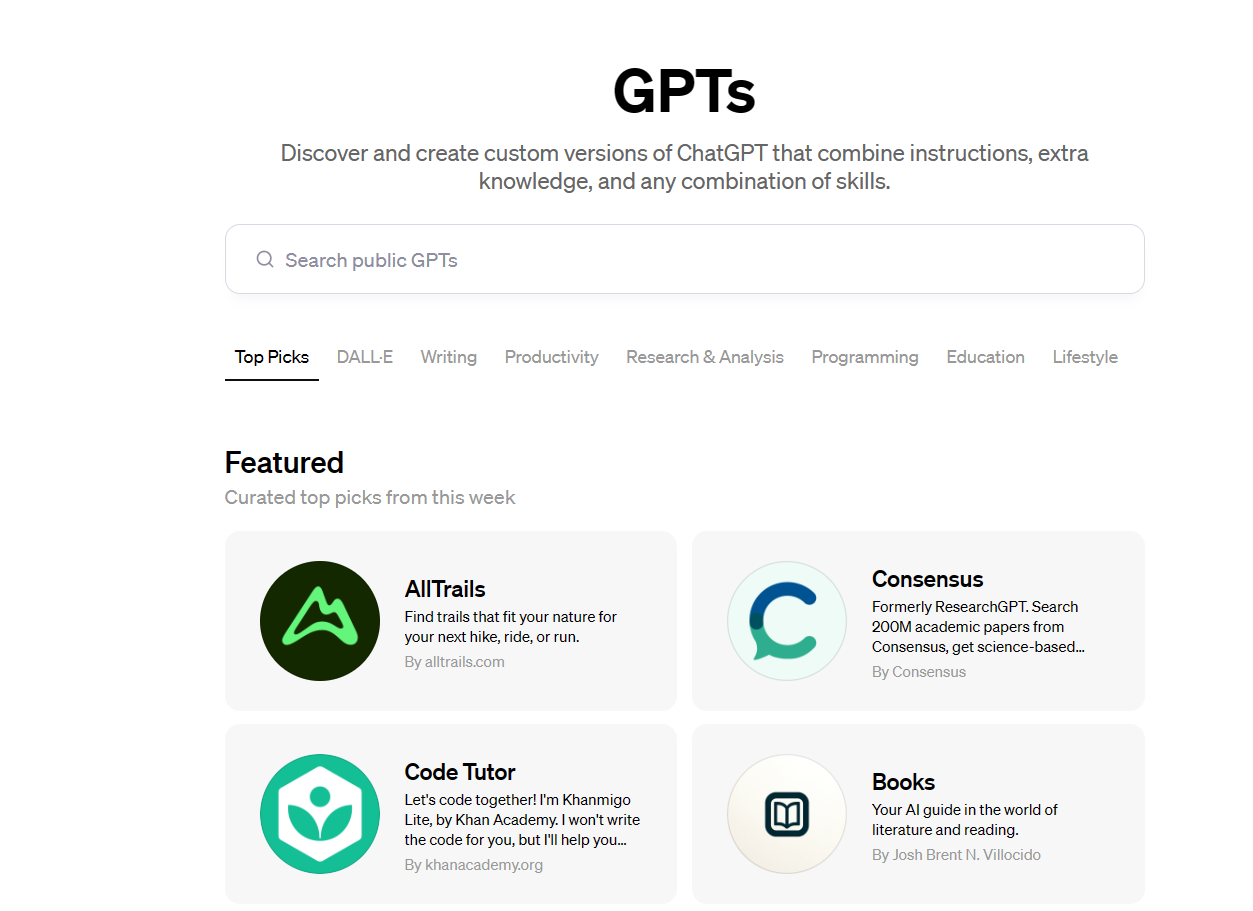
With a paid plan, you can select tools like WebPilot from the GPTs store to include real-time web search results in its responses — which reduces this risk to some extent.
Even then, responses are limited to what web searches can surface, and detailed, up-to-the-minute information is still out of reach. This is the biggest limitation.
AI Does Not Take Responsibility for Outcomes
This goes without saying, but AI takes no responsibility for its answers.
AI can confidently state things that turn out to be wrong, or give answers that were reasonable at the time but prove incorrect in practice. The responsibility for evaluating that information always rests with the user.
If you invest based on a ChatGPT response and lose money, there is no recourse with OpenAI.
The user is always responsible. AI is not.
The right way to use AI in investing — both now and in the future — is to treat its responses as one input among many, and to make final decisions through your own comprehensive judgment.
Related Articles


Summary
This article covered practical ways to use ChatGPT for investing.
ChatGPT is full of potential — the use cases above are just a starting point, and there are many more ways to apply it. I’d encourage you to think of your own (and share them with me).
As future versions like GPT-4.5 and GPT-5 are released, accuracy will continue to improve. Other AI tools useful for investing will also emerge.
Getting into the habit of asking “could this new AI tool be useful for investing?” every time something new comes out will open up more and more possibilities over time.
I’ll continue writing articles whenever I come up with new approaches — I hope you’ll check back.
Also popular with readers