About this article
This article is the seventh deep dive in the “System Architecture” category of the Architecture Crash Course for the Generative-AI Era series, covering network design.
Network design fixes the physical / logical skeleton between servers and to the outside; a CIDR once decided is effectively unchangeable. The article covers CIDR design, the 3-tier subnet structure, multi-AZ, external connectivity, and gives criteria for “draw it wide, with margin, aligned to internal standards.”
Before you read this
This article uses a good deal of infrastructure vocabulary — servers, networks and so on. If that is unfamiliar, reading the primers "Servers and the Cloud" and "How a Web Service Works" first makes it far easier to follow. You can also look anything up in the glossary as you read.
What is network design in the first place
Network design is, roughly speaking, “the work of designing communication paths between servers and to the Internet.”
Imagine the plumbing in an apartment building. The pipe diameter and branching must be decided before construction. If you decide “actually, I want independent pipes per room” after move-in, it’s a major tear-down-the-walls operation. Cloud network design is the same — once IP-address ranges and subnet partitioning are decided, changing them requires rebuilding every resource.
Why network design matters
What happens if you move forward with a tentative network design? A fresh VPC assigned a casual 10.0.0.0/16 — then three months later, another department discovers they’ve been using the same range on-prem for years. The VPC has to be rebuilt from scratch. This is a commonly reported failure pattern in the industry.
Network design is a project-week-1 decision. Tentative-and-defer here collapses everything once serious construction starts. “Get it running and then think about it” is the layer where this approach is most catastrophic.
This article uses AWS terminology, but Azure and Google Cloud have almost identical concepts. Six terms carry you through: VPC (a virtual network private to you), subnet (a subdivision inside the VPC), CIDR (the 10.0.0.0/16 notation for an IP range), IGW (the connection point to the internet), NAT GW (the proxy for outbound traffic from a private subnet) and security group (a firewall applied per resource).
CIDR design principles — take it wide, and follow the internal standard
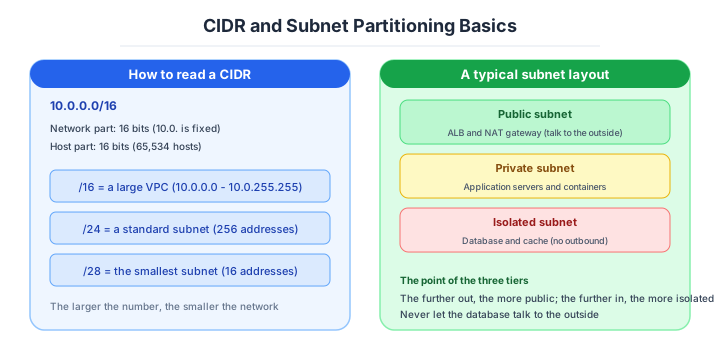
CIDR (Classless Inter-Domain Routing) is the IP-range notation. Numbers like /16 and /24 indicate “the bit length of the network portion.” Smaller number = wider range.
The default for the entire VPC is /16 (65,536 addresses), taken wide. Subdivide into /24 (256 addresses) per subnet.
VPC           10.0.0.0/16   <- 65,536 addresses (whole)
+ Public-a   10.0.0.0/24   <- 256 addresses
+ Public-c   10.0.1.0/24
+ Private-a  10.0.10.0/24
+ Private-c  10.0.11.0/24
+ DB-a       10.0.20.0/24
+ DB-c       10.0.21.0/24
CIDR overlap with other companies, sites, or internal systems is forbidden. VPN and VPC peering connections fail when IPs overlap. If your org has a standard for IP ranges, follow it; using 10.0.0.0/16 based on personal preference is a landmine.
CIDR: take wide (/16), confirm no conflict with internal standards before locking it.
The three-tier subnet structure
Subnets divide a VPC into purpose-specific compartments. Public / Private / Isolated as a 3-tier structure is the modern standard.
| Tier | Use | Internet |
|---|---|---|
| Public Subnet | ALB / NAT GW / Bastion | Direct connection allowed |
| Private Subnet | App servers, workers | Outbound only via NAT |
| Isolated Subnet | DB, internal batch | No external connectivity |
The 3-tier structure preserves the basic rule “DB unreachable from the Internet.” Exposing a DB directly to the Internet is forbidden by every security baseline; breaking this is a hotbed for major data breaches.
DB lives in the Isolated subnet. Architecturally unreachable from outside.
Which subnet behaves as public and which as private is decided by the route table.
Route tables define “for this destination, send via this next hop” for resources in a subnet. Different route tables per subnet produce public vs private behavior.
| Source subnet | Destination | Next hop |
|---|---|---|
| Public | 0.0.0.0/0 (Internet) | IGW |
| Private | 0.0.0.0/0 | NAT GW |
| Isolated | VPC only | local |
Public -> IGW, Private -> NAT GW is the default. NAT GW is for “private subnets that need outbound but no inbound,” but with hourly + data-transfer billing it’s surprisingly costly — use only when needed.
Multi-AZ configuration
An AZ (Availability Zone) is a physically separated data center within the same region. Power and network failures can hit one AZ at a time, so placing the same configuration across multiple AZs is multi-AZ design.
Region: ap-northeast-1 (Tokyo)
+ AZ-a: Public-a / Private-a / DB-a
+ AZ-c: Public-c / Private-c / DB-c
ALB automatically distributes traffic across AZs; RDS’s Multi-AZ places primary and standby in different AZs and auto-fails-over in tens of seconds. Production: multi-AZ as the rule. Cutting corners here means a single AZ outage drops the service entirely.
Production is multi-AZ, no exceptions. Single-AZ is dev/staging only.
Firewalls and external connectivity
The two firewall types are Security Groups (SG) and Network ACLs (NACL). Different roles; use them appropriately.
| Aspect | Security Group | Network ACL |
|---|---|---|
| Applies to | Per resource (EC2, etc.) | Per subnet |
| Stateful | Yes (return traffic auto-allowed) | No |
| Deny rules | Not possible (allow only) | Possible |
| Main use | General firewall | Coarse subnet-wide control |
| Evaluation | All rules | By rule number |
Default firewall control via SG. NACLs are for cases like “block this specific IP from the entire subnet.” New builds usually leave NACLs at default (allow all) and control via SG.
SG is enough by default. NACL is for special subnet-wide control.
Connecting outward has several tiers, chosen by requirement.
Multiple methods connect a cloud VPC to the outside (sites, other clouds, Internet). Pick by security, bandwidth, and cost.
| Method | Use | Trait |
|---|---|---|
| IGW + public IP | Internet-facing | Simplest, public |
| NAT GW | Private outbound | No direct inbound |
| VPN | Site <-> cloud | Internet-based, encrypted |
| Dedicated line (Direct Connect, etc.) | High reliability / bandwidth / low latency | $1k+/month, expensive |
| VPC Peering | VPC-to-VPC direct | Same / different region |
| Transit Gateway | Multi-VPC / multi-account hub | Large orgs |
Small/mid in-house integrations: VPN is enough. Finance and large enterprises run dedicated lines for closed-network connectivity that bypasses the Internet.
For traffic to cloud services themselves, PrivateLink keeps it off the public internet.
PrivateLink connects to AWS / Azure / GCP services without going through the Internet. Services normally accessed publicly (S3, RDS, SSM, CloudWatch) can be reached over closed networks via VPC endpoints.
| Service | Name |
|---|---|
| AWS | VPC Endpoint / PrivateLink |
| Azure | Private Endpoint |
| GCP | Private Service Connect |
In tightly regulated industries (finance, healthcare, public sector), routing all major AWS services through VPC Endpoints is the rule.
DNS is the other half of the picture.
DNS maps domain names to IPs. Cloud uses both public DNS for external services and private DNS for internal name resolution.
| Type | Use |
|---|---|
| Public DNS | Service exposure (api.example.com, etc.) |
| Private DNS | Internal name resolution (Route 53 Private Hosted Zone) |
| Split-horizon | Same domain, different resolution inside vs outside |
For microservice-to-microservice traffic, “resolve by service name” (Service Discovery) matters. Hardcoding IPs is a landmine — connections drop on scale events. Internal DNS that absorbs IP changes is the rule.
Internal traffic uses DNS names, not IPs. Resilient to service additions and removals.
Bandwidth and latency are the constraints all of this is sized against.
Network design considers bandwidth (throughput) and latency (delay). In cloud, by communication distance:
| Range | Latency target | Cost |
|---|---|---|
| Same AZ | < 1ms | Free (often) |
| Same region, different AZ | 1-2ms | Low |
| Same country, different region | 10-30ms | Medium |
| Cross-country (e.g. Japan-US) | > 100ms | High |
DB and app servers belong in the same AZ as a rule. Cross-AZ traffic adds latency and cost. Cross-region transfers are usually billed; missed in cost estimates, this is a “surprise on the bill” region.
How to choose — three scenarios by scale
If you are building solo or at a startup — one VPC and the minimum NAT
One VPC, taken wide at /16, with the three-tier subnet layout and an internet gateway is a good place to start. A NAT gateway is an invisible cost source — roughly $30 to $60 a month each, plus transfer charges — so keep costs down with a single NAT (or a configuration with no NAT at all) while you are at MVP stage, and strengthen it to multi-AZ NAT when you promote to production. Writing the configuration in Terraform or CDK from the start means duplicating an environment takes minutes.
If you are a small or mid-size SaaS — a VPC per environment and multi-AZ NAT
Separate production, staging and development into different VPCs, and make multi-AZ with one NAT gateway per zone the standard in production. A VPN is enough for connecting to internal sites. Once you pass three VPCs and need them interconnected, stop stringing peering connections together and consolidate on a transit gateway.
If you are a large enterprise — hierarchical management and a closed network
Tens to hundreds of VPCs managed hierarchically by business unit, environment and country, with a closed network built from dedicated lines and a transit gateway. CIDR allocation follows the network team’s internal standard exactly, and traffic to the major cloud services is standardised on VPC endpoints. At this size, change guardrails through Policy as Code are mandatory.
A guideline by scale
“Wide and from day one” is the rule, but realistic configurations differ by phase.
| Phase | VPC count | CIDR policy | External | Typical cost |
|---|---|---|---|---|
| Personal / MVP | 1 | /16 (10.0.0.0/16) | IGW + single NAT GW | up to $30/mo |
| Startup | 1-2 | /16 (consider per-use VPCs) | IGW + multi-AZ NAT GW | up to $300/mo |
| Mid-sized SaaS | 3-10 | Per environment (prod/stg/dev separation) | Transit Gateway + VPN | $300-3k/mo |
| Enterprise | 50-hundreds | Hierarchical: BU / env / country | Direct Connect + TGW + VPC Lattice | $30k+/mo |
NAT Gateway is hourly + transfer billing, an invisible cost source at ~$30-60/month per gateway plus data transfer. Multi-AZ with one per AZ is the production rule, but applying that to dev environments is wasteful — varying NAT structure per environment is the practical play.
One NAT GW per AZ. Single-AZ NAT means an AZ outage kills outbound from other AZs too.
AI decision axes — Can it be reproduced exactly from IaC?
With AI-driven development as the assumption, “can it be coded in Terraform / CloudFormation” is the absolute requirement.
- Check internal CIDR standards and existing systems’ IP ranges first (no overlap).
- Adopt the 3-tier subnet structure (Public/Private/Isolated) as default.
- Multi-AZ as a production requirement (NAT GW per AZ).
- Code the entire configuration (Terraform / CDK) so AI can generate PRs.
Network design as Terraform modules
When VPC, subnets, and security groups are defined as Terraform modules, AI can read the existing module structure and replicate new environments or propose SG rule additions as PRs.
In practice, defining VPC module variables (CIDR, AZ count, subnet layout) and switching terraform.tfvars per environment is standard. AI can accurately generate these variable files, completing new environment setup in minutes.
Guardrails when delegating SG changes to AI
When AI handles security group rule additions, it sometimes writes code opening 0.0.0.0/0 to prioritize operational validation. To prevent this, embed Policy as Code tools (tfsec, Checkov) in the CI pipeline to auto-detect and reject overly permissive rules.
AI-generated network configs tend toward “works but dangerous” states, so operational design assuming automated verification (not just human review) is critical.
Pitfalls and forbidden moves
Here are the six most dangerous ways network design goes wrong.
| Forbidden move | Why it is bad → what to do instead |
|---|---|
Starting the CIDR at /24 | it runs out as soon as you split subnets and the whole VPC has to be rebuilt → take /16 from the start |
| Creating a VPC without checking the internal standard CIDR | IP ranges overlap and VPN or dedicated-line connections cannot be made → check with the network team before designing |
| Putting the database in a public subnet | it fails every security standard and breeds leaks → put it in an isolated subnet |
Opening an admin port to 0.0.0.0/0 in a security group | bots find it within hours and it becomes a target → restrict the source addresses |
| Placing the NAT gateway in only one availability zone | a failure in that zone stops outbound traffic from the others too → one per zone in production |
| Addressing internal traffic by IP | connections break when things scale → go through service discovery or DNS names |
Author’s note — the day the VPN would not connect because the CIDRs overlapped
A junior engineer assigns 10.0.0.0/16 to a VPC for an enterprise cloud-migration project; another department has been using the same range on-prem for years. When Direct Connect / VPN time arrives, the overlap surfaces, the VPC gets rebuilt with a different range, and EC2 / RDS / ALB and all resources are recreated. This is reported repeatedly in the field.
I’ve heard from infra engineer friends, “They told me to redo the VPC I built over 3 months by next month.”
The lesson: “CIDR sits on the same map as your physical infrastructure.” Numbers you can’t decide alone, looking only at your VPC. The habit of checking the network-management team and internal standards documents before designing prevents months of loss.
The moment IP enters the connected world, you alone don’t get to decide.
What to decide — what is your project’s answer?
Articulate your project’s answer in 1-2 sentences for each:
- VPC CIDR (no overlap with other systems)
- AZ count and placement
- Subnet types and per-CIDR
- NAT Gateway necessity and placement
- External connectivity (VPN / dedicated line / PrivateLink)
- Security Group design policy
- DNS / name-resolution policy
- Integration with internal systems
Write your answers down as an ADR. A concrete guide to writing them is here.
Related Articles
Summary
This article covered cloud network design — CIDR, 3-tier subnets, multi-AZ, external connectivity, SG/NACL.
New VPCs: “wide /16 + 3-tier subnets + multi-AZ + code-managed” is the default. Confirm CIDR doesn’t conflict with internal standards first, DB always in Isolated, NAT GW per AZ. Stay within these and major incidents don’t happen.
The next article covers security foundation (the system-architecture-stage map of security functions to build in).
Back to series TOC -> ‘Architecture Crash Course for the Generative-AI Era’: How to Read This Book
I hope you’ll read the next article as well.
Also popular with readers
📚 Series: Architecture Crash Course for the Generative-AI Era (18/95)