About This Article
This article explains how to claim unemployment insurance (失業保険) when leaving a company to go independent as a freelancer.
With generative AI and other powerful tools now widely available, individuals can accomplish far more on their own than ever before — and the number of people leaving companies to go freelance is only going to grow. For people making that move, unemployment insurance provides meaningful financial support during the transition.
That said, the process is surprisingly complex and full of restrictions. Going in without understanding them can cause real problems.
Personally, I think a system this difficult to access fails at its stated purpose of supporting unemployed workers — but that’s a fundamental issue with Japanese policymaking. For now, let’s walk through how to actually navigate it.
The Process of Claiming Unemployment Insurance as a Prospective Freelancer
Here’s a detailed look at how to receive unemployment insurance when leaving a company to go freelance.
Many sites cover the basic application steps, but few address how long the whole process actually takes. This article covers that in detail.
What Is Unemployment Insurance?
First, a quick explanation of what “unemployment insurance” (失業保険) actually is.
“Unemployment insurance” is actually a colloquial term, not the official name. People call it that because it pays out like insurance when you’re out of work — but the proper term is “unemployment benefits” (失業等給付), which are paid through a public insurance program called “employment insurance” (雇用保険).
Employment insurance is a public system that provides necessary benefits to workers who become unemployed or face difficulty maintaining continuous employment, in order to stabilize their lives and employment situation.
For regular full-time employees, enrollment in employment insurance is automatic — you don’t need to do anything. The issue is with part-time and temporary workers, who must actively request enrollment themselves. If you’re not enrolled in employment insurance, you can’t receive these benefits.
Prerequisites
Before going through the steps, here are the conditions you must meet to be eligible:
- You are enrolled in employment insurance (雇用保険)
- You have worked for at least a minimum period (12+ months for voluntary resignation)
- If you have a side business, it is under 20 hours per week
- You have not yet filed a business registration form (開業届)
Condition 1 is straightforward — if you’re not enrolled, you can’t receive benefits.
Condition 2 depends on the reason for leaving. Since most people going freelance leave voluntarily (自己都合), you must have worked for at least 12 months before resigning to be eligible.
Condition 3 applies if you’ve already started a side business to prepare for going freelance. If that side work exceeds 20 hours per week, it may be treated as your primary occupation, disqualifying you from benefits. This is self-reported, so it’s tempting to fudge the number — but getting caught means being penalized for fraudulent collection. Report accurately.
Condition 4 is related to condition 3. If you’ve already filed a business registration form for a side business, you won’t be recognized as unemployed and therefore cannot receive benefits.
Timeline
Here’s how long the process takes, using my actual dates as a reference. Keep in mind that procedures can vary slightly by municipality — the general flow will be similar, but specific steps and timing may differ.
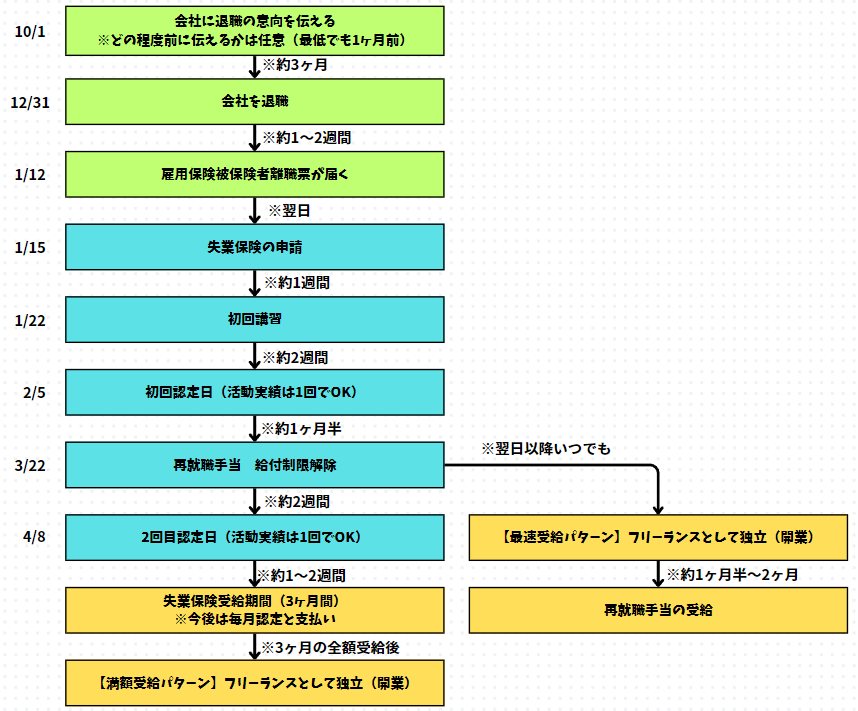
Let me walk through each step:
Step 1: Give notice of resignation. Legally, one month’s notice is the minimum, but given my seniority, I gave approximately three months’ notice — telling my manager on October 1.
Step 2: Resign from the company. After giving notice, you’ll submit a formal resignation letter stating your last day, complete any handover work, and leave.
Step 3: Wait for your separation certificate (離職票). Before you can apply for unemployment benefits, you need a document called the “雇用保険被保険者離職票” (employment insurance separation certificate). Your former employer files for and issues this document after your last day — it typically takes one to two weeks to arrive. During this period, there’s nothing you can do but wait.
Step 4: Apply at HelloWork. Once you have the separation certificate, go to your local HelloWork (公共職業安定所) employment office to apply. At this initial visit, you’ll receive a brief explanation and an invitation to the first orientation session.
Step 5: Attend the first orientation. This session lasts about an hour and covers the details of how unemployment benefits work. After the session, you’ll be given the date of your first certification day (認定日).
Step 6: First certification day. At this appointment, you self-report your job search activity and confirm that you’re actively seeking employment. If you resigned voluntarily, a two-month benefit restriction period (給付制限) applies, so your next certification day will be two months later.
Step 7: Re-employment allowance window opens. After the first certification day, once the seven-day waiting period plus one-month re-employment allowance restriction has passed, you become eligible to apply for the re-employment allowance (再就職手当). This is the earliest point at which you can register your freelance business and receive a lump-sum payment.
Step 8: Second certification day and beyond. After the second certification day, regular benefit payments begin. For voluntary resignations, you can typically receive benefits for three months — but you must attend monthly certification days and cannot be working during this period.
Honestly, going through this process myself, I felt the system takes far too long. Given Japan’s economic situation, I don’t expect major improvements any time soon — if you can’t sustain yourself financially through this period on savings, it may be more practical to skip the benefits and start job-searching immediately. The irony is that a system designed to help unemployed people without money is essentially only usable by people who already have savings.
As a side note: if you were laid off or your company went bankrupt (i.e., not voluntary resignation), the benefit restriction period doesn’t apply and you can start receiving benefits immediately after the waiting period. But in reality, the vast majority of resignations in Japan are classified as voluntary — and making people wait this long in those cases doesn’t reflect reality.
One update worth noting: there was news that the benefit restriction period will be shortened from two months to one month starting in 2025, which should speed things up somewhat.
Estimated Benefit Amount (Voluntary Resignation)
Before the detailed breakdown, here’s a rough sense of how much you can expect to receive.
The exact amount depends on many factors and can only be confirmed at HelloWork, but here’s my own case:
I was in my thirties when I left. I resigned voluntarily, making me eligible for three months of benefits. My pre-resignation daily wage was at or near the upper limit for benefit calculations.
Given these conditions, I applied for the re-employment allowance early in the process and received a total of approximately ¥440,000 (the full amount arrived over about five months from application).
Had I waited out the full three months without using the re-employment allowance, the total would likely have been around ¥700,000 (about six months from application).
That’s a substantial amount either way — despite the lengthy and cumbersome process, the financial benefit is significant if you can use it.
For the official calculation method and daily benefit caps, refer to the Ministry of Health, Labour and Welfare resource below:
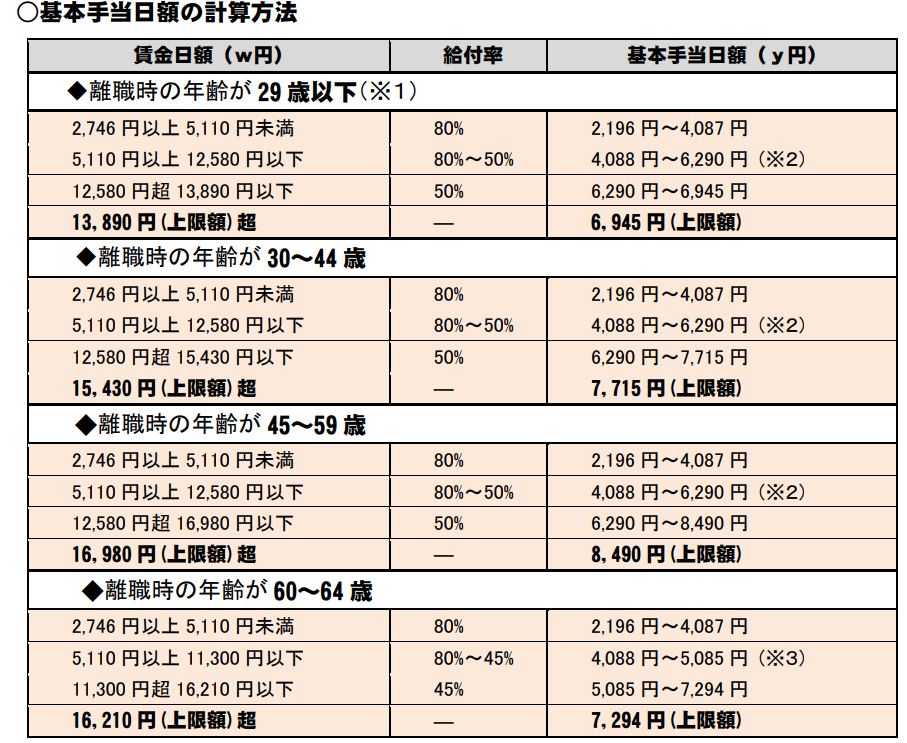
Basic unemployment benefit daily amount sourced from:
Ministry of Health, Labour and Welfare — Employment Insurance Amendment Summary (PDF)
Detailed Steps for Applying for Unemployment Insurance
The overall flow is described above. Some steps require further explanation — those are covered here.
Certification Days (認定日)
The certification day is one of the most important parts of the unemployment insurance process. It’s the date on which HelloWork verifies that you are still unemployed and eligible for benefits. Only after being certified on that day do you qualify for payment.
The first certification day is about three weeks after you apply. After that, they’re scheduled roughly monthly — but if you resigned voluntarily, the two-month benefit restriction means your second certification day is set two months after the first.
Certification is done by self-reporting your job search status on a form. As with other self-reported fields in this process, lying risks penalties for fraudulent collection — report honestly.
One inconvenient requirement: you must report actual job search activity. Simply browsing job listings online doesn’t count. You need to report concrete activities — attending an interview, going to a seminar, or similar.
The easiest qualifying activity is going to HelloWork and consulting with a career advisor. Do that right after each certification day and you’ll immediately satisfy the next month’s requirement.
The minimum is two qualifying activities per month. However, the first certification day only requires attendance at the initial orientation, and the second certification day only requires one qualifying activity — so the burden becomes heavier from the third month onward.
Benefit Restriction Period (給付制限)
The benefit restriction period is the window during which people who voluntarily resigned are not yet eligible to receive unemployment benefits.
“Voluntary resignation” (自己都合) includes leaving because you disliked the company, found a better-paying job, wanted to advance your career, or — as in this case — wanted to go freelance. It’s any departure driven by personal reasons rather than company decisions.
About 80% of all resignations in Japan are classified as voluntary, so if you’re reading this, your situation probably falls into this category.
The restriction period used to be three months; it was shortened to two months and is scheduled to become one month in 2025. This is a meaningful improvement, though the overall timeline remains long.
One important note: if you’re using the re-employment allowance rather than regular benefits, the effective restriction period is one month (not two), meaning you can access your money faster.
Re-employment Allowance (再就職手当)
The re-employment allowance is a lump-sum payment for people who find new employment before their benefit period ends. For voluntary resignations with three months of eligible benefits, if you start a new job (or register as a freelancer) before the end of that period, you receive a portion of the remaining benefits upfront.
The payout rate is:
- 70% of remaining benefits if at least 2/3 of the benefit period remains
- 60% of remaining benefits if between 1/3 and 2/3 of the benefit period remains
To receive the full benefit amount, you’d have to wait out the entire three-month period — during which you can’t work and must attend monthly certification days. If you want to start freelancing as soon as possible, the re-employment allowance is the better choice.
The restriction for the re-employment allowance is only one month (not two), so you can register as a freelancer and claim it earlier than you could begin regular benefit payments.
Important warning: if you open your business before the restriction period ends, you lose all unemployment benefits. Time this carefully.
To claim the re-employment allowance as a freelancer, you need to prove that you’ve actually started a business. The standard proof is a copy of your filed business registration form (開業届). However, some HelloWork offices may ask for additional evidence of business activity.
In my case, they asked for proof that I was actually running a business. They accepted receipts for business expenses — I submitted receipts totaling about ¥300,000, which covered equipment I was planning to buy anyway. Depending on your situation, meeting this requirement could be challenging, so be aware of it.
Going Freelance (Filing Your Business Registration)
“Going freelance” comes down to filing a business registration form (開業届) with the tax office. The article below explains how to create and submit this form:
How to File a Business Registration Form in Japan Using MoneyForward Cloud
When I went to submit my form, the entire process at the tax office took just a few minutes — it’s surprisingly easy.
[Update] Re-employment Allowance Payment Received
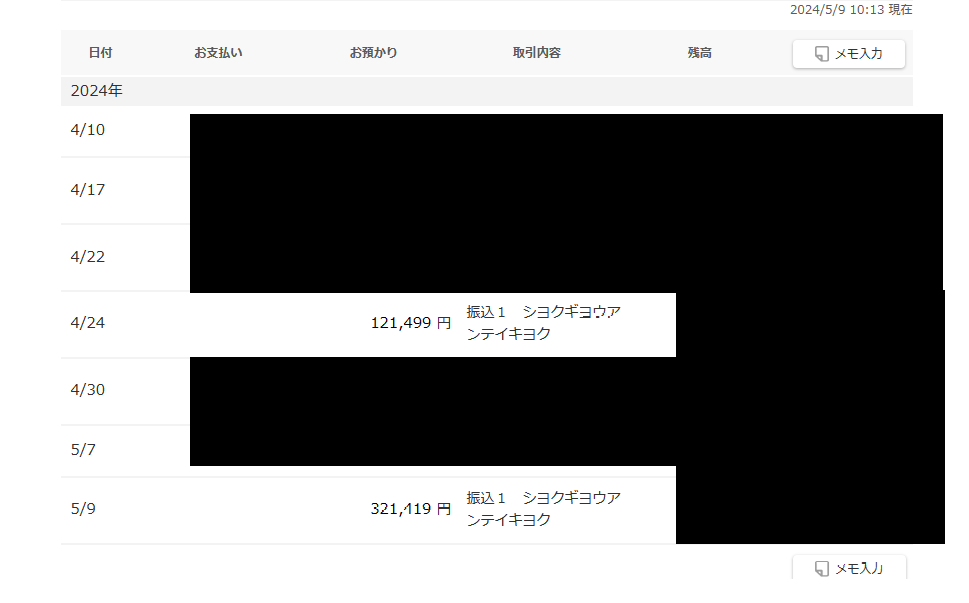
The re-employment allowance I applied for was successfully deposited. The payment appears in bank statements under the name “シヨクギヨウアンテイキヨク” (Hello Work / Public Employment Security Office). The total came to approximately ¥440,000.
I had estimated around ¥500,000, so it came in a bit short. In my case: I submitted the business registration form and re-employment allowance application on April 8, then submitted receipts proving business activity on April 22.
The payment arrived in two installments — April 24 and May 9 — as shown in the image below. The two payments likely represent: basic benefits through April 22, and the re-employment allowance for the remainder.
My case was probably processed relatively quickly. If you’re expecting a re-employment allowance, allow for some additional time.
Summary
This article covered how to receive unemployment insurance when leaving a company to go freelance. I found the application process quite difficult myself, which is why I wanted to document it — hopefully it saves someone the trouble of figuring it out from scratch.
The system has real flaws, but the amounts involved are significant. If you’re eligible and can navigate the process, it’s worth doing.
My sense is that this system remains so difficult to use partly because Japanese workers tend not to complain publicly. If the government hears no dissatisfaction, it has no reason to improve things — and may make them worse. If reading this has left you with frustrations about the system, I’d encourage you to express them. That kind of feedback is what moves policy.

Also popular with readers