
What Is “Factfulness”?
“Factfulness” is a term coined by Swedish physician and statistician Hans Rosling, and the book bearing that name became a global bestseller.
The book has three authors: Hans Rosling, his son Ola Rosling, and Ola’s wife Anna Rosling Rönnlund.
The word “Factfulness” combines “fact” + “full” + “ness” — literally “a state full of facts.” In practice, it means: seeing the current state of the world correctly, based on facts.
And that’s the book’s message in a nutshell: learn to see the world as it actually is, based on data.
To explain what that means concretely, the book presents 13 quizzes and 10 instincts (cognitive biases) that distort our perception.
This article draws on the content of FACTFULNESS: Ten Reasons We’re Wrong About the World — and Why Things Are Better Than You Think.
The 13 Quizzes (Questions)
Let’s take the 13 quizzes that appear at the opening of the book. Answers will follow. Try your best — even if you’re not sure, pick a guess.
Question 1: What share of girls in low-income countries complete primary school today? A — 20% B — 40% C — 60%
Question 2: Where does the majority of the world’s population live today? A — Low-income countries B — Middle-income countries C — High-income countries
Question 3: In the past 20 years, the proportion of the world’s population living in extreme poverty has… A — Almost doubled B — Remained about the same C — Almost halved
Question 4: What is the current global life expectancy? A — 50 years B — 60 years C — 70 years
Question 5: There are approximately 2 billion children in the world today (under age 15). According to the UN, what will that number be in 2100? A — 4 billion B — 3 billion C — 2 billion
Question 6: The UN forecasts that the world population will increase by another 4 billion by 2100. What is the main reason? A — More children (under 15) B — More adults (15–74) C — More elderly (75 and older)
Question 7: How has the number of deaths per year from natural disasters changed over the past 100 years? A — More than doubled B — Remained about the same C — Decreased to less than half
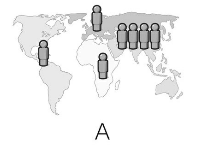
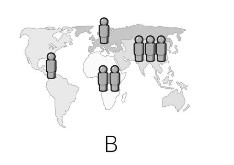
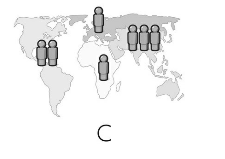
Question 8: The world currently has approximately 7 billion people. In the maps below, each person symbol represents 1 billion people. Which map correctly represents the distribution of the world’s population?
Question 9: How many of the world’s 1-year-old children are vaccinated against at least one disease today? A — 20% B — 50% C — 80%
Question 10: Worldwide, 30-year-old men have on average spent 10 years in school. How many years have women of the same age spent in school? A — 9 years B — 6 years C — 3 years
Question 11: In 1996, tigers, giant pandas, and black rhinos were all listed as endangered. How many of these three species are more at risk of extinction today than they were then? A — 2 B — 1 C — 0
Question 12: How many people in the world have access to at least some electricity? A — 20% B — 50% C — 80%
Question 13: Global climate experts believe that, over the next 100 years, average temperatures on Earth will… A — Get warmer B — Remain the same C — Get colder
The 13 Quizzes (Answers)
The correct answers are:
Q1 — C: 60% Q2 — B: Middle-income countries Q3 — C: Almost halved Q4 — C: 70 years Q5 — C: 2 billion Q6 — B: More adults (15–74) Q7 — C: Less than half Q8 — Map B (Americas: 1 billion; Europe: 1 billion; Africa: 1 billion; Asia: 4 billion) Q9 — C: 80% Q10 — A: 9 years Q11 — C: 0 Q12 — C: 80% Q13 — A: Get warmer (excluded from scoring — 86% of respondents got this right)
Quiz Results: Scientists, Chimpanzees, and You
How did you do?
The author didn’t put these quizzes at the front of the book for entertainment. They’re there to show you how accurately you understand the world as it currently exists.
These quizzes have been administered to professionals around the world — medical students, teachers, university professors, scientists, elite bankers, journalists, and top politicians. The results are consistently low, with an average score of 2 correct answers out of 12.
(Question 13 on global warming is excluded — 86% answered correctly, so it’s set aside.)
If a chimpanzee were given this multiple-choice quiz (three options per question), it would answer correctly by chance roughly 33% of the time — or 4 out of 12 questions.
In other words, the world’s most educated and accomplished people consistently score worse than a chimpanzee guessing at random.
What this reveals is that people systematically perceive the world as more dangerous, violent, and bleak than it actually is.
Why does this happen? Lack of knowledge? Outdated information? Media influence? The author Hans Rosling initially suspected all of these — but through years of experience and observation, he concluded the problem runs deeper.
Most people hold beliefs like: “Wars, violence, natural disasters, corruption, and famine are everywhere — the world is only getting more dangerous. The rich keep getting richer and the poor keep getting poorer. If we don’t act fast, natural resources will run out.”
But the reality is different. Most of the world’s people are already in the middle-income bracket. Girls attend school. Babies get vaccinated. People take vacations abroad. The world, measured by data, has been improving decade by decade.
Not every metric improves every year, and serious challenges remain — but humanity has made extraordinary progress. This is what Factfulness — seeing the world based on facts — actually looks like.
The reason people consistently choose the most negative and extreme answers, Rosling argues, is something he calls “the overdramatic worldview” — a product of human instincts shaped by millions of years of evolution. These instincts are deeply ingrained and very hard to change.
Factfulness systematizes 10 such dramatic instincts, and shows how to recognize and manage each one.
By incorporating these practices into daily life, you can train yourself to see the world as it actually is, based on facts. That is the book’s goal.
The 10 Instincts (10 Cognitive Biases)
Here is an overview of the 10 instincts the book describes. The actual book explains each in considerable depth — this article provides concise summaries.
- The Gap Instinct — “The world is divided into two groups”
- The Negativity Instinct — “The world is getting worse and worse”
- The Straight Line Instinct — “The world’s population will just keep growing”
- The Fear Instinct — “Things that aren’t dangerous feel terrifying”
- The Size Instinct — “The number in front of me is the most important one”
- The Generalization Instinct — “One example applies to everything”
- The Destiny Instinct — “Everything is predetermined”
- The Single Perspective Instinct — “The world can be understood from one angle”
- The Blame Instinct — “Blaming someone will solve the problem”
- The Urgency Instinct — “If I don’t act right now, disaster will follow”
The Gap Instinct
“The world is divided into two groups”
The gap instinct is the tendency to divide the world into two simple categories — “rich” and “poor,” “developed” and “developing.” We do this to make complex reality easier to process.
But in reality, most countries occupy a middle ground, with varying degrees of economic and social development. Income distributions, for example, show that extreme poverty and extreme wealth each represent a small minority — the vast middle is overwhelmingly dominant.
Our perception ignores this and falls into false binaries: “Africa is all poor,” “Europe is all wealthy.” This distortion leads to misunderstanding and bias.
To overcome the gap instinct, analyze data in detail and actively look for the middle ground — track income levels, health, and education across many countries, and you’ll find a world developing in stages, not split into two camps.
The Negativity Instinct
“The world is getting worse and worse”
The negativity instinct makes us overly sensitive to bad news and negative information, leaving us feeling that the world is deteriorating. Media coverage reinforces this — dramatic bad news gets prioritized.
In reality, many measures have improved significantly. Global poverty rates have fallen sharply over recent decades. Life expectancy has risen. Literacy rates have gone up.
Yet frequent reporting of terrorism, natural disasters, and crime misleads us into thinking the world is dangerous and declining.
To overcome this instinct, focus on long-term data and positive developments — recognize long-term improvements in health, education, and economic growth. This enables a more balanced view of reality.
The Straight Line Instinct
“The world’s population will just keep growing”
The straight line instinct is the tendency to assume things will continue in a linear direction. We assume population growth will continue forever, or that economic growth will proceed at a constant pace.
In reality, most growth and change follow complex, nonlinear patterns. Population growth, for example, has been slowing as birth rates fall, urbanization increases, and education improves. A naive extrapolation overstates it dramatically.
To overcome this instinct, consider multiple scenarios and understand the forces driving change — rather than projecting current trends indefinitely.
The Fear Instinct
“Things that aren’t dangerous feel terrifying”
The fear instinct causes us to over-react to frightening events and exaggerate their frequency and impact. Dramatic media coverage reinforces this.
In reality, many frightening events are statistically rare. Plane crashes and terrorist attacks receive enormous media coverage, but the actual probability of encountering them in daily life is extremely small.
Yet we avoid airplanes or cancel travel based on these fears. To overcome the fear instinct, analyze risks calmly and objectively — compare the frequency of plane crashes to car accidents, and you’ll find driving is far more dangerous. Base your judgments on data rather than fear.
The Size Instinct
“The number in front of me is the most important one”
The size instinct makes us over- or under-estimate the scale of things — getting swept up in large numbers without seeing them in proportion.
A disaster’s damage figure may seem staggering, but comparing it to GDP or to other countries’ experiences puts it in perspective. Similarly, a single event in part of a country gets reported as if it represents the whole.
To overcome this instinct, understand the context and proportion behind numbers — compare figures across multiple dimensions rather than taking any single data point at face value.
The Generalization Instinct
“One example applies to everything”
The generalization instinct drives us to draw broad conclusions from limited examples. Cultural and national stereotypes feed this bias.
One crime involving a tourist gets reported from a particular country — and suddenly the whole country seems dangerous, even if its overall crime rate is low.
To overcome this instinct, actively seek diverse perspectives and data, and work to eliminate stereotypes. When evaluating travel safety, look at overall crime statistics and local information rather than isolated incidents.
The Destiny Instinct
“Everything is predetermined”
The destiny instinct is the belief that things are fixed and cannot change — “poor countries will always be poor,” for example.
But history shows that many countries have undergone dramatic transformation. South Korea and Singapore were considered poor nations just a few decades ago — today they are highly developed. Change is clearly possible.
Yet the destiny instinct leads to policies and assumptions that assume the status quo will persist forever, ignoring the potential for transformation.
To overcome it, study historical examples and long-term trends that demonstrate change is possible. Understand how education and technological innovation have contributed to development, and maintain flexible thinking rather than fixed assumptions.
The Single Perspective Instinct
“The world can be understood from one angle”
The single perspective instinct drives us to explain complex problems through a single lens or cause — for example, attributing all poverty to lack of education.
But solving poverty requires approaches spanning economic growth, healthcare, infrastructure, and social security — not just education. Focusing on one factor causes us to miss all the others.
To overcome this instinct, adopt multi-dimensional approaches and examine problems from multiple viewpoints. In policy-making, gather diverse expert opinions and analyze problems from multiple angles. Collect data and cases broadly before drawing conclusions.
The Blame Instinct
“Blaming someone will solve the problem”
The blame instinct drives us to attribute problems to specific individuals or groups. We blame an economic crisis on particular politicians or companies.
But most serious problems arise from multiple compounding causes that require structural understanding. Economic crises involve market dynamics, policy failures, and international factors simultaneously.
The blame instinct leads us to focus on easily comprehensible individual causes — losing sight of the whole picture and making effective solutions harder to find.
To overcome it, analyze problems from multiple angles and consider multiple causal factors. Seek expert perspectives and consider data from many directions. Focus on identifying concrete solutions, not just assigning blame.
The Urgency Instinct
“If I don’t act right now, disaster will follow”
The urgency instinct is a compulsive feeling that action must be taken immediately. Media coverage emphasizing urgency and situations that feel time-constrained reinforce it.
But taking time for calm analysis and planning is critical. Excessive urgency leads to poor judgments and hasty actions.
During the early stages of a pandemic, for example, rapid response is necessary — but without calm data analysis and planning, the response risks being inappropriate or causing panic.
The urgency instinct makes us fixate on short-term solutions and lose sight of long-term consequences. To overcome it, take a moment to pause even under pressure, evaluate the situation calmly with full information, and consider the long-term impacts before acting.
Closing
Thank you for reading. Factfulness is a global bestseller, and for good reason — its content will feel genuinely fresh to almost anyone.
If you took the opening quizzes fresh, your accuracy was almost certainly low. That’s not unusual — it’s the point.
As the book demonstrates, people systematically perceive the world as worse than the data shows it to be. In reality, the world has been improving by almost every measure.
Of course, from a micro perspective, corruption persists, wars continue in some regions, and poverty still affects many people. But compared to any point in the past, all of these metrics are trending in the right direction.
The next time you encounter negative news in daily life, try not to respond based only on subjective feeling. Make the effort to evaluate it against objective data — and if you can manage that, you’ll be putting the book’s core lesson into practice.
Thank you for reading to the end.
I’ve also written reviews of other books, linked below:
Warren Buffett’s Financial Statement Analysis: 58 Rules for Picking Superstar Stocks

Also popular with readers