Introduction
This article covers the manga adaptation of The Richest Man in Babylon — its content, the lessons it offers, and my personal impressions.
The Richest Man in Babylon is a beloved must-read on building wealth, celebrated not only in Japan but around the world. The original text is quite dense, however, which can make it a high hurdle for readers who aren’t used to long-form prose.
Japan has a wonderful cultural tradition of adapting challenging ideas into manga — making complex subjects accessible to anyone — and this manga version is a fine example of that tradition at work.
I find this culture genuinely admirable. If Japan leveraged it more broadly, the country could become a world-class cultural powerhouse. In practice, the quality of such adaptations varies widely, and not all of them contribute meaningfully to raising the level of public understanding.
This particular adaptation, however, is exceptionally well crafted. While it alters certain plot details from the original, it faithfully reproduces the core lessons the book is trying to teach. Reading between the lines, it’s clear that the manga’s author had a deep understanding of The Richest Man in Babylon and a genuine desire to share those lessons with as many people as possible.
Read this manga and you’ll come away with the essential wealth-building wisdom from the original — which is why I’d encourage anyone who’s hesitant to tackle the book to start here.
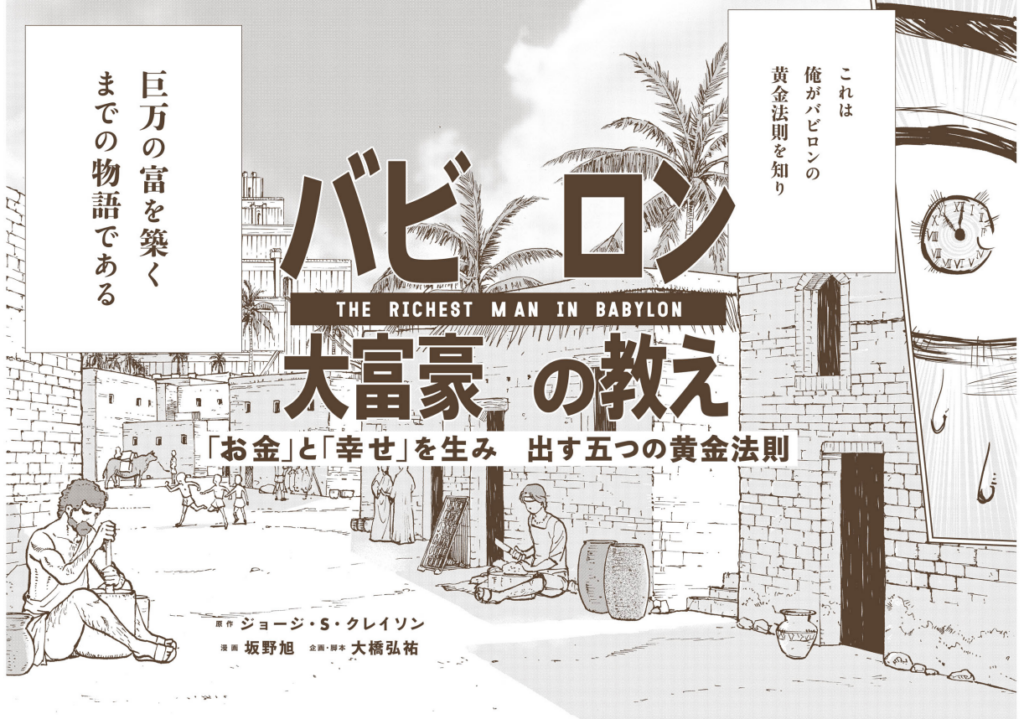
This article draws on the content of Manga Babylon Daifugou no Oshie: “Okane” to “Shiawase” wo Umidasu Itsutsu no Ougon Housoku (Manga: The Richest Man in Babylon — The Five Golden Laws for Creating Money and Happiness).
About The Richest Man in Babylon
The story is set in ancient Babylonia, roughly 4,000 years ago. The characters living in that world discuss money from a variety of perspectives and social positions — much like people today.
The book is structured as a series of loosely connected short stories, each centered on a different protagonist living in a slightly different time. Recurring motifs run through the tales: children and grandchildren of characters from earlier stories pass the same wisdom down to people in different circumstances, helping them turn their lives around.
The manga is organized as follows:
Prologue: Modern Man Driven by Money — Chapter 1: The Richest Man in Babylon — Chapter 2: The Hall of Learning — Chapter 3: The Trial — Chapter 4: The Return — Chapter 5: The Wall — Chapter 6: The Man Who Was a Slave — Chapter 7: The Legacy — Chapter 8: The Prince’s Caravan — Epilogue: The Final Golden Law
Let me walk through each section.
Prologue: Modern Man Driven by Money
Former archaeologist Takuya Oba receives a request from his friend Takeshi Kondo to decipher a clay tablet, apparently from ancient Babylonia, that has just been unearthed. Oba, who has lost his job, his savings, and his wife and daughter, initially refuses.
But Kondo persuades him: the tablet may contain ancient Babylonian “truths about acquiring wealth,” and deciphering it might give Oba a chance to get everything back. Hesitant but intrigued, Oba agrees to take on the task.
Chapter 1: The Richest Man in Babylon
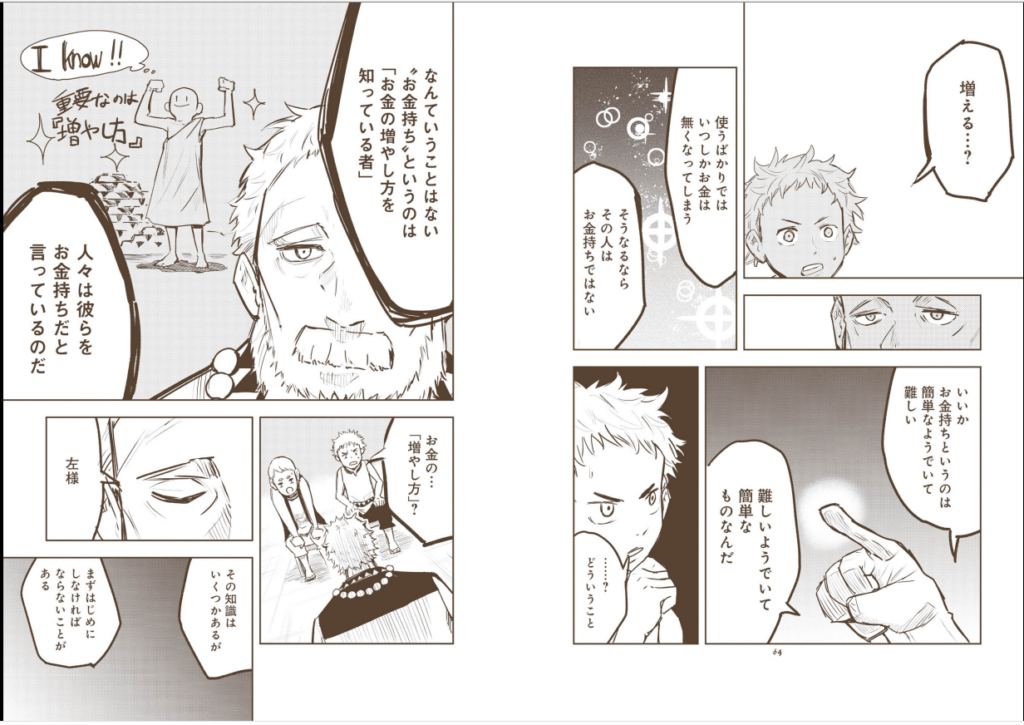
“Why, when we work just as hard, are some people poor and others rich?”
The story shifts back to ancient Babylonia. The protagonist is Bansir, son of a weaponsmith. Bansir works hard every day but wonders why he stays poor — and what it would take to become wealthy.
Together with his friend Kobbi, he goes to see Arkad, the wealthiest man in the city, to ask how to get rich. Arkad invites them into his home.
He begins by asking the two what they think a “rich man” is. They answer: “someone who has a lot of money.” Arkad says that’s wrong — because if all you do is accumulate without knowing how to grow it, you’ll eventually spend it all and cease to be rich. A truly rich person, he tells them, is “one who knows how to grow money.”
And the first step to becoming wealthy, he says, is to save one-tenth of your income.
Chapter 2: The Hall of Learning
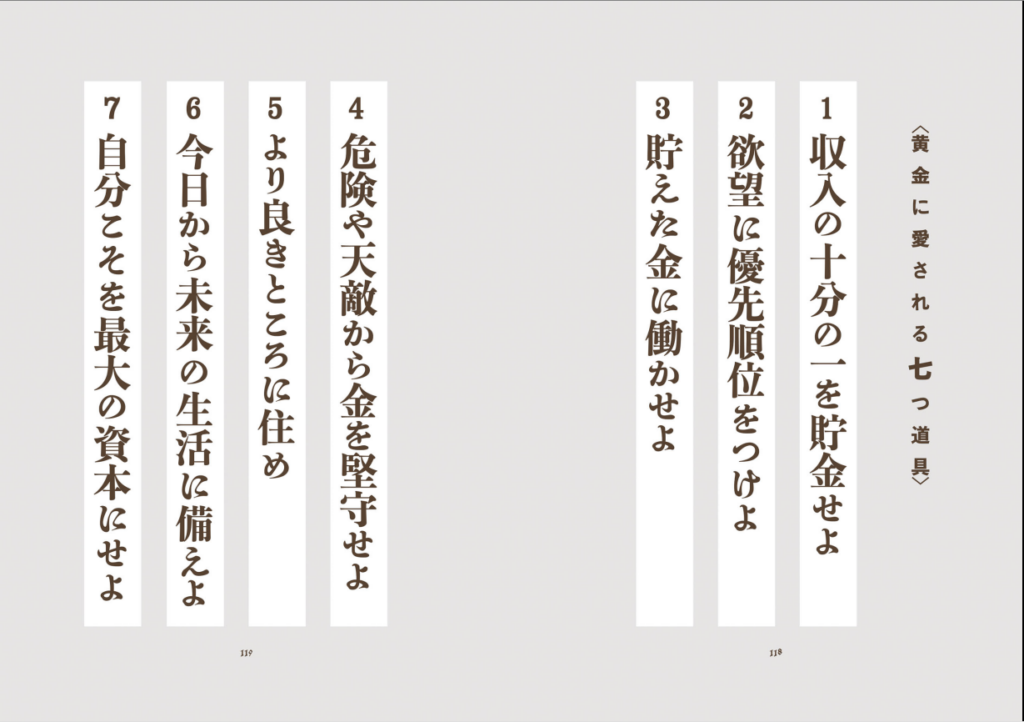
“The Seven Tools of Gold — known only to the wealthy”
Six months after Chapter 1, Bansir and Kobbi have faithfully followed the teaching to save one-tenth of their income and return to hear a lecture hosted by Arkad on the next stage of wealth-building.
There, Arkad teaches them the complete Seven Tools for Growing Gold.
The Seven Tools for Growing Gold
- Save at least one-tenth of your income.
- Prioritize your desires.
- Put your savings to work.
- Guard your gold against loss and enemies.
- Make your home a worthy place to live.
- Provide for your future, starting today.
- Make yourself your greatest investment.
Chapter 3: The Trial

“Which holds more value — a bag of gold coins, or a bag of wisdom?”
Arkad, recognizing Bansir’s exceptional business instincts, decides to test whether he is worthy of being a successor. Arkad presents Bansir with a choice: take the bag of gold coins, or take the bag of wisdom — but only one.
Bansir answers that gold can bring short-term happiness, but it cannot buy lasting security. Therefore, he chooses the bag of wisdom.
Arkad tells him: “Then prove that wisdom is worth more than gold.” He sends Bansir on a journey and instructs him not to return until he has filled the bag with gold coins through the power of wisdom alone.
On the road, Bansir loses half his travel funds betting on a horse race. He then teams up with a man he meets and starts a small jewelry business, slowly earning money — until his partner secretly gambles away all their funds, leaving Bansir with nothing.
Recalling Arkad’s instruction not to open the bag of wisdom until all his resources were gone, Bansir opens it.
Inside the bag is a clay tablet inscribed with The Five Golden Laws.
The Five Golden Laws
Law 1: Gold comes willingly and grows joyfully to the person who saves no less than one-tenth of their income for the future of themselves and their family.
Law 2: Gold works diligently and multiplies for the person who finds it profitable employment, whose master tends it like a shepherd tending a flock.
Law 3: Gold clings to the protection of the cautious owner who invests it under the advice of those skilled in its handling.
Law 4: Gold slips away from the person who invests in businesses or purposes with which they are unfamiliar, or which are not approved by those skilled in its guardianship.
Law 5: Gold flees from the person who would force it to impossible earnings, who follows the alluring advice of tricksters and schemers, or who trusts their own inexperience.
Chapter 4: The Return
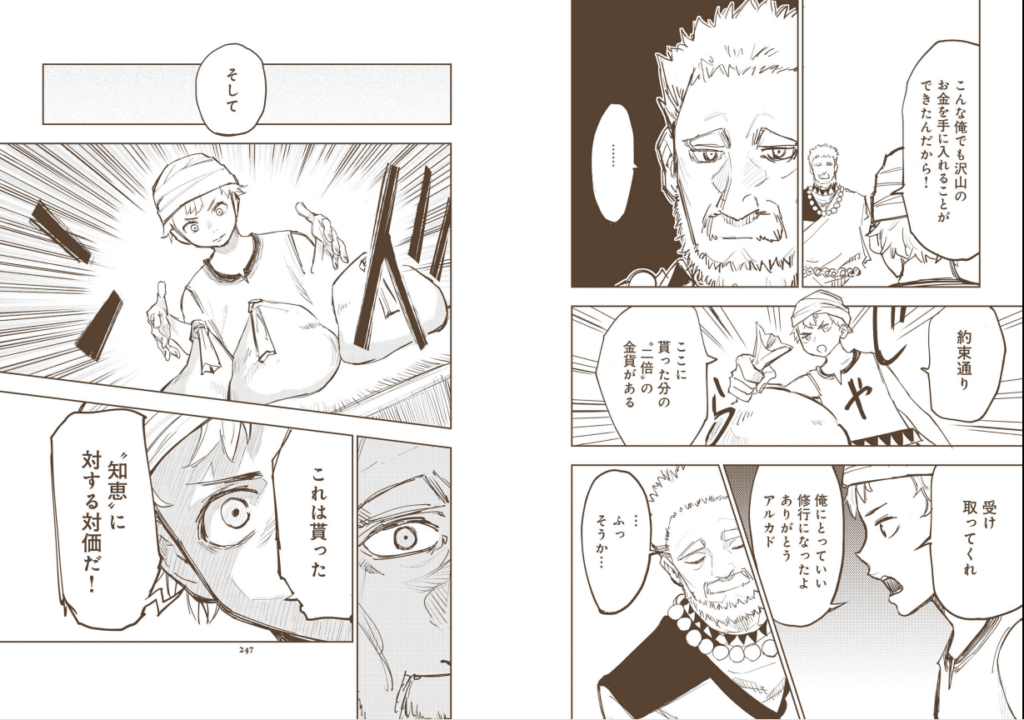
“Through the advice of wise men, savings begin to work hard”
With the Golden Laws now understood, Bansir sees clearly why money had kept slipping away from him. He begins working diligently, saves one-tenth of every income, and uses those savings to launch a business alongside experts in their field.
Three years after setting out, Bansir returns to Babylonia. He has not merely filled the bag — he has earned more than three times the coins that would have filled it. The wisdom has proven greater than gold.
Arkad is overjoyed and asks Bansir to stand beside him as an ally in the growth of Babylonia.
Chapter 5: The Wall

“Because there is something worth protecting, a person can rise again and again”
An Assyrian army invades Babylonia. The city’s massive walls prevent a frontal assault, so the Assyrians attempt a small-unit infiltration. Babylonia ultimately wins the battle, but the fighting claims many lives — including Arkad and Bansir’s parents.
In his final moments, Arkad tells Bansir: “Become a mighty wall that protects those you love.”
The walls of Babylon started thin and fragile, but grew stronger over time. They protect not only the nation but the spirit of its citizens. The same is true of a person — having something worth protecting becomes the foundation for growth, and as long as that foundation holds, one can fight on. With those words, Arkad passes away.
Chapter 6: The Man Who Was a Slave
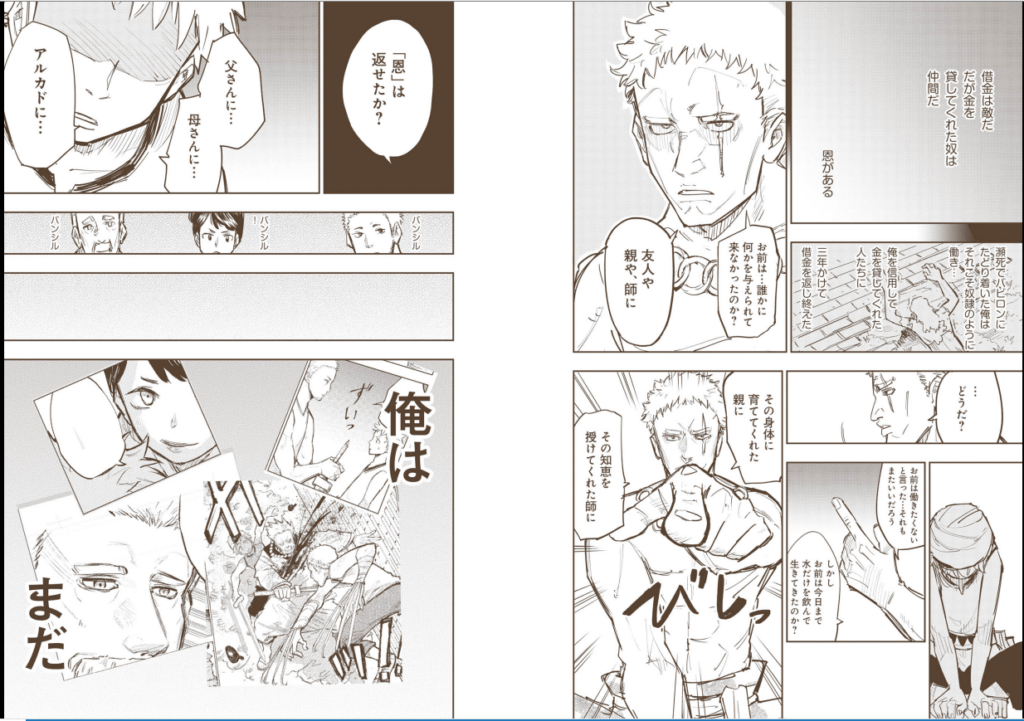
“Is your soul that of a slave — or of a free man?”
Devastated by the loss of Arkad and his parents, Bansir stops working and falls into destitution. The moneylender Dabassia comes to collect a debt; Bansir says he doesn’t care if he’s sold into slavery.
Dabassia responds by telling Bansir about his own past as a slave. He had once been a craftsman who lived with his wife and worked in his father’s shop. Certain his wages would soon increase, he borrowed freely — until the interest payments overwhelmed him. His wife left. He joined a band of robbers to win big, was quickly caught, and was sold into slavery.
Most of the other slaves were destined to become eunuchs, but Dabassia was assigned as a camel keeper to a master named Sheera. He told Sheera that he was once a free man.
Sheera laughed and replied: “You didn’t become a slave because you were enslaved. You were enslaved because you had already become one.” He added: “If your soul is that of a free man, you should already be honored in the land where you were born.”
From that day forward, Dabassia began asking himself every day whether the soul within him was that of a slave or a free man.
A slave need only do what he is told. But as a free man, Dabassia reasoned, he should not settle for slave’s work — he should do more. He threw himself into labor.
One day, his master Sheera gave him a chance to escape and told him to prove the soul of a free man. Dabassia resolved to return to his homeland of Babylon.
He barely made it back alive — and realized there that he had received enormous kindness from the many people he had borrowed from. A free man, he understood, must repay not only debts in money, but debts of gratitude. Over three years, he repaid every last creditor.
Dabassia then asks Bansir: “Has no one ever given you anything? Have you lived on water alone?” Bansir hears these words and remembers all the kindness shown to him by his parents and by Arkad. He also realizes he has repaid none of it. That realization moves him to start working again.
Chapter 7: The Legacy

“An ancient debt repayment record saves a man in the modern era”
One by one, Bansir seeks out those he borrowed from and explains his intention to repay them. Working without rest for years, he finally clears every debt.
He then sets his sights on “the prosperity of Babylonia” — his way of repaying his parents and Arkad. Following the Golden Laws faithfully, wealth accumulates around him and he draws ever closer to becoming one of the city’s great wealthy men.
The story returns to the present. Oba realizes that the clay tablet contained no romance or adventure — it was Bansir’s own record of debt repayment and his journey to reclaim the soul of a free man.
And what was inscribed on that tablet, Oba understands, is the unchanging truth that has endured from antiquity to the present day:
- The Seven Tools of Gold
- The Five Golden Laws
- If you want to be rich, learn what the wealthy do — and do the same
- Become a mighty wall that protects what you love
- Debt is a weakness of the soul; repaying those who showed you kindness restores human dignity
Chapter 8: The Prince’s Caravan

“Why does a person work? It turned out not to be for money”
Years have passed since Bansir repaid his debts. He has become the wealthiest man in Babylon and has married the princess of Babylonia.
One day, traveling with a royal caravan alongside Prince Hadan, Bansir is asked: “Most people want to become rich so they don’t have to work. You’re already the richest man in Babylon — why do you still work?”
Through his long years of debt repayment, Bansir had come to feel that the work he put in earnestly was appreciated by the people around him — and that their gratitude was converted into money. That gratitude filled his heart like light.
So Bansir answers: “Money is just a byproduct. I work in order to be appreciated by many people.”
Epilogue: The Final Golden Law

Having fully deciphered the clay tablet and Bansir’s record of repayment, Oba resolves to reclaim the soul of a free man for himself. He begins working with determination and eventually pays off all his debts — but his wife and daughter have not returned.
No matter how much money he accumulates, he realizes, none of it feels good without his family. That, he understands, is his own Golden Law. He reaches out to his wife and daughter, asking if they can be a family once more.
Personal Impressions
I’ve read the original book version of The Richest Man in Babylon as well, and this manga adaptation struck me as exceptionally well done. In the original, each chapter features a different protagonist; here, the manga makes Bansir the consistent central character, which gives the story narrative coherence and emotional pull.
Despite those structural changes, every essential lesson from the original book has been preserved. For a manga adaptation of a celebrated classic, this comes as close to a perfect score as one could hope for.
There are moments where I felt the depth of certain ideas could have been greater — but given the constraints of manga (page count, panel composition, and so on), that’s understandable.
The Richest Man in Babylon was first published nearly a century ago and has since established itself as an indispensable financial text around the world.
From the summaries above, you can grasp the book’s main message — but it’s worth noting that this isn’t simply a book about how to make money. It goes deeper: into the meaning of work, and how the money and relationships that emerge from work should be understood and engaged with.
There are countless books about money out there, but The Richest Man in Babylon is one I’d recommend reading before most of them.
If this manga version has piqued your interest, I’d encourage you to pick up the original book as well. And if the original feels a bit daunting right now, please check out my article on the book version too.
Impressions: Chapter 1
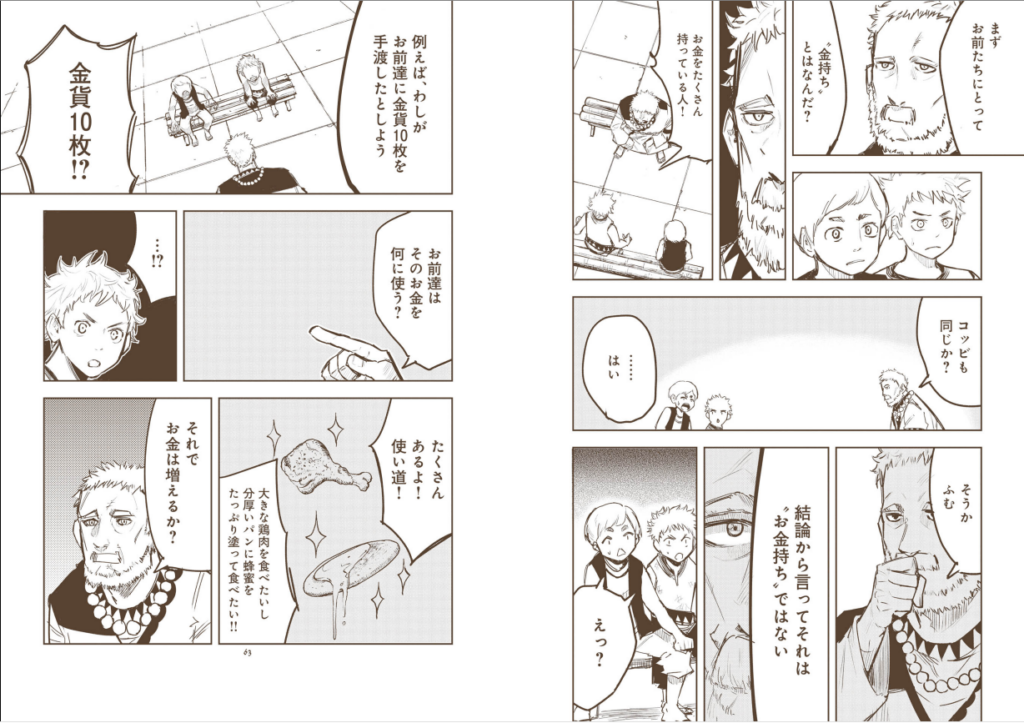
Chapter 1 serves as an introduction, with many scenes of Bansir and Arkad discussing what it means to be wealthy.
In the original, the protagonist is an adult weaponsmith named Bansir who seeks out Arkad; the manga deliberately makes him a child in order to carry a single protagonist through the rest of the story. That’s a perfectly reasonable narrative choice.
The scene that stuck with me most in this chapter is the discussion about the definition of “a rich man.” In the original, it isn’t Arkad but the surrounding characters who comment on the importance of money’s flow over its quantity — which doesn’t land as memorably. The manga’s presentation of this concept was much clearer and more impactful.
Impressions: Chapter 2
Chapter 2 covers the Seven Tools of Gold — one of the most important concepts in the original. The content is nearly identical to the book, and while the explanations are streamlined for the manga format, the substance is the same.
For a detailed breakdown of each tool, please refer to my article on the original book (linked above).
Impressions: Chapters 3 & 4
I combined these two chapters because, honestly, the division between them felt somewhat arbitrary. Together, they cover the Five Golden Laws — another cornerstone concept from the original, on equal footing with the Seven Tools.
In the original, it is Arkad’s son who goes on the journey; the manga reassigns this role to Bansir in order to keep the protagonist consistent. The horse-racing incident is the same, though in the original the subsequent business failure is handled differently.
Both the Seven Tools and the Five Golden Laws are the most essential teachings in The Richest Man in Babylon, and I can feel the author’s deep respect for the source material in how closely these sections mirror the original episodes.
Impressions: Chapter 5
Chapter 5 departs significantly from the original. In the book, the wall episode is a relatively minor subplot; here, it’s a major turning point where Arkad and Bansir’s parents are killed.
This was likely a structural necessity — setting up the next chapter’s debt-repayment arc required Bansir to suffer a major blow first.
The interpretation also shifts: the original uses the city wall as a metaphor for protection — insurance, savings, and reliable investment — emphasizing the importance of stable asset management. The manga instead uses it to argue that having something worth protecting gives a person the will to rise again. This reading feels like the author’s own addition.
I don’t personally object to the idea, but since the manga also omits several other episodes from the original about stable investment, I did feel the gap in coverage somewhat.
Impressions: Chapter 6
Chapter 6 is one of my personal favorites. It follows the original fairly closely, centering on Dabassia — a morally complicated character — rather than Bansir.
The question “Is your soul that of a slave or a free man?” is thought-provoking. I found myself wondering whether someone who just drifts through daily life without challenging themselves is really free.
I’ve spent much of my own life doing exactly that — busy with daily work, rarely receiving deep gratitude, rarely producing truly satisfying results. That realization made me feel like my own soul might have become a slave’s. And that discomfort drove me to start this blog and begin writing — to take some kind of action.
Impressions: Chapter 7
Chapter 7 functions as a summary of everything the manga has taught so far. The message is that no matter what adversity you face, the Seven Tools and the Five Golden Laws can carry you through. In the original, a parallel modern-day debt-repayment episode conveys the same idea.
As the story suggests, the truths of The Richest Man in Babylon are timeless — regardless of era or social standing, knowing them versus not knowing them makes a profound difference.
In modern life, saving one-tenth of income should be more achievable than it was in ancient Babylon — which means today’s readers may actually be better positioned to apply these teachings.
Impressions: Chapter 8
Chapter 8 explores what happens after you’ve followed the Golden Laws and become wealthy. The specific plot differs from the original, but the shared focus — why the wealthy continue to work — is the same.
In the original, Arkad speaks of “knowing the joy of work,” contrasting those who find labor burdensome with those who throw themselves into it and share that joy with others. The latter succeed more easily, and even after becoming wealthy, work remains a pleasure — which is why they never stop.
The manga instead frames it as working out of gratitude. I believe that’s an interpretation the author arrived at independently, and I think it’s a valid one.
People who continue to work after becoming wealthy all have different reasons, but what they share is that they continue working because they love it. That’s what I believe connects them.
People on Japan’s rich lists tend to work harder than anyone even after achieving wealth. In the end, I think it’s simply because they love working — and it’s because they love it that they succeed. And since work and human life are inseparable, isn’t it far better to find joy in it than to endure it grudgingly?
Summary
This article covered the manga adaptation Manga Babylon Daifugou no Oshie: The Five Golden Laws for Creating Money and Happiness — its plot, structure, and my personal impressions.
The manga alters various episodes from the original yet captures essentially everything the original intends to convey. It’s a remarkably faithful and well-executed adaptation.
This manga speaks to timeless truths that have held constant from antiquity to the present: how to relate to money, what work truly means, and how to build meaningful relationships with others. I think it has something valuable to offer everyone.
If this article has sparked your interest, I hope you’ll pick up a copy of the manga.
And if you’d like to go further, please also check out my article summarizing the original book.
Summary & Review: The Essential Guide to Wealth from The Richest Man in Babylon
Also popular with readers