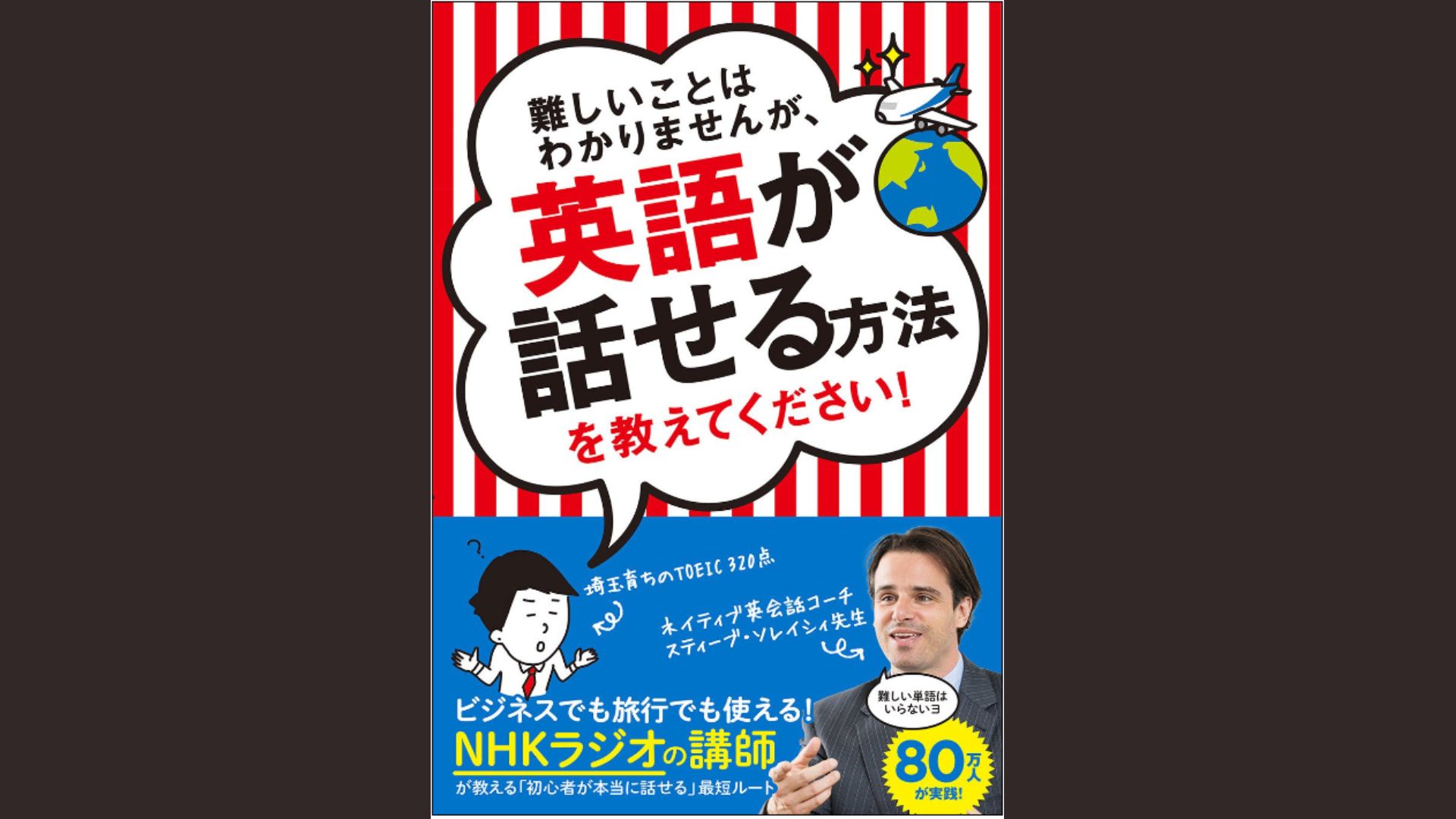
About I Don’t Know the Hard Stuff, But Please Teach Me How to Speak English! (Mindset Chapter → Beginner Fluency Chapter)
Wanting to become able to speak English, I browsed various English-related books — and this one, I Don’t Know the Hard Stuff, But Please Teach Me How to Speak English! (referred to hereafter as “the book”), was so useful that I wrote this article as both a personal reference and a review.
This article specifically covers the range from “Chapter 1: Mindset” through “Chapter 2: Beginner Fluency” in the book.
Unlike typical English books, this one doesn’t introduce any suspicious “do X and you’ll be able to speak English” study methods. From the very beginning, it repeatedly states: “To become able to speak English, you need to actually converse with English speakers.”
It also argues that although mastering a small portion of middle-school English is enough to hold a conversation, Japan’s English education is nothing more than an “English puzzle” — no matter how high your score in Japan’s English education system, you won’t become able to hold a conversation (and it may even work against you).
The book opens with a classic middle-school English exercise as an example of its core argument:
[Exercise] Combine the two sentences into one.
I know that girl. That girl is Mary.
[Answer]
I know that girl who is Mary. (I know the girl named Mary.)
You can combine them using a relative pronoun as shown — but the book forcefully argues: there was no need to combine them into one sentence in the first place!
The original two sentences communicate the meaning perfectly well in actual conversation. Yet when students are drilled to solve “English puzzles” with a single correct answer, they find themselves in real conversations wondering “which is the most correct way to say this?” — and can’t get words out spontaneously.
In Japanese too, if you want to ask a restaurant for a salad, you could say it in any number of ways that all work. The book says the most important thing to understand first is: conveying what you’re thinking to the other person matters far more than getting a check mark on your English.
This article draws on the content of I Don’t Know the Hard Stuff, But Please Teach Me How to Speak English!
The Shortcut to Speaking English: Master the “Fishing Rods”
The previous section introduced the book’s core philosophy: to become able to hold a conversation in English, you need to repeatedly practice speaking with actual English speakers — not study Japan-style English puzzles.
That said, jumping straight into conversation with an English speaker is an intimidatingly high bar. So the book argues that if you master versatile, all-purpose expressions, you can communicate your intentions even with minimal English.
In Japanese, for example, the word daijoubu (“okay/alright”) is extraordinarily versatile: “Are you daijoubu right now?” can mean “Do you have a minute?”; “Are you daijoubu?” directed at someone can express concern for their health. English has similarly versatile words.
Mastering these all-purpose expressions in English lets you apply them across a wide range of situations — and eliminates the need to memorize complex expressions for every scenario, making conversation much easier.
The book borrows from the proverb “Give a man a fish and you feed him for a day; give a man a fishing rod and you feed him for life” and calls these versatile expressions “fishing rods.”
Using “fishing rods” to learn English is apparently the standard approach in English education worldwide — which makes it all the more puzzling that Japan insists on its own unique English puzzle system, training students only to score points on paper tests.
That said, the book does acknowledge a positive: even if Japan’s English education isn’t useful for conversation, having broad knowledge of difficult vocabulary and grammar is genuinely impressive by global standards. Simply adding conversation-focused instruction alongside the existing curriculum could make a significant difference.
The English “Fishing Rods” Introduced in the Book
Here are the specific “fishing rods” introduced in the book.
Fishing Rods List
- Would you?
- May I?
- I have a problem here.
- Hi.
- Sorry?
- Thanks.
- It’s that way.
- May I have ~ ?
Fishing Rod: Would you?
The first fishing rod introduced is “Would you?” — which on its own means “Would you please ~?”
As a concrete example: if you want to ask a store clerk to wrap a wine bottle so it won’t break, make eye contact and say “Would you?” while miming a wrapping gesture. That’s enough to get the message across.
Real conversation, unlike a paper test, is supported by context and gestures — which means you rarely need complex language to supplement your meaning. A “fishing rod” plus a gesture is usually sufficient.
Gestures alone often don’t work, which is exactly why pairing them with a fishing rod matters.
Other examples: hand someone your camera and say “Would you?” to ask them to take a photo; point at a pen that dropped near them and say “Would you?” to ask them to pick it up.
Fishing Rod: May I?
The next fishing rod is “May I?” — which means “May I ~?” or “Is it okay if I ~?”
As a concrete example: if the person next to you on a train has their bag on the seat you want to sit in, say “May I?” while pointing at the occupied seat — it communicates “May I sit there?” perfectly.
More examples: point at the last slice of pizza while eating with a friend and say “May I?” to ask if you can have it; raise your hand in a meeting and say “May I?” to indicate you’d like to add something.
The distinction from “Would you?”: use “Would you?” when asking someone else to do something for you; use “May I?” when asking if you yourself may do something. With that sense in mind, you can use both correctly.
Fishing Rod: I have a problem here.
The next fishing rod is “I have a problem here.” — literally “I have a problem here.”
As a concrete example: if you suddenly feel pain in your side while traveling abroad, say “I have a problem here.” while pointing to your side — it communicates “my side hurts.”
You can also substitute “here” to cover a wide range of situations. For example, if your monitor is acting up, say “I have a problem with this.” while pointing at it — it tells the other person the monitor has a problem (it’s broken).
Fishing Rod: Hi.
An extremely simple fishing rod — but the book explains that “Hi.” is probably the single most versatile word used in everyday life.
If you had to name the most common form of communication in daily life, it would be greetings. In Japan, the most common form of greeting is probably the eshaku — a slight bow. Abroad, the eshaku generally doesn’t translate, and “Hi.” is the equivalent expression.
English textbooks in Japan translate “Hi.” as something like “Hey!” — but in practice it’s used when passing someone in an elevator, greeting a colleague in the morning, and greeting a boss. The range of nuance in Japanese would span eshaku, konnichiwa, and otsukaresamadesu.
“Hello.” is also a greeting, but it’s primarily used as “moshi-moshi” when answering the phone or “gomen kudasai” when calling on someone — for everyday greetings, “Hi.” is overwhelmingly more common.
The pronunciation isn’t a cheerful “Haaa-i!” — a calm “Hn” tone is closer to how it actually sounds.
“Hi again” means “Nice to see you again” or “Sorry to bother you again”; “Hi, I’m ○○” serves as “Nice to meet you, I’m ○○” — a substitute for “nice to meet you.” Extremely versatile.
Fishing Rod: Sorry?
Another simple word — “Sorry?” is introduced as a fishing rod that lets you express apology at different levels with ease.
As a concrete example: if you didn’t catch what someone said, saying “Sorry?” communicates “Could you say that again?” — and it’s considered more natural and polite than “One more, please.”
You can also use it as a straightforward apology, adjusting the level of formality by varying the expression:
Three levels of sorry:
- Sorry. (Excuse me / My bad)
- Sorry about that. (I’m sorry)
- I’m sorry about that. (I sincerely apologize)
Another special use: say “I’m sorry to hear that.” when someone shares bad news — like losing their wallet — to express sympathy and concern.
Fishing Rod: Thanks.
Just as important as apology, “Thanks.” is introduced as the fishing rod for expressing gratitude.
“Thanks.” is the ideal word for acknowledging small acts of kindness. “Thank you.” said flatly in response to a small gesture can come across as slightly presumptuous — as if you expected it. So “Thanks.” is the safer default.
“Thanks.” is also a noun, which means it scales up easily: “Many thanks.” and “Thanks a lot.” work for larger acts of kindness. Making “Thanks.” your conversational default for gratitude is the recommended approach.
In Japanese terms, “Thanks.” sits around the level of doumo — a casual, light expression of thanks.
When someone says “Thanks.” to you, “Sure.” is the common reply — equivalent to “not at all” or “no problem.”
Fishing Rod: It’s that way.
This fishing rod covers giving directions to a foreigner in English: “It’s that way.” (Over there / In that direction.)
Middle-school English probably taught you to answer directions with a long sentence starting with “Go straight ~” — but most people find they can’t keep the words flowing from there.
In practice, you don’t need to give that level of detail. Start with “It’s that way.” while pointing in the right direction — that alone tells the person which way to go.
If more detail seems necessary, add “It’s on the left” or “It’s on the right” to be more specific.
Phrases like “left hand” that you learned in middle school aren’t necessary — the simpler phrasing works just fine.
If you want to add distance: “It’s far” or “It’s fifteen minutes from here” — continuing with “It’s ~” lets you communicate the distance as well.
Conversely, if you yourself want to ask for directions, raise the intonation at the end of “It’s far?” to turn it into a question meaning “Is it far?” (Technically “Is it far?” is grammatically correct, but raising the pitch at the end of a statement communicates the same meaning.)
Fishing Rod: May I have ~ ?
The last fishing rod is “May I have ~ ?” — used when making a request (“Could I have ~ , please?”).
People who learned English in school probably think the way to ask for something is “Water, please” — a “noun + please” construction. But native speakers tend to hear this as slightly childlike or blunt — like saying “Give me water.”
For that reason, when asking someone for something, the essential phrase to remember is: “May I have water?” — the “May I have ~ ?” structure.
With this phrasing, whatever you want, you just swap in the word — an extremely versatile fishing rod.
If you don’t know the word for something, “May I have that?” while pointing works perfectly.
“May I have ~ ?” also goes beyond simple requests: add a person’s name at the end and it becomes “May I speak with ○○?” (calling someone to the phone or summoning them); use “May I have your telephone number?” to ask for information.
My Impressions
Having summarized the book’s core content and the various fishing rods with concrete examples, what stands out most is something unusual for an English learning book: its flat-out declaration that “to become able to speak English, you need to actually converse with English speakers.”
It sounds obvious when you think about it — but the book’s simple conclusion is that the only way to get better at speaking English is to keep speaking it, even badly. The “fishing rods” give you enough versatile tools to communicate at a minimum level, lowering the barrier to starting.
As the book itself notes, using fishing rods for basic communication is an introduction to English conversation — once you get comfortable there, you can gradually develop more solid conversational ability. The logic that you simply cannot become able to speak English without starting to practice speaking it resonated with me completely.
The English learning tips you typically see online — “Memorize ○○ words and you’ll be able to speak English!” or “Just listen to English audio through headphones and you’ll get fluent!” — are mostly dubious, involving reading and listening but almost no actual speaking practice.
The content itself: schools and English books spend endless time on relative pronouns, objective case, and similar topics — but real conversation doesn’t require consciously thinking about those things very often. (Knowing them is certainly better than not, but still.)
In Japanese, no one consciously thinks about grammatical structures while speaking. The same logic applies.
What the book says is completely different from typical English books — and I found it far more persuasive. It gave me a clear direction for how I want to approach learning going forward.
That said, I might actually try practicing English conversation and run into situations where the fishing rods just don’t work — but that would be a good experience in itself.
For reviews of books in other genres, see below:
The Richest Man in Babylon: Summary, Review & Timeless Lessons on Wealth
Also popular with readers