Introduction
This article summarizes Warren Buffett and the Interpretation of Financial Statements: The Search for the Company with a Durable Competitive Advantage (shortened hereafter), and covers the criteria Buffett uses to select his investment targets.
There are many books themed around Buffett’s investment thinking, but this one occupies a distinct niche: it functions as a practical guide for reading financial statements to identify exceptional companies.
The focus is on specific financial statement items — which numbers are favorable and which are not — making it unusually concrete. Some familiarity with financial statements is helpful, but the book is written accessibly enough that beginners can follow along.
If this article interests you, I’d encourage you to buy the full book.
This article draws on the content of Warren Buffett and the Interpretation of Financial Statements (Japanese edition, published by Tokuma Shoten).
About the Book
Warren Buffett and the Interpretation of Financial Statements is co-authored by Mary Buffett — former daughter-in-law of Warren Buffett’s son Peter — and David Clark, one of the world’s leading Buffett researchers.
Note: Buffett himself has never written a book — investing is his profession, not writing. (His annual letters contain many of his own words, but those are edited compilations.) Mary and David have spent years observing Buffett’s investment philosophy up close and have translated it into books.
The content here reads almost like a direct transcription of Buffett’s thinking.
The book is organized into five sections:
- The Essence of Buffett’s Wealth-Building Method
- How to Read an Income Statement the Buffett Way
- How to Read a Balance Sheet the Buffett Way
- How to Read a Cash Flow Statement the Buffett Way
- How to Evaluate Companies with Durable Competitive Advantage
The Essence of Buffett’s Wealth-Building Method
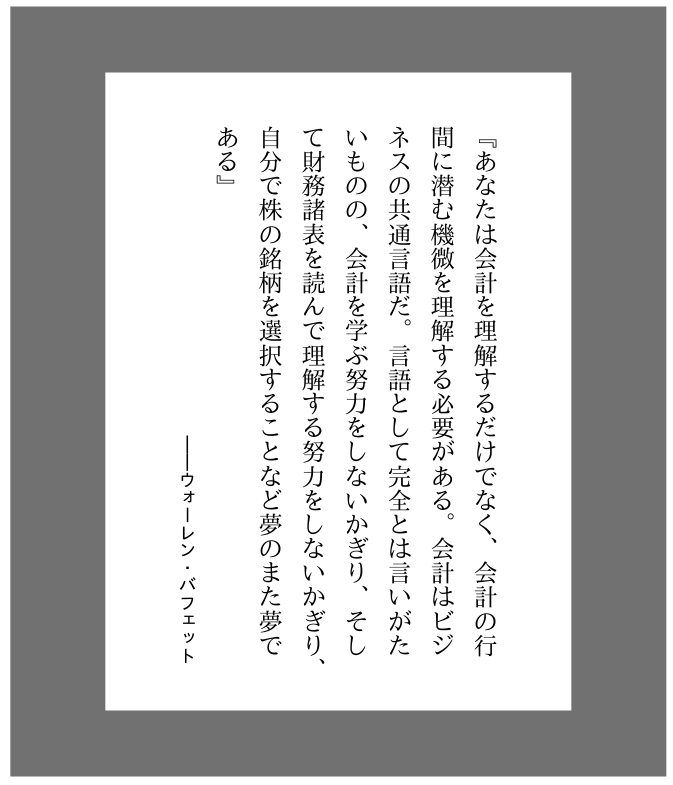
Buffett’s mentor Benjamin Graham’s strategy was to buy “oversold stocks” at prices below their long-term intrinsic value, then sell when the market corrected its mispricing. This approach is known today as “value investing.”
But Graham only trusted numbers — he had no interest in what business the company actually ran.
Buffett built on Graham’s value investing framework while adding a crucial question: does the target company have durable competitive advantage?
Investing in a company with durable competitive advantage, Buffett asserts, is like riding a 100% reliable prophecy.
Three Models of Superstar Companies
Buffett categorized companies with durable competitive advantage — what he calls “superstar companies” — into three models:
Model 1: Companies that sell a unique product no one else can replicate Model 2: Companies that sell a unique service no one else can replicate Model 3: Companies that buy and sell a product or service that the general public consistently demands, at low cost
Model 1 examples: Coca-Cola, Pepsi, Hershey, Budweiser, The Washington Post, Wrigley, Kraft.
These companies “own a piece of the consumer’s mind” — because their product is so deeply embedded in consumer preference, there’s no need to change it, and they can charge more and sell more than competitors.
Model 2 examples: Moody’s, H&R Block, American Express, ServiceMaster, Wells Fargo.
Like Model 1, these companies own a piece of consumers’ minds — people need their services and are willing to pay for them.
Both Models 1 and 2 share a fundamental characteristic: dominant products or services that put them in a near-monopoly position and allow them to earn high margins.
Model 3 examples: Walmart, Costco, Nebraska Furniture Mart.
These companies operate large-scale purchasing and selling. Their sheer volume allows them to generate higher margins than competitors through the economics of high-volume, low-margin business.
Invest in any company belonging to one of these three models, Buffett says, and cash will flow into your pocket year after year — not just next year, but the year after, and the year after that.
And the key word in “durable competitive advantage” is durable. To confirm it, you need to read a company’s financial statements and look for consistency — the kind that extends into the future.
How to Read an Income Statement the Buffett Way

This section covers how to read an income statement using Buffett’s approach. The key checkpoints he identifies are:
- Companies with durable competitive advantage tend to show consistently high gross profit margins
- Selling, General & Administrative expenses (SG&A) should be consistently low
- Companies requiring heavy R&D spending have an inherent fragility in their competitive position
- Depreciation is an extremely real cost and should never be excluded from profit calculations
- The ratio of interest expense to operating profit reflects the company’s risk level
- First of all: check whether net income is on a consistent upward trend
The basic premise: track these metrics over a 10-year period. If you can confirm consistency, that’s your signal of durable competitive advantage.
High Gross Profit Margins Indicate Durable Competitive Advantage
Gross profit is a critical item in the income statement — but what you want is not the raw number but the gross profit margin (gross profit ÷ revenue), which shows gross profit as a percentage of sales.
Companies with durable competitive advantage consistently show high gross profit margins, Buffett says. They can command prices far above cost of goods sold — precisely because of that advantage.
Buffett’s benchmark: companies with gross margins consistently above 40% are likely to have some form of durable competitive advantage. Companies consistently below 20% are likely to have none.
SG&A Should Be Consistently Low
The Selling, General & Administrative (SG&A) line includes executive compensation, advertising, travel, legal fees, commissions, and employee salaries.
Companies without durable competitive advantage tend to have higher SG&A because they’re fighting hard in competitive markets and must keep spending.
Buffett avoids companies where SG&A is consistently high (frequently near or above 100% of gross profit). Conversely, companies where SG&A is consistently below 30% of gross profit are excellent; companies in the 30–80% range may still have durable competitive advantage if they maintain that range consistently.
Heavy R&D Is a Sign of Structural Vulnerability
R&D expenses — costs for developing and obtaining patents and advanced technology — can be a red flag.
Companies with a high ratio of R&D to gross profit may be chronically forced into this expenditure to stay ahead of competitors. If they reduce spending, they lose their edge — meaning their competitive advantage depends entirely on continued heavy investment, which is inherently fragile.
The book doesn’t give a specific threshold, but the examples used suggest that companies spending more than ~30% of gross profit on R&D may be at risk.
Depreciation Is a Real Cost — Never Exclude It
Depreciation represents the wearing out of machines and buildings over time (e.g., a ¥10 million printing press with a 10-year life depreciates ¥1 million per year).
Companies with durable competitive advantage tend to have low depreciation as a percentage of gross profit. The book doesn’t give explicit targets, but examples suggest that companies with depreciation at 6–8% of gross profit have durable advantage, while companies without it show 22–57%, suggesting that 10–15% or below is a favorable indicator.
Interest Expense as a Share of Operating Profit Reflects Risk Level
A company with high interest expense relative to operating profit likely belongs to one of two categories:
- A company facing brutal competition requiring massive capital investment to stay viable.
- A company with excellent underlying economics that has been burdened with heavy debt through special circumstances (e.g., a leveraged buyout).
Companies with durable competitive advantage typically have interest expense below 15% of operating profit — though this varies significantly by industry. Banks, for example, may show 30% and still be in a healthy position. Always compare within the same industry.
Look First at Whether Net Income Is Consistently Rising
Net income = revenue minus all expenses and taxes.
A single strong year means little. What matters for identifying durable competitive advantage is whether net income is on a long-term upward trend (10+ years). The trend doesn’t need to be perfectly smooth — it just needs to be consistently pointing upward over time.
As a general rule: companies where net income has consistently been above 20% of revenue over the long term are likely to have durable competitive advantage. Companies consistently below 10% are unlikely to have it. The 10–20% range is ambiguous — some in that range do have it.
How to Read a Balance Sheet the Buffett Way

The key balance sheet checkpoints Buffett identifies:
- In difficult times like a great recession, cash is the ultimate weapon
- Companies with sharp swings in inventory warrant caution
- Companies with consistently lower accounts receivable-to-sales ratios than competitors likely have some form of competitive advantage
- The current ratio cannot be used to distinguish superior from inferior companies
- Look at what companies are acquiring — pay attention to companies with growing goodwill
- Extremely high return on total assets may actually signal competitive fragility
- Exclude from investment consideration banks with more short-term borrowing than long-term
- Companies with durable competitive advantage almost always carry little or no long-term debt
- Look for a treasury-adjusted debt-to-equity ratio of 0.80 or less
- Steady, long-term growth in retained earnings is a hallmark of durable competitive advantage
- High return on equity will eventually show up as rising stock prices
Track these over 10 years and confirm consistency.
Cash Is the Ultimate Weapon in Difficult Times
“Cash and cash equivalents” on the balance sheet is exactly what it says — cash and near-cash (short-term CDs, treasury securities, highly liquid assets).
A large cash position may reflect: (a) the company using its competitive advantage to generate large amounts of cash — good; or (b) the company having just sold part of its business — less good.
Conversely, a company with little or no cash on hand may have mediocre or poor underlying economics.
When a company is suffering a temporary business problem and its stock has crashed, Buffett always checks the cash position to determine whether the company has the financial strength to survive the crisis. The test: does it hold large amounts of cash and near-cash, with little or no debt? If yes, it will likely weather the storm.
To determine whether cash was generated by core operations rather than asset sales, Buffett looks at the last 7 years of balance sheets.
Companies with Sharp Inventory Swings Warrant Caution
Inventory refers to finished products held in a warehouse for future sale.
Most companies face the risk of inventory becoming obsolete over time — but companies with durable competitive advantage rarely need to update their products, so their inventory never becomes outdated.
As a result, these companies tend to see inventory and net income grow together. A company whose inventory surges and then crashes within a few years may have experienced a boom-and-bust cycle in a highly competitive industry.
Consistently Lower Accounts Receivable-to-Sales Signals Competitive Advantage
Accounts receivable represents sales completed but not yet paid — revenue “floating” between delivery and receipt of payment.
In highly competitive industries, companies frequently offer more favorable payment terms to attract customers — which inflates accounts receivable as a percentage of total sales.
When comparing companies in the same industry, a company that consistently maintains a lower AR/sales ratio than its peers is likely to have some form of competitive advantage.
The Current Ratio Cannot Distinguish Superior Companies
The current ratio (current assets ÷ current liabilities) is commonly used as a measure of liquidity — higher is better. But many companies with durable competitive advantage actually have current ratios below 1.
This is because their high profitability means their cash generation easily covers current liabilities, even if the ratio says otherwise. Don’t use the current ratio as a filter for durable competitive advantage.
Pay Attention to Goodwill Growth
Goodwill represents the premium paid when acquiring another company above its net asset value.
Companies with excellent cash-generating power are almost never acquired at book value — goodwill tends to grow. If goodwill has been rising over a long period, the company may be consistently acquiring businesses worth more than their book value — a very favorable sign.
Extremely High ROA May Actually Signal Competitive Fragility
Total assets = current assets + long-term assets. Return on total assets (ROA) = net income ÷ total assets.
Many analysts say: higher ROA is better. But Buffett cautions that an extremely high ROA (above 40%) may signal that barriers to entry in the industry are very low — making the advantage easy to replicate. In that case, high ROA alone is not a reliable indicator of durable competitive advantage.
Exclude Banks with More Short-Term Borrowing Than Long-Term
Short-term debt matures within one year. Banks can borrow at 5% in short-term markets and lend at 7% in long-term markets — a seemingly easy way to profit.
But this practice — known in finance as “rolling over the debt” — carries a worst-case risk: the short-term funding source dries up, and the bank finds itself in crisis.
To eliminate this risk, when buying financial institution stocks, Buffett always excludes companies with more short-term borrowing than long-term.
Companies with Durable Competitive Advantage Carry Little or No Long-Term Debt
Long-term debt matures more than one year out. Companies with durable competitive advantage almost always carry little or no long-term debt — because their high profit margins allow them to pay it off quickly.
If this pattern has held for approximately 10 years, the company is likely to have durable competitive advantage.
Exception: a company acquired via leveraged buyout (LBO) may temporarily carry large long-term debt. In those cases, the company’s bonds may actually be a better investment than its stock.
Look for Treasury-Adjusted Debt-to-Equity Below 0.80
Debt-to-equity = total liabilities ÷ total equity. In theory, companies with durable competitive advantage should have low liabilities and high equity — and thus a low debt-to-equity ratio.
However, these companies often pour accumulated retained earnings into stock buybacks, which reduces book equity and makes the debt-to-equity ratio look worse than it really is.
To see through this, calculate the treasury-adjusted debt-to-equity ratio by adding back all buyback-inflated value to equity. Excluding special cases like financial institutions, a treasury-adjusted ratio of 0.80 or below indicates likely durable competitive advantage.
Steady, Long-Term Growth in Retained Earnings Is a Key Indicator
Retained earnings are the portion of net income not paid out as dividends or used for buybacks — kept inside the company.
Retained earnings are one of the most important figures on the balance sheet. If the growth rate of retained earnings has been large on average over the past five years, the company is likely to have durable competitive advantage.
The book doesn’t give an explicit threshold, but examples suggest companies with durable advantage show retained earnings growing at 6–23% per year. A rough benchmark: above 10% growth is a strong indicator.
Note: some excellent companies (like Microsoft) have at times reduced retained earnings through aggressive buybacks — keep that in mind when evaluating.
High Return on Equity Will Eventually Appear as Rising Stock Prices
ROE = net income ÷ total equity. Companies where ROE is consistently higher than the industry average are likely to have durable competitive advantage.
The book doesn’t explicitly state a threshold, but examples suggest that companies with durable advantage show ROE of 24–34%. A rough benchmark: above 20% is a strong indicator.
How to Read a Cash Flow Statement the Buffett Way

Key cash flow checkpoints:
- Companies with durable competitive advantage tend to have low capital expenditures
- Companies that consistently buy back shares rather than raising dividends create more wealth for shareholders
Low Capital Expenditures in Companies with Durable Competitive Advantage
Capital expenditures (capex) represent cash spent on acquiring assets held for more than one year — land, production equipment, patents, etc.
Most companies incur ongoing capex just to maintain their operations. Telecom companies, for example, spend enormous sums annually maintaining their networks.
Companies with durable competitive advantage tend to have low capex. Specifically: companies that have maintained capex below 50% of annual net income over many years are strong candidates, and those below 25% are very strong candidates.
Stock Buybacks Over Dividend Increases Enrich Shareholders More
The “stock issuance (redemption)” line in the cash flow statement shows net proceeds from stock issuance minus stock repurchases.
Companies with durable competitive advantage generate large cash flows and must decide how to deploy them: dividends, buybacks, or retained earnings.
From a shareholder wealth perspective, buybacks are preferable to dividends — dividends trigger taxes immediately, while buybacks defer taxes until the shares are sold. Companies that have consistently bought back shares year after year (showing a negative number on the issuance line) are demonstrating that they have a sustainable source of surplus cash — and are likely to have durable competitive advantage.
How Buffett Evaluates Companies with Durable Competitive Advantage
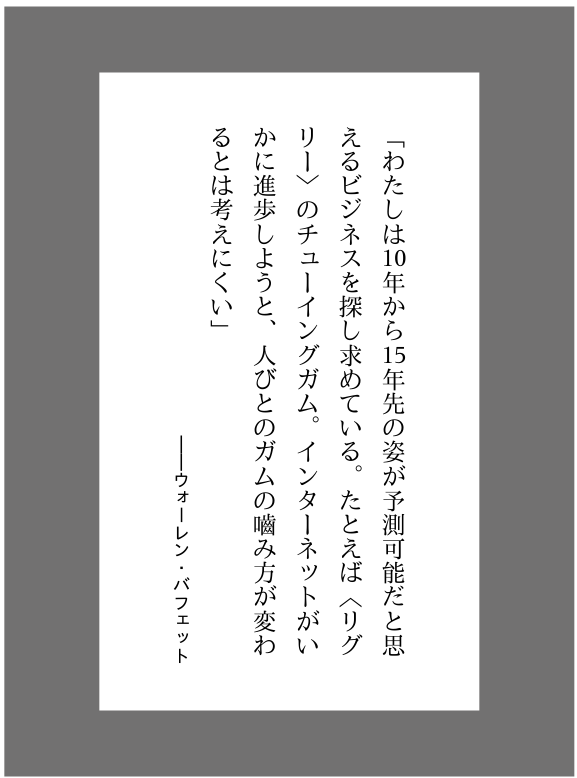
The key evaluation points:
- The revolutionary concept of “equity bonds” and how to apply it in practice
- How Warren decides when to buy a great company’s stock
- How Warren decides when to sell
The “Equity Bond” — Buffett’s Revolutionary Concept
“Equity bond” appears to be a term Buffett coined. It refers to something like a “principal-guaranteed stock-index-linked bond.” Ordinarily, principal-guaranteed bonds carry very low interest rates. Stock-index-linked funds, by contrast, carry high risk and high potential return with large price swings.
Buffett believes that investing in a company with durable competitive advantage combines the advantages of both: invest once, and you effectively have principal guaranteed (near-zero risk of permanent loss), plus stable, high-return annual income that grows year after year — like “compound interest that expands upward.”
This thinking comes from the recognition that companies with durable competitive advantage consistently earn high profits and are unlikely to go bankrupt — making them functionally equivalent to principal-guaranteed instruments.
When Does Warren Decide to Buy?
Under Buffett’s theory, the lower the purchase price, the better the long-term outcome.
In practice, great companies’ stocks almost never trade at bargain prices. Value investors typically avoid these stocks precisely because they’re already well-valued.
The best buying opportunities come in two situations: (1) when the overall market enters a bear phase, or (2) when a short-term, fixable problem causes a temporary decline in a specific company.
In the second case, you must verify thoroughly that the company holds sufficient resources (cash, etc.) to solve its problem.
Conversely, Buffett warns against buying when the overall market appears to be at peak bull-market euphoria.
When Does Warren Decide to Sell?
Buffett’s philosophy is to find a company with durable competitive advantage and hold it for the long term — treating it like an equity bond that compounds indefinitely. In principle, he never sells.
But in rare cases, selling may be advantageous:
Situation 1: A chance to buy a better company at a better price (e.g., temporary crash) arises, and the current position must be liquidated to fund it.
Situation 2: The company appears to be losing its durable competitive advantage — perhaps because technological development has introduced a competitor that threatens the previously unchallenged position.
Situation 3: A stock market bubble has pushed the great company’s stock far beyond the true economic value of its underlying business — specifically, when the P/E ratio exceeds 40x.
Reflections on the Book
This book documents the specific stock selection methodology of Warren Buffett — who needs no introduction among investors. While most Buffett books focus on his philosophy and quotes, this one is distinguished by the sheer number of specific numerical thresholds it provides.
In practice, Buffett did use the methods described here to identify great companies and hold them for decades — which is how he became a billionaire. Understanding and applying this book’s content isn’t a guarantee of Buffett-level wealth, but it’s not impossible either.
That said, whether Buffett’s investment philosophy will remain effective in future markets is an open question, and I wouldn’t recommend taking this book at face value without building your own investment philosophy on top of it.
Below are the parts that left the deepest impression on me.
”Durable Competitive Advantage”
Buffett uses this phrase constantly. The concept essentially describes businesses in near-monopoly positions that consistently generate high returns — and I’m struck by the fact that this framework didn’t exist in investing until Buffett popularized it.
Most people would immediately think of infrastructure companies as the obvious candidates — but infrastructure businesses tend to have high maintenance costs, so their profitability often isn’t as high as you’d expect.
Buffett’s insight, I think, is to focus on profit margin rather than revenue. Companies that generate abundant cash relative to their size — despite not being the largest — are far more valuable per revenue dollar than averagely profitable companies of similar scale.
What particularly struck me is that Buffett doesn’t heavily weight revenue growth when selecting targets. In business generally, revenue growth tends to be the metric everyone watches most closely — since nearly every other business metric flows from it. The fact that “durable competitive advantage” can be identified without prioritizing top-line growth is a uniquely interesting selection criterion.
The “Equity Bond” Concept
Buffett says that investing in a company with durable competitive advantage is equivalent to owning an equity bond with rising interest rates. Personally, I find this slightly bold.
It’s true that a company consistently generating large net income is unlikely to go bankrupt. But I wouldn’t go as far as calling it “principal-guaranteed.” In a severe market-wide crash or a long-running company-specific problem, there’s clearly the possibility of being substantially below cost for an extended period.
I suspect Buffett’s reasoning is: companies with high earnings will always eventually recover even after a crash, so for a long-term holder, the principal is effectively safe. But that recovery story is really a story about the strength of the U.S. economy over the past several decades — not a universal guarantee.
Japan, for instance, saw its stock market take nearly 30 years to recover from the post-bubble collapse. Had Buffett been investing in Japan using his own philosophy during that period, recovering losses alone would have consumed decades.
Buffett’s investment theory is fundamentally strengthened by the fact that America was an economic powerhouse for a long time. Applying the same logic to other countries or future periods is, in my view, potentially very dangerous.
That said, I do strongly agree with the underlying principle: companies that consistently generate high net income are superior investment targets. The “equity bond” framing may be a stretch, but the core observation it’s built on is sound.
Summary
Thank you for reading. Warren Buffett and the Interpretation of Financial Statements takes Buffett’s investment philosophy and maps it onto concrete financial statement numbers — making it an extremely valuable read for anyone who admires Buffett and wants to understand how he actually thinks.
Even if you’re not confident in your financial statement literacy, this article has at least explained what each key item represents — so you should have a working understanding of the framework.
Of course, Buffett considers far more than these financial statement items when making investment decisions, so this book alone won’t give you his complete thinking. But it provides excellent benchmarks.
I remember reading this book as a student and finding it enormously educational. This time — a decade or more later — re-reading it to write this article reminded me why it made such an impression. If you found this article useful, I’d encourage you to buy and read the full book.
I’ve also written a broader investment fundamentals overview linked below. Feel free to check it out.
Investment Basics: Stocks, Crypto, NISA and Funds Explained

Also popular with readers
📚 Series: Warren Buffett's Investment Strategy (1/3)