About Buffettology
Ever since my student days, I’ve admired Warren Buffett — the investor who became a billionaire through investing — and I’ve read many books about him.
Most Buffett books, however, cherry-pick his famous quotes and decision-making moments and basically spend the whole time saying “Buffett is amazing!” which I found somewhat unsatisfying. Fine for self-help or philosophical reading, but not particularly useful for learning how to invest.
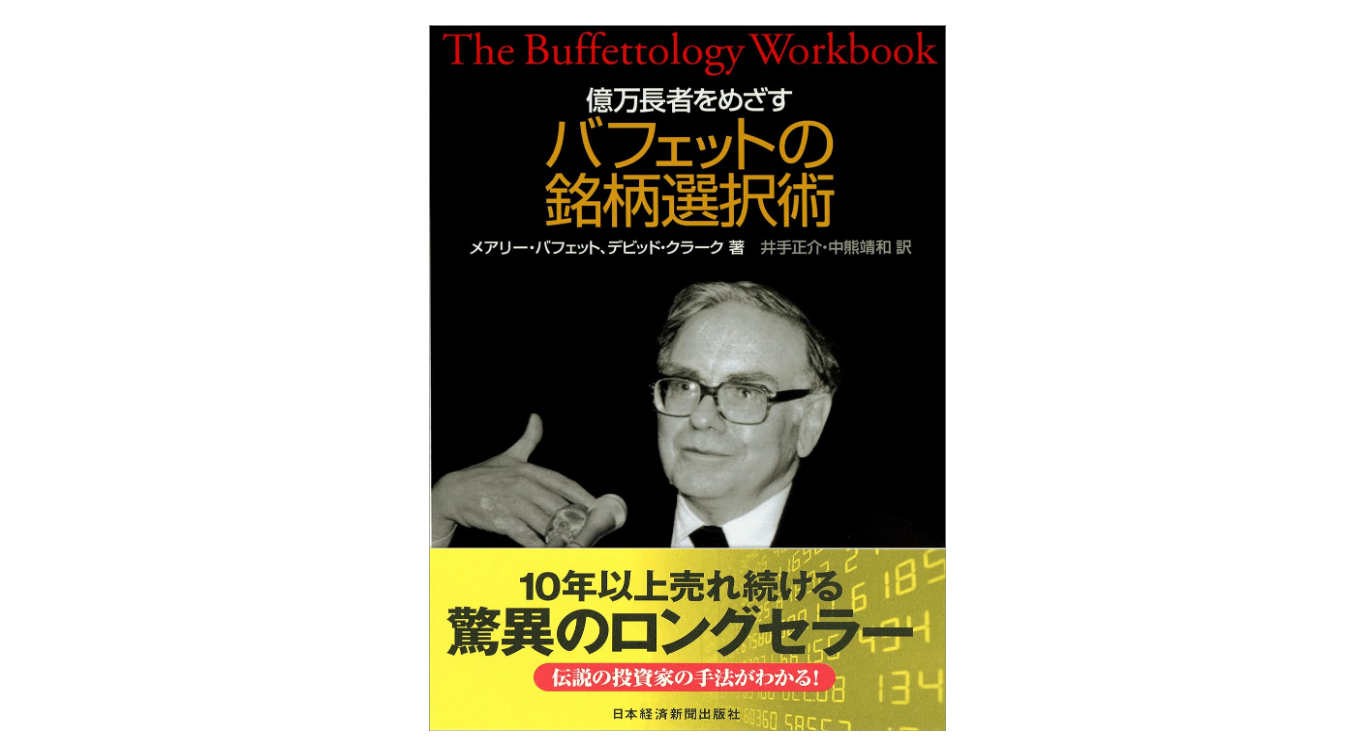
This book — Buffettology (referred to hereafter as “the book”) — is different. It explains Buffett’s stock selection method in concrete, specific terms, using actual metrics and indicators. It is the single most useful investment book I’ve ever read.
The lack of a Kindle edition is a significant downside, but even accounting for that, I believe it’s absolutely worth reading. I read this book over 10 years ago as a student, built up ¥1,000,000 in savings as a working adult, and then started investing — growing my assets to several times that amount in about five years.
My current investment approach has since evolved away from what the book describes (I now focus primarily on swing trading), shaped by various experiences along the way. But for “people just starting out in investing” or “people who want to try long-term investing but aren’t sure what criteria to use,” this book provides enormous value.
This article draws on the content of Buffettology: The Previously Unexplained Techniques That Have Made Warren Buffett the World’s Most Famous Investor.
Buffett’s Investment Approach
Most readers of this article probably already know the basics of Buffett’s approach, but let me summarize it to establish a shared foundation.
Buffett’s core method is fundamental analysis — analyzing a company’s intrinsic value using metrics like P/E ratio, P/B ratio, EPS, and ROE to determine whether the current stock price is undervalued or overvalued relative to that intrinsic value. The thesis: undervalued companies will eventually be priced at their intrinsic value by the market, delivering returns exceeding the original investment.
Within fundamental analysis, Buffett places special emphasis on long-term holding. Though this isn’t covered explicitly in the book, his investment time horizon — spanning 10+ years — is evident from statements like:
“Only buy something that you’d be perfectly happy to hold if the market shut down for 10 years.”
— Warren Buffett
The biggest difference between Buffett’s approach and generic fundamental analysis is his emphasis on “consumer monopoly” companies — companies with strong brand power, or that provide products or services that other businesses or individuals are compelled to use continuously in their daily operations.
Consumer monopoly companies are expected to survive market turbulence and develop long-term, giving them exceptional future prospects.
The opposite of a consumer monopoly company is a “commodity” company — no brand power, many competitors, constant price wars, and squeezed margins. Buffett explicitly says to avoid these.
In short: Buffett uses fundamental analysis and proprietary criteria to identify consumer monopoly businesses at undervalued prices, then holds them for the long term until the market recognizes their true value.
Buffett’s 8 Criteria for Identifying Consumer Monopoly Companies
Chapter 5 of the book — “8 Criteria for Identifying Consumer Monopoly Companies” — is the most important section. It identifies the following criteria:
8 Criteria for Consumer Monopoly Companies
- Does it have a product or service with apparent consumer monopoly power?
- Is earnings per share (EPS) on a strong and consistent upward trend?
- Does the company carry excessive long-term debt?
- Is return on equity (ROE) sufficiently high?
- Does the company need to reinvest a large portion of retained earnings just to maintain its current position?
- Can retained earnings be freely used for new ventures or share buybacks?
- Can it pass on inflation to its prices?
- Is the reinvestment of retained earnings reflected in rising stock prices?
1. Does It Have a Product or Service with Consumer Monopoly Power?
The fact that this is the first criterion tells you how much Buffett values “consumer monopoly power.” There’s no specific numerical metric for it — it requires individual judgment.
Buffett suggests finding products with consumer monopoly power this way:
“Stand in front of any store — a convenience store, supermarket, drugstore, bar, gas station, bookstore — it doesn’t matter which. Ask yourself: what branded products does this store absolutely have to carry? In other words, what products would make you question the manager’s judgment if they weren’t on the shelf? Write them down.”
— Warren Buffett
The results of that exercise — Coca-Cola and similar products with overwhelming brand power — are examples of consumer monopoly companies. In Japan too, anyone can likely identify at least one consumer monopoly company using this method.
Further detail on “consumer monopoly power” appears in Chapter 6 of the book — worth reading directly.
2. Is EPS on a Strong Upward Trend?
Even a company with strong consumer monopoly products can have concerns about its future if overall company management has problems. Buffett uses the historical trend of EPS (earnings per share) to detect management issues.
EPS Calculation EPS = Net Income ÷ Shares Outstanding
The book illustrates which type of company deserves more attention:
| Year | Company A | Company B |
|---|---|---|
| 1990 | $1.07 | -$1.57 (loss) |
| 1991 | $1.16 | $0.06 |
| 1992 | $1.28 | $0.28 |
| 1993 | $1.42 | $0.42 |
| 1994 | $1.64 | -$0.23 (loss) |
| 1995 | $1.60 | $0.60 |
| 1996 | $1.90 | -$1.90 (loss) |
| 1997 | $2.39 | $2.39 |
| 1998 | $2.43 | -$1.25 (loss) |
The point is clear: when you line up 10 years of EPS, does the company show a consistent upward trend like Company A?
Of course, there will be periods where the overall market slumps (like the Lehman shock) or an entire industry struggles. But a true consumer monopoly company should return to strong EPS growth after such periods.
That said, if EPS drops sharply, it’s important to determine whether it’s a temporary issue, a sign of a future downtrend, or a problem the company can solve — and to evaluate accordingly.
The book also explains how to use projected EPS (based on a 10-year average growth rate) to calculate estimated stock prices 10 years out, deriving an expected return rate — see the book for those calculations.
3. Does It Carry Excessive Long-Term Debt?
Consumer monopoly companies generate strong cash flows from their businesses and therefore should have no need to take on long-term debt — that’s Buffett’s argument.
The book cites Coca-Cola, whose long-term debt was less than one year’s worth of earnings. Similarly, Gannett had after-tax earnings of $990 million against long-term debt of about $1 billion — repayable in roughly one year. Gillette had earnings of $1.2 billion against long-term debt of $2.4 billion — repayable in two years.
From these examples, Buffett appears to use long-term debt within 3 years of after-tax earnings as his benchmark for “not excessive.”
To use a Japanese example: Toyota’s March 2018 financials showed long-term debt of ¥10,006,374 million against net income of ¥2,493,983 million — the debt exceeds four years of earnings. By Buffett’s standard, Toyota doesn’t qualify as a consumer monopoly company.
In practice, a company of Toyota’s scale doesn’t face an existential problem from that level of debt — it simply means Buffett wouldn’t target it. And companies famous for heavy debt (like SoftBank) have seen steady performance and stock appreciation anyway, so high long-term debt alone doesn’t disqualify a company entirely.
But the general principle holds: a company that can repay all long-term debt within about one year of earnings is likely to have strong future prospects.
4. Is Return on Equity (ROE) Sufficiently High?
ROE is heavily emphasized not just by Buffett but by investors globally.
ROE Calculation ROE = Net Income ÷ Equity × 100 (%)
Buffett found that the average ROE for American companies at the time of his research was about 12%. He therefore concluded that a company should have an ROE of at least 15% to qualify as excellent — and higher is better.
Examples from stocks Buffett held: Coca-Cola 33%, Hershey Foods 16.7%, Disney 18%, ServiceMaster 40%, UST 30%+, Gannett 27%, McDonald’s 18%. All exceed 15%.
Toyota’s ROE at the time referenced above was 13.7% — below the 15% threshold, confirming again that it doesn’t meet Buffett’s consumer monopoly standard.
Note: Japan’s average corporate ROE only first exceeded 10% in 2018, so Buffett’s 15% benchmark may be harder to meet in Japanese markets.
5. Does the Company Need to Reinvest Heavily in Retained Earnings Just to Stay in Place?
Companies generally generate earnings each year and return a portion as dividends. If a company has ROE of 12% and pays out 8% as dividends, 4% accumulates as retained earnings annually — theoretically increasing corporate value by 4% per year compounded.
But Buffett cautions that this model breaks down in practice. Most companies use retained earnings to maintain existing equipment and operations — it doesn’t translate into shareholder value growth.
Toyota and other automakers require enormous, expensive factories and equipment that must be maintained continuously. New product development also demands constant R&D. Companies that must spend heavily just to keep existing operations running are not Buffett’s type.
Buffett preferred companies that require almost no equipment maintenance or R&D — examples cited in the book include: “the only newspaper in town,” candy and chewing gum manufacturers, razor blade makers, soda and beer companies.
These are “low-tech” companies that have been making the same products for over a decade. Companies with overwhelming brand power who keep making the same product have minimal maintenance and R&D costs.
It’s worth noting, however, that this preference caused Buffett to miss much of the IT boom — his difficulty understanding volatile, R&D-heavy tech companies meant he sat out most of the U.S. tech industry’s massive growth. (Buffett now holds large positions in companies like Apple, so his thinking clearly evolved.)
I don’t think this criterion is meaningless even given that outcome — but it’s worth bearing in mind.
6. Can Retained Earnings Be Freely Used for New Ventures or Share Buybacks?
This criterion is closely related to the previous one and difficult to define precisely.
Buffett’s point: is the company reinvesting retained earnings into new ventures that generate above-average returns? Or is it using retained earnings aggressively for share buybacks? Either of these is a sign of a quality company.
This is hard to assess without digging into each company’s annual IR disclosures, so I’d suggest using it as a final check after narrowing down your target.
One practical note: when companies do buybacks, both shares outstanding and equity decrease — which mechanically boosts EPS and ROE. So if EPS and ROE already meet Buffett’s standards, this criterion may be largely redundant.
I should add: this criterion matters a lot for consumer monopoly companies as Buffett defines them, but in high-growth industries like tech, I see it as slightly risky. A company choosing to do buybacks rather than reinvest in its business is essentially saying “we don’t see much room to grow through internal investment.” Similarly, companies paying excessive dividends are effectively declaring the same thing — which makes me personally view them with some caution in growth contexts.
7. Can It Pass on Inflation to Its Prices?
Similar to Criterion 1, this asks: does the company’s consumer monopoly power let it raise prices in line with inflation without losing customers?
The U.S. inflation rate has historically been around 2% per year, so maintaining the same profit level requires price increases of similar magnitude over a multi-year period. Without this, rising input costs will squeeze margins.
Japan historically had low or negative inflation, so this criterion has been less pressing here — though that’s changed in recent years, with visible price hikes across many categories. The companies that raised prices and maintained sales volumes are exactly the consumer monopoly type Buffett describes; those that lost customers due to price increases are not.
8. Is the Reinvestment of Retained Earnings Reflected in Rising Stock Prices?
Similar to the EPS growth criterion, this one asks: is the company’s growing profitability actually being reflected in the stock price over time?
The book compares Berkshire Hathaway and General Motors (GM) over a 17-year period from 1983:
- Berkshire Hathaway: equity per share +3,900%, stock price +4,900%
- GM: equity per share +11%, stock price +106%
The point: even if a company appears to be managing well year over year, what matters is whether that performance is showing up as an upward trend in the stock price over a 10-year period.
If retained earnings are being absorbed by maintenance costs rather than growing shareholder value, the stock price won’t reflect the earnings growth.
Summary of Buffett’s Consumer Monopoly Criteria
Summarizing the above into concrete criteria:
- Has a product or service with apparent consumer monopoly power
- EPS shows a consistent upward trend over 10+ years
- Long-term debt is within 3 years of after-tax earnings
- ROE is 15% or above
- Core business does not require heavy equipment maintenance or R&D spending
- Retained earnings are deployed into new ventures or share buybacks
- Can raise prices in line with inflation without losing customers
- Stock price rises consistently in proportion to earnings growth
Is Buffett’s Stock Selection Method Correct?
Having covered the method, I want to be direct: even replicating Buffett’s approach exactly would not guarantee large gains.
Buffett is without question the person who has made the most money through “investing” — and I deeply respect both his achievements and his analytical depth. But I think a significant part of Buffett’s outsized gains was also a function of his era.
Looking at the Dow Jones chart: when Buffett became an active investor in the 1950s, the Dow was around 300 points. As of 2018, it was around 25,000 — a largely uninterrupted uptrend despite occasional crashes. If Buffett had used somewhat looser criteria, he still would likely have grown his assets significantly through long-term holding.
That said, the fact that Buffett outperformed everyone else who was in the same market environment does validate his theory to a meaningful degree.
By contrast, Japan’s Nikkei Average hit its bubble peak around 38,000 in 1990 — and for nearly 30 years afterward (until very recently), it never reached that level again. If Buffett had started his investing career in Japan in the early 1990s, I genuinely cannot see how his long-term investing method would have let him grow his assets anything like he did in the U.S.
My conclusion: Buffett’s stock selection method was unquestionably the most correct approach for the U.S. market from the 1950s through the recent era. But it cannot be assumed to be universally correct in all eras and all countries.
Closing
Thank you for reading. This became more of a summary and commentary than a traditional book review — which even I feel a bit conflicted about. For anyone who wants to learn about everything in the book beyond just stock selection criteria, buying and reading it yourself is the best path.
As I’ve noted throughout: I don’t believe Buffett’s stock selection method is infallible in all times and circumstances. What I do know is that it was clearly correct for one particular country during one particular era.
Even accounting for that caveat, I believe the content of this book represents something close to a fundamental truth about stock investing. If you’re an individual investor who wants to improve your results, reading this book will not be a waste of your time.
If this article was helpful, I hope you’ll pick up the book itself.
And for more on Buffett-related reading, check out my article on his financial statement analysis approach:
Warren Buffett’s Financial Statement Analysis: 58 Rules for Picking Superstar Stocks

Also popular with readers
📚 Series: Warren Buffett's Investment Strategy (3/3)