Mythology & Religion Power Ranking TOP100
This article introduces Rank 18: Satan from the “Mythology & Religion Power Ranking TOP100”, which ranks the gods, monsters, and heroes of world mythology, religion, and legend in order of strength.
If you want to see the full TOP100 list and the criteria behind the rankings, check out the overview article below.
Rank 18: Satan (Judaism, Christianity, Islam, and related religions)

😈 What happens if Satan fights the other gods?
I built a simulator that pits the 100 entries in this ranking against each other. It opens with Satan already picked, and an opponent of the same tier chosen for you.
⚔ Send Satan into battleOverview
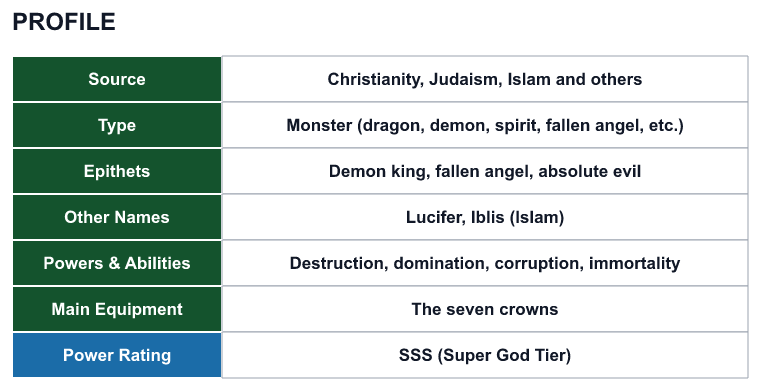
Satan is a figure appearing in the Abrahamic religions of Judaism, Christianity, and Islam. His role varies somewhat across each religion, but in most depictions he is treated as a being of evil that leads humanity astray and into corruption.
In Judaism, Satan is closer to an angel who serves God — he tests humans by taking away their property, family, and health, but is fundamentally obedient to God.
In Islam, he appears under the name Iblis, a spirit (jinn) who defied God and is destined to corrupt humanity until the Day of Judgment.
The Satan most people are familiar with is the Christian version — a being who rebelled against God, was cast down to the earth, and is depicted as the embodiment of absolute evil.
It is commonly said that Satan was originally a fallen angel named Lucifer, but in the Bible the word “Lucifer” means “the shining one (Morning Star)” and there is nothing in scripture that suggests Satan was originally an angel named Lucifer.
In Christianity, the Book of Revelation describes Satan as: “The great dragon was hurled down — that ancient serpent called the devil, or Satan, who leads the whole world astray. He was hurled to the earth, and his angels with him.” So Satan is a great dragon, a devil, and an ancient serpent (equated with the serpent of Eden). His appearance is also described: “an enormous red dragon with seven heads and ten horns and seven crowns on its heads.”
In later centuries, a passage referring to the fall of a king of Babylon was reinterpreted as describing the fall of Lucifer. Since Lucifer means “the shining one,” he must have been an angel — but since he fell from heaven, he must be a fallen angel — and since Satan was also cast down from heaven, Lucifer and Satan must be the same being — and therefore Satan’s true identity is the fallen angel Lucifer. This interpretation became widespread, but since “Lucifer” was originally a metaphorical expression for a Babylonian king and was never an angel’s name to begin with, this is effectively a misinterpretation built upon another misinterpretation.
The modern image of Satan was shaped enormously by the 17th-century epic poem Paradise Lost, which transformed him from a vaguely defined symbol of evil into a vivid, rebellious fallen angel — a characterization that captured enormous attention.
Satan is primarily a figure who corrupts humanity through indirect means, and there are almost no descriptions of his direct combat power.
However, the Book of Revelation states: “His tail swept a third of the stars out of the sky and flung them to the earth” — indicating that a single sweep of his tail can knock countless stars from the sky.
It is also stated that Satan was the one who granted power to the Beast of Revelation, meaning Satan’s own power must far exceed that of the Beast.
That said, in the war in heaven he was defeated by the army of angels led by Michael, and so it is also true that he lacks the power to overwhelm a heavenly host. Furthermore, he is ultimately destined to be tormented forever in the lake of fire and sulfur by God.
Ranking Reason
In fantasy games, anime, and other fiction, Satan (Lucifer) is frequently depicted as a powerful demon or fallen angel — but in Christianity, his most prominent source, he is described as a great red dragon with seven heads and ten horns.
While he is often imagined as a being capable of rivaling God, in actual Christian scripture the impression is more that God was simply tolerating him as a test of human faith. Whenever God or His messengers act, Satan is defeated in what reads almost like an effortless one-sided encounter — he is far from a match for the One God.
Even so, his power is strong enough to casually knock stars from the sky, and through the Beast of Revelation he effectively conquered the world (with only a portion of Christians remaining unconquered).
Furthermore, based on the depiction of the Beast recovering almost instantly from a lethal wound, Satan is thought to possess a similar ability — making him effectively immortal against anyone other than God.
In practice, he was defeated by Michael’s angelic host and cast to earth, and was also sealed for a thousand years by God’s messenger — yet he revived even from that.
While he lost to Michael’s army in battle, both sides were leading forces of their own, so which one would win in a direct one-on-one fight is unclear. But considering the scale of his influence, I felt Satan would have the edge in a one-on-one matchup, and placed him at this position accordingly.
About the Book
I wrote a book that compiles this entire ranking! The reasoning behind each placement is grounded in the actual lore and episodes from each mythology, so I think it makes for a fairly convincing read.
The book also contains many columns and extras not published on this blog, so if you are interested, please check it out below.

Also popular with readers
📚 Series: Mythology Power Ranking (Individual Characters) (83/100)