Mythology & Religion Power Ranking TOP100
This article introduces Rank 27: Tiamat from the “Mythology & Religion Power Ranking TOP100”, which ranks the gods, monsters, and heroes of world mythology, religion, and legend in order of strength.
If you want to see the full TOP100 list and the criteria behind the rankings, check out the overview article below.
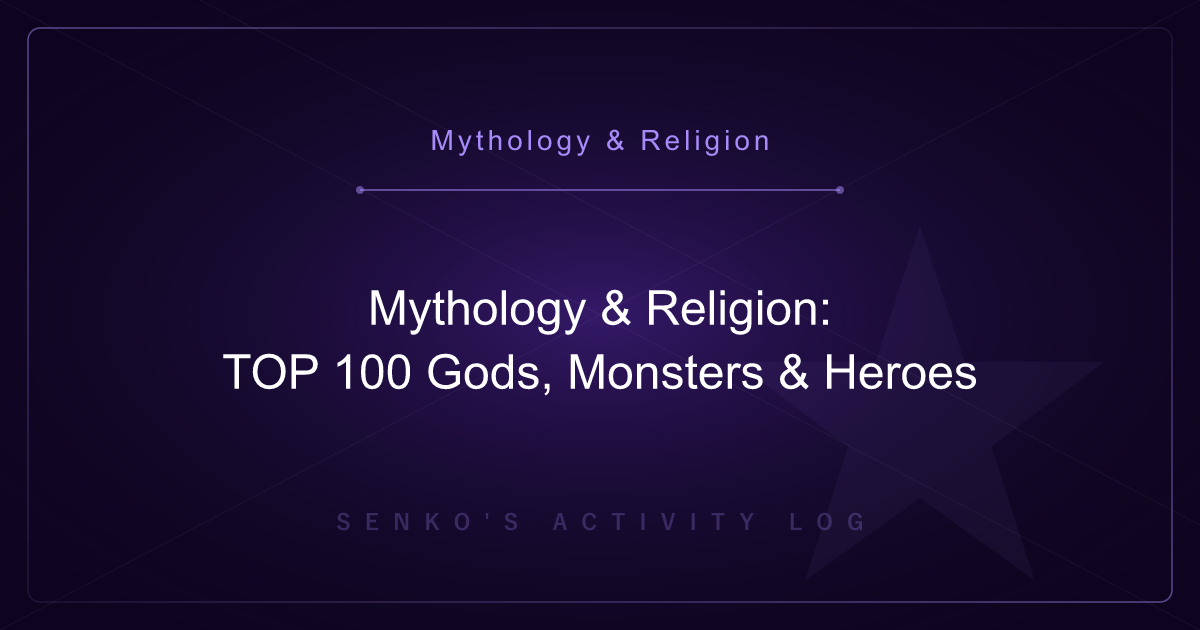
Rank 27: Tiamat (Mesopotamian Mythology, Babylonian Mythology)
🐙 What happens if Tiamat fights the other gods?
I built a simulator that pits the 100 entries in this ranking against each other. It opens with Tiamat already picked, and an opponent of the same tier chosen for you.
⚔ Send Tiamat into battleOverview
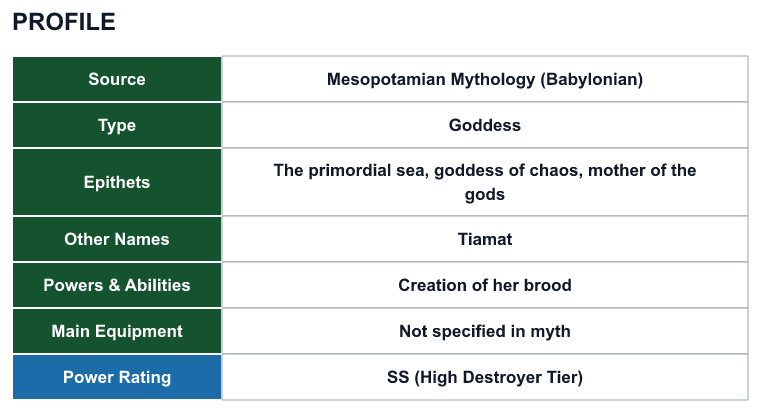
Tiamat is the primordial goddess of the sea in Mesopotamian mythology, and the mother figure who, together with her husband Apsu, gave birth to all the gods of the next generation.
In the early period of Mesopotamian mythology (Sumerian mythology), the primordial sea was called “Nammu,” but in the later period (Babylonian mythology), “Tiamat” emerged as the goddess of the primordial sea.
Although she is referred to as a goddess, her form is most often depicted as something resembling a dragon, and she was said to be of such enormous size that her body was later used as the material for the creation of heaven and earth.
One day, Tiamat’s husband Apsu grew frustrated with the younger generation of gods (his sons and grandchildren), who caused nothing but chaos, and he devised a plan to exterminate all the gods.
However, the plan was discovered by Ea, who turned the tables and killed Apsu. Then Ea and his son Marduk began playing on top of Apsu’s remains, which was finally enough to make Tiamat snap — and so she declared war on the younger generation of gods.
Wielding the power of primordial chaos, Tiamat created eleven monsters, granted the “Tablet of Destinies” — which controls the laws of fate and the universe — to her commander Kingu, and assembled a vast army of her divine followers.
But when the army of next-generation gods led by Marduk clashed with Tiamat’s forces, Marduk displayed such overwhelming power that Tiamat’s army fled in terror.
Left with no choice, Tiamat faced Marduk in single combat, but an arrow Marduk fired pierced her belly and killed her. Her body was then split in two, and each half became heaven and earth — leading to the creation myth.
Reason for This Ranking
Tiamat’s battle in Mesopotamian mythology has few depictions, and we can barely tell her actual size or the scale of her power. However, some passages do allow us to estimate her strength.
First, her body was said to be vast enough to become the material for heaven and earth — by that logic, she would likely even dwarf Jormungandr, the greatest creature in Norse mythology.
Also, when the other next-generation gods saw Tiamat’s army, they fell into a state of panic, which tells us that Tiamat had overwhelming power that none of the gods save Marduk could contend with.
The Mesopotamian gods are not weak by any measure — some, like Adad, possess the power to easily wipe out all of humanity — so the fact that even such gods feared Tiamat speaks volumes about her strength.
Furthermore, the eleven monsters Tiamat gave birth to were said to possess power rivaling the gods themselves.
As for the “Tablet of Destinies” she gave to Kingu, it held the power to govern the universe — capable of rewriting or restoring the laws of fate and the world. In later mythology, it was used to shape the laws of the universe, making it an object of truly staggering power.
However, Kingu was so terrified of Marduk that he was captured before he could use it at all, making it a complete waste.
On the flip side, Tiamat’s greatest weakness is that she lost to Marduk in straightforward single combat and was killed. While it is fair to say that she lost because Marduk was simply that strong, dying from an arrow shot through the belly suggests her immortality is far too low.
Of course, Marduk’s bow was undoubtedly capable of killing gods, but even so, she seems too fragile — and compared to the greatest destruction gods, she does fall somewhat short.
Taking all of this into account, I placed her at this position in the ranking.
About the Book
I wrote a book that compiles this entire ranking! The reasoning behind each placement is grounded in the actual lore and episodes from each mythology, so I think it makes for a fairly convincing read.
The book also contains many columns and extras not published on this blog, so if you are interested, please check it out below.

Also popular with readers
📚 Series: Mythology Power Ranking (Individual Characters) (74/100)