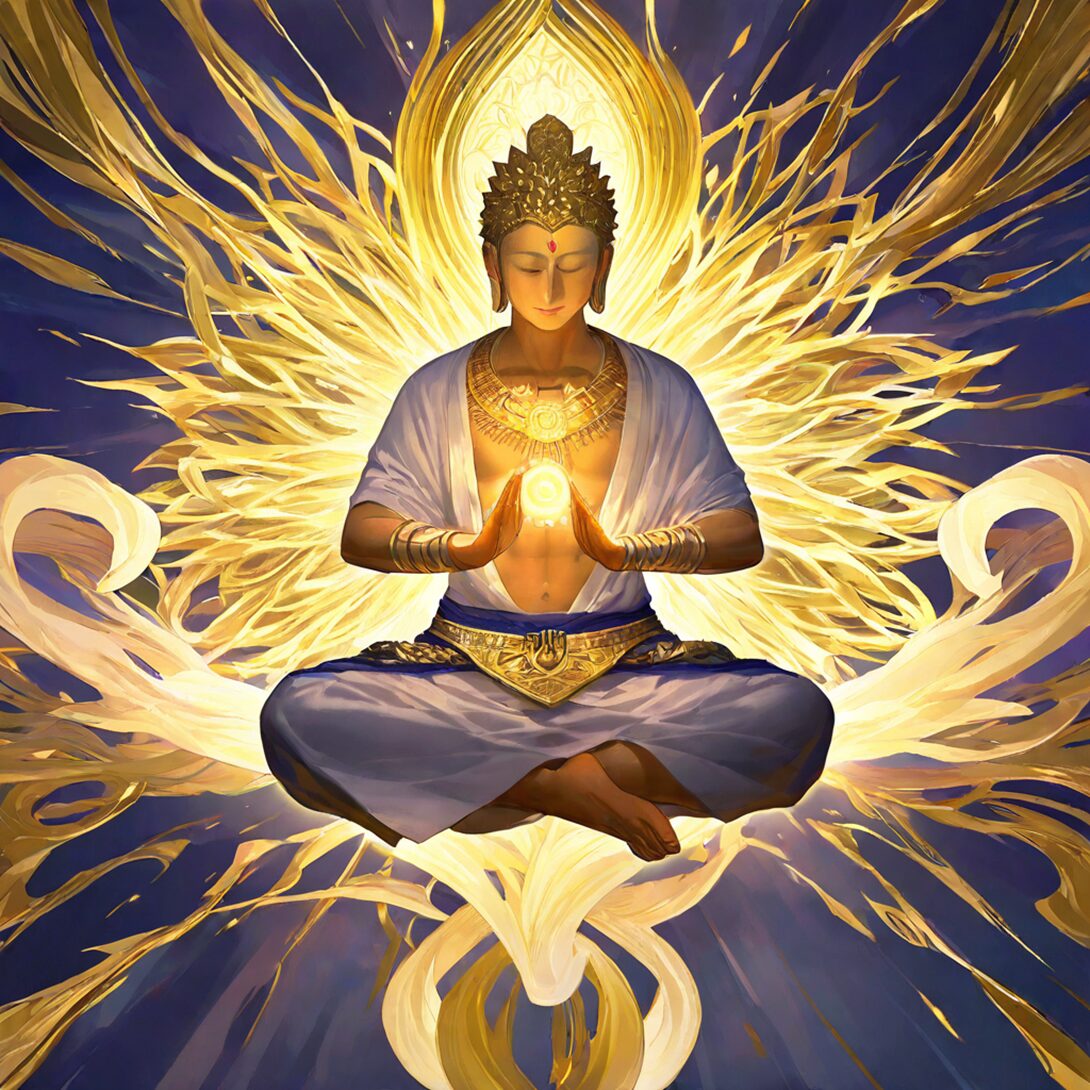
Mythology & Religion Power Ranking TOP100
This article introduces Rank 3: Vairocana from the “Mythology & Religion Power Ranking TOP100”, which ranks the gods, monsters, and heroes of world mythology, religion, and legend in order of strength.
If you want to see the full TOP100 list and the criteria behind the rankings, check out the overview article below.
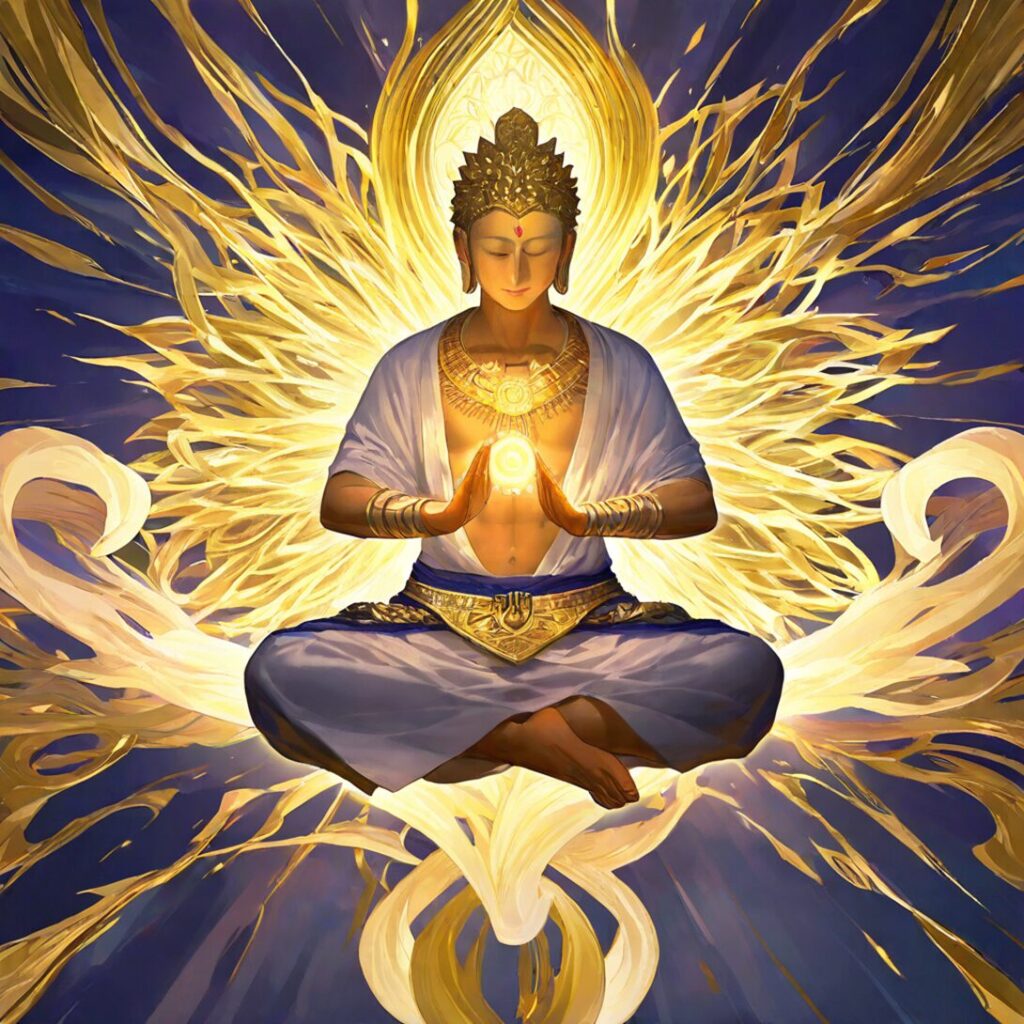
Rank 3: Vairocana (Buddhism / Esoteric Buddhism)
☸️ What happens if Vairocana fights the other gods?
I built a simulator that pits the 100 entries in this ranking against each other. It opens with Vairocana already picked, and an opponent of the same tier chosen for you.
⚔ Send Vairocana into battleOverview
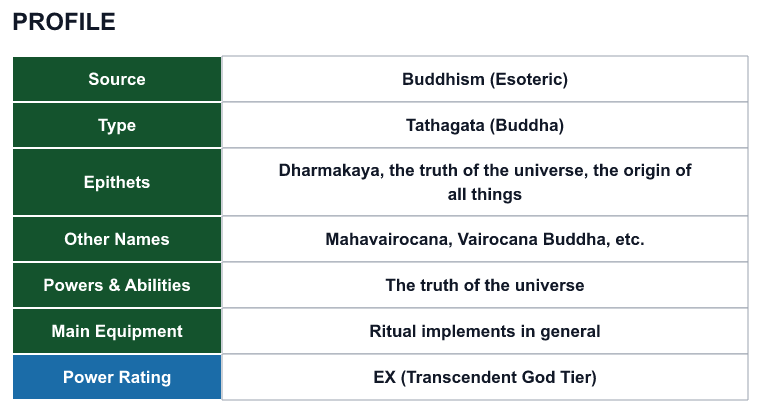
Vairocana (Dainichi Nyorai in Japanese) is regarded as the supreme being in Buddhism — especially in esoteric Buddhism — and is described as “the eternal, indestructible truth of the cosmos itself.”
In Buddhist cosmology, Vairocana embodies the “Dharmakaya” (the Dharma Body), one of the Three Bodies (Trikaya). The famous buddhas in Buddhism — Amitabha, Shakyamuni, Acala (Fudo Myo-o), Bhaisajyaguru (Yakushi Nyorai), and others — are all considered manifestations of Vairocana appearing in different forms (similar to avatars in other mythologies).
Furthermore, in esoteric Buddhism, everything in existence — the earth, the sea, the sky, mountains — is understood to be a manifestation of the cosmic truth (Vairocana) taking various forms. This means Vairocana is literally “the source of all things,” or more precisely, everything in existence is Vairocana.
Even I’m starting to lose track of what I’m saying, but the point is: you reading this book, me writing it, and the book itself — all of it is Vairocana! In his truest form, Vairocana is something like the laws of the universe (its fundamental rules), and by nature should have no personality — yet he is frequently depicted in personified form, such as the Great Buddha of Nara in Japan.
He can also appear with a distinct personality as a buddha of the “Nirmanakaya” (Transformation Body) type, such as Shakyamuni Buddha.
This depends greatly on the interpretation of Buddhist doctrine and the sect in question, but Vairocana can be understood as something approaching a pure concept, or alternatively as a reality that pervades all things in existence.
One famous episode illustrating the power of Shakyamuni Buddha: in Journey to the West, Sun Wukong flew at full speed all the way to what he believed was the edge of the universe — only to discover he was still on the palm of Shakyamuni’s hand.
Of course, Journey to the West is closer to a work of fiction, so it may not accurately represent the true nature of Shakyamuni. But even from this depiction, we can understand that Shakyamuni — whose mere palm can span the universe — is literally a being on an entirely different level. Even a single finger could presumably stretch to cosmic scale.
Ranking Reason
Vairocana is the truth of the cosmos itself, meaning that even an attack capable of destroying the universe could be nullified by simply manipulating the laws of reality — or more accurately, destroying the universe wouldn’t even affect him at all, since his existence transcends it entirely.
In a sense, even the opponent’s very existence is Vairocana, which means no battle can meaningfully be fought against him.
He is nearly on par with the One God, but the key difference is that Vairocana does not consciously create or destroy things of his own will. If a conflict with the One God were to arise, that distinction could put Vairocana at a disadvantage.
That said, at this level of existence, almost no being can stand against him — which is why this ranking position is where he belongs.
Note: in this ranking, all buddhas and Buddhist deities are treated as manifestations of Vairocana (similar to avatars), following the esoteric Buddhist view. For this reason, no Buddhist deity other than Vairocana has been included.
Incidentally, Buddhism has a hierarchy of divine ranks, which from highest to lowest are: Nyorai (Tathagata), Bosatsu (Bodhisattva), Myo-o (Vidyaraja), and Ten (Deva) — four classes in total.
Nyorai like Shakyamuni rank highest; Bosatsu like Kannon (Avalokitesvara) come next; Myo-o like Fudo Myo-o (Acala) follow; and Ten like Bishamonten (Vaisravana) are at the bottom.
A higher rank doesn’t necessarily mean greater power in combat, but if other Buddhist figures were included in future rankings, their rank would be a factor to consider.
About the Book
I wrote a book that compiles this entire ranking! The reasoning behind each placement is grounded in the actual lore and episodes from each mythology, so I think it makes for a fairly convincing read.
The book also contains many columns and extras not published on this blog, so if you are interested, please check it out below.

Also popular with readers
📚 Series: Mythology Power Ranking (Individual Characters) (98/100)