Mythology & Religion Power Ranking TOP100
This article introduces Rank 49: The Moirai from the “Mythology & Religion Power Ranking TOP100”, which ranks the gods, monsters, and heroes of world mythology, religion, and legend in order of strength.
If you want to see the full TOP100 list and the criteria behind the rankings, check out the overview article below.
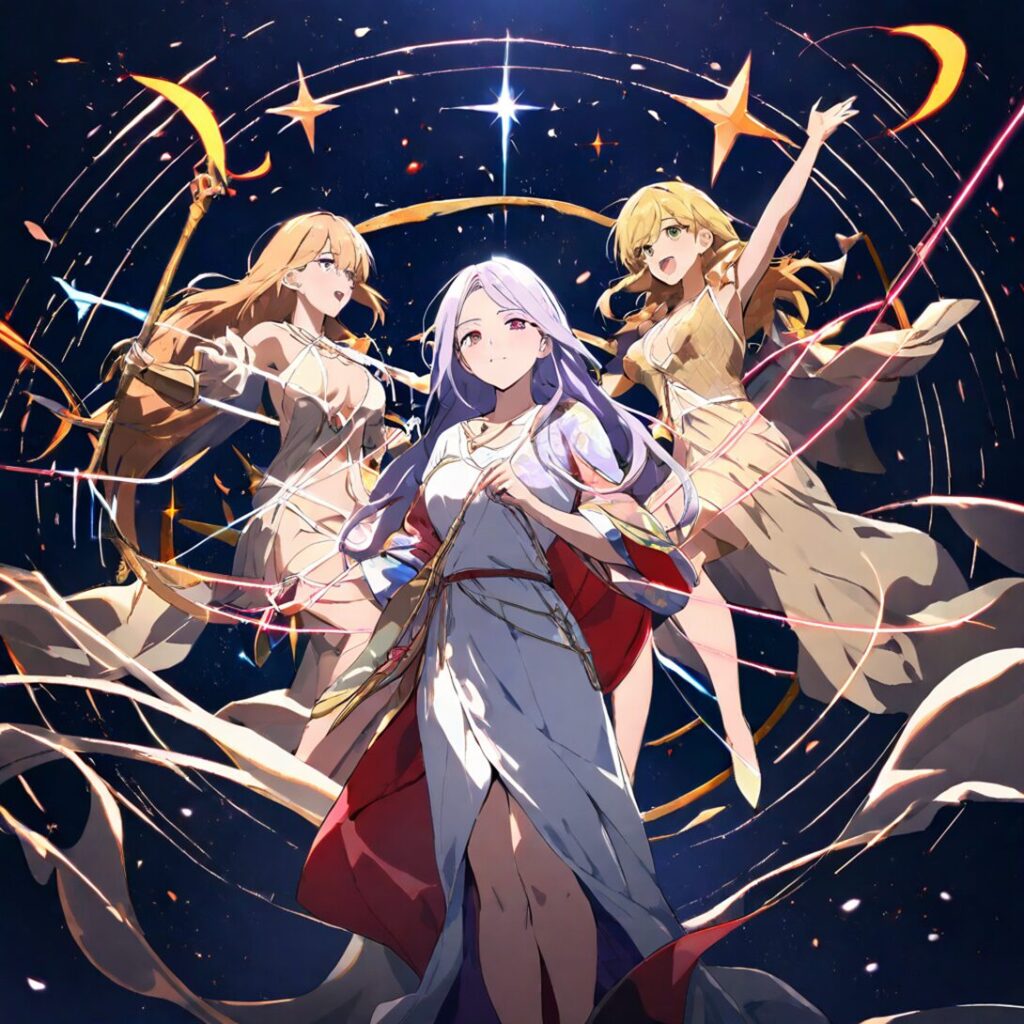
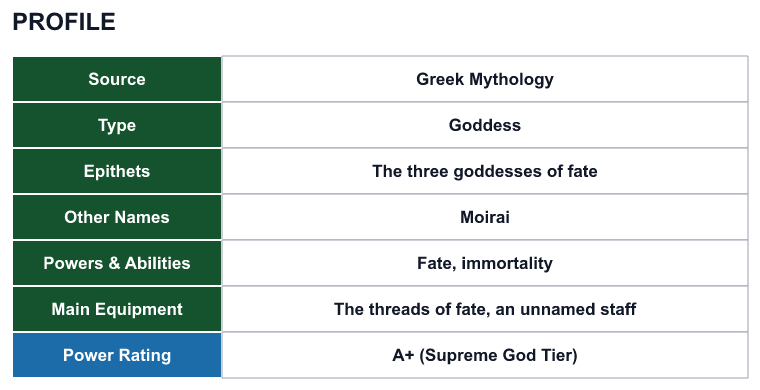
Rank 49: The Moirai (Greek Mythology)
🧵 What happens if The Moirai fights the other gods?
I built a simulator that pits the 100 entries in this ranking against each other. It opens with The Moirai already picked, and an opponent of the same tier chosen for you.
⚔ Send The Moirai into battleOverview
The Moirai are three sister goddesses of fate who appear in Greek mythology, and even Zeus cannot defy the fate they have decreed — making them beings with an authority that stands head and shoulders above all others in Greek mythology.
The Moirai operate as follows: Clotho spins the thread of fate (the beginning of life), Lachesis measures the length of the thread (the length of a life), and Atropos cuts the thread (the end of life) — together determining destiny. (They are the Norse mythology equivalent of the Norns.)
Originally, the Moirai were regarded as a single goddess, but as the myths evolved through the ages, they became a trio of sister goddesses.
For the purposes of this ranking, I struggled with how to handle them, but since the strong impression is that they function as one unit — and are essentially meaningless without all three together — I am making a special exception and evaluating them as a group in their full three-sister form.
The Moirai are goddesses of fate, but the prevailing theory is that they do not have free rein to decide fate as they please. Instead, they are said to be actualizing the destiny set by Ananke (goddess of fate and necessity), who stands above them.
Indeed, if this were not the case, there would have been no need for the wars against the Gigantomachy or Typhon — they could have simply spun the fates of the giants and Typhon and been done with it. So it is certain that their authority has limits.
On the other hand, there is the episode in which Apollo got them drunk and they changed the fate of Admetus, who was supposed to die — suggesting that a certain degree of discretion in exercising their fate is granted to them.
This is also confirmed by the episode involving Achilles, where it is depicted that they had prepared two possible fates for him in advance.
Reason for This Ranking
The three goddesses of the Moirai govern “fate” — a nearly privileged authority within Greek mythology — and even Zeus is depicted in the myths as being unable to overturn a fate decreed by the Moirai.
Furthermore, the fate governed by the Moirai does not apply only to things like where and when one dies, but encompasses the entire script of one’s life (including mundane things like whom one exchanges words with on any given day), making it an extremely versatile authority.
In modern interpretations of Greek mythology, they are often treated as subordinate to Zeus, but in older Greek mythology there is a strong theory that the Moirai were of higher standing than Zeus — which may help explain why their authority is so extraordinarily powerful.
However, the Moirai’s power over fate is not believed to be omnipotent, and in the myths they primarily determine the life and death of humans — there are no depictions of them decreeing the death of divine beings or giants.
It is probably difficult for even the Moirai to determine the fate of beings with great power or immortality, such as divine races or giants.
However, it is likely they can exert at least some influence even against opponents who are mighty gods or giants — and what hints at this is the scene where they offer Typhon “ephemeral fruits” to eat.
While it may look like the Moirai acting with quick thinking, the fact that they could do so because they foresaw either Typhon’s or their own fate makes it a rather convincing scene.
Incidentally, the three goddesses of the Moirai may look like they have strong fate-governing abilities but weak direct combat power — but in the Gigantomachy, they actively fought and beat down powerful giants like Agrios and Thoon with bronze clubs, suggesting their direct combat power is also among the upper tier of the Greek pantheon.
Furthermore, by using their power to manipulate fate to gain even a slight advantage for themselves against opponents of equal or greater strength, I judged them capable of matching even the highest-tier gods — and placed them at this position in the ranking.
About the Book
I wrote a book that compiles this entire ranking! The reasoning behind each placement is grounded in the actual lore and episodes from each mythology, so I think it makes for a fairly convincing read.
The book also contains many columns and extras not published on this blog, so if you are interested, please check it out below.

Also popular with readers
📚 Series: Mythology Power Ranking (Individual Characters) (52/100)