Mythology & Religion Power Ranking TOP100
This article introduces Rank 5: Shiva from the “Mythology & Religion Power Ranking TOP100”, which ranks the gods, monsters, and heroes of world mythology, religion, and legend in order of strength.
If you want to see the full TOP100 list and the criteria behind the rankings, check out the overview article below.
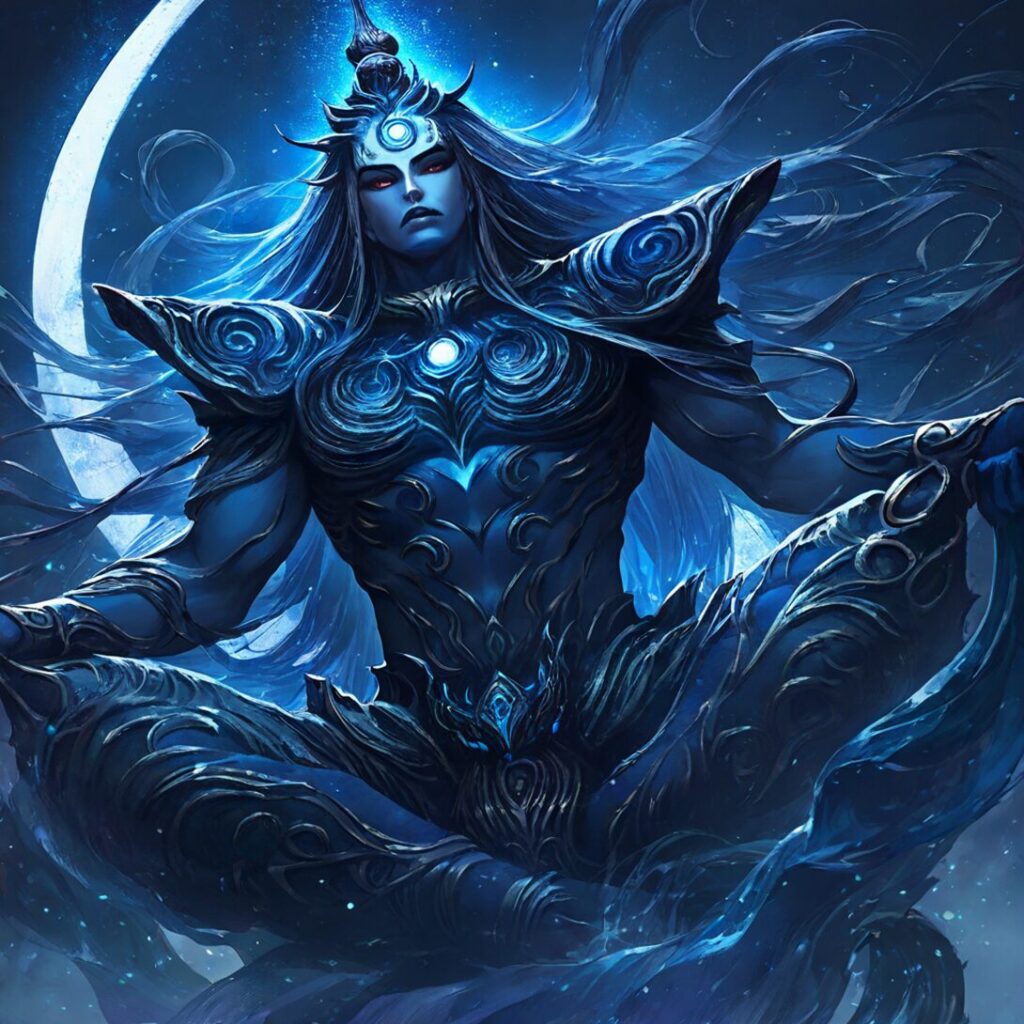
Rank 5: Shiva (Indian Mythology / Hinduism)
🔱 What happens if Shiva fights the other gods?
I built a simulator that pits the 100 entries in this ranking against each other. It opens with Shiva already picked, and an opponent of the same tier chosen for you.
⚔ Send Shiva into battleOverview
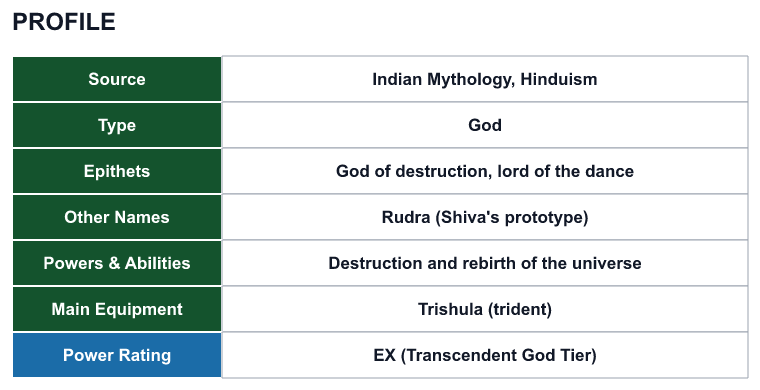
Shiva is one of the most famous and important deities in Indian mythology and Hinduism — one of the three pillars of the Trimurti (the Hindu Trinity).
Shiva is the god of destruction in Indian mythology and possesses the greatest power among its deities. His strength is said to be such that a mere dance could destroy the entire universe, making him stand in a class of his own even within the already colossal scale of Indian mythology.
Indian mythology is known for dramatically shifting how gods are depicted depending on the era, as well as an extreme escalation of divine power levels over time — and no figure illustrates this more clearly than Shiva. Here is a brief look at how Shiva’s power inflated across different periods:
■ Shiva as an example of Indian mythology’s power escalation
Vedic period: “Rudra (Shiva’s prototype) can summon storms.”
Epic period: “Shiva is a god of destruction. He is incredibly powerful and feared.”
Puranic period: “If Shiva dances, the universe ceases to exist.”
Medieval and later traditions: “If Shiva’s third eye opens, the world is annihilated.”
It’s hard not to feel like the people writing Hindu texts were just having fun at some point. Shiva’s power kept being amplified further and further, while Indra — who was once the supreme god in the Vedic period — was gradually reduced to a stepping-stone role by comparison.
Indian mythology was primarily shaped during the Vedic period (approximately 1500–500 BCE), then gradually transitioned into Hinduism through the Epic period (approximately 500 BCE – 500 CE), and became fully established as Hinduism during the Puranic period (approximately 300–1000 CE).
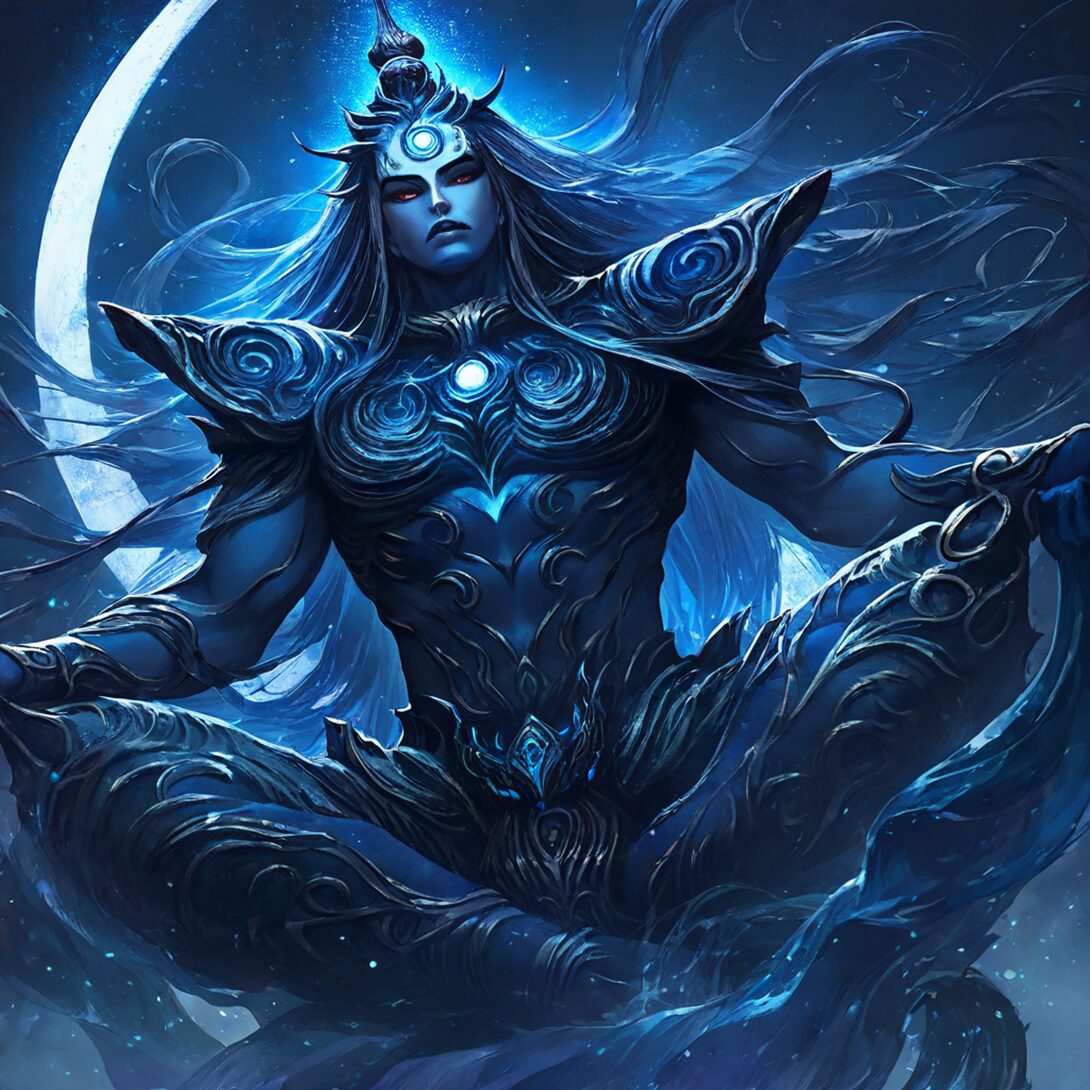
Shiva’s dance is called the “Tandava.” It symbolizes the destruction and regeneration of the universe, and when Shiva dances in anger or sorrow, the entire universe trembles and collapses — only to be reborn afterward.
His third eye on his forehead is said to emit beams of flame, and in mythology he used it to incinerate Kama, the god of love. In later traditions (post-Puranic), the power of the third eye was further amplified — even opening it was said to reduce the entire world to ash.
Shiva is also supremely powerful in direct combat. There are numerous episodes of his feats, such as single-handedly destroying all the mighty Asuras who lived in the three cities known as Tripura with a single arrow — clearly demonstrating a level of power that transcends the other deities in Indian mythology.
Ranking Reason
Shiva frequently appears in games, anime, and other media as the ultimate destroyer god, and once you hear that his mere dance can destroy the universe, it’s hard to argue against it.
Within Indian mythology, the only being that can be considered his equal is Vishnu. Brahma, despite being the other member of the Trimurti, is treated as clearly inferior to Shiva.
As for his immortality, there is the famous episode where Shiva drank the world-destroying poison “Halahala” — a venom capable of annihilating everything — and survived with nothing more than a blue-stained throat. Combined with the logical conclusion that he would survive even the destruction of the universe, it seems safe to say that the concept of death simply does not apply to Shiva.
Furthermore, one of Shiva’s avatars, “Mahakala,” is regarded as a being who controls time itself. This means Shiva transcends not only physical limitations but even high-dimensional concepts like time — making him an entity that even cosmic-scale adversaries would struggle to defeat.
Taking all of these extraordinary powers into account, I placed Shiva at this position in the ranking. As for the order between Shiva and Vishnu, who are considered equals in mythology, I gave it considerable thought — but ultimately decided that Shiva’s destructive power gives him the edge in terms of “raw strength,” placing him above Vishnu.
In reality, I believe a battle between these two would end without a decisive winner.
Some theory sites suggest that “Vishnu is superior to Shiva,” but there is no text in Indian mythology or Hinduism that explicitly states one is above the other (it is simply a matter of competing sect claims). So mythologically speaking, treating these two gods as equals is the correct approach — and I ask that you understand the ranking order here reflects the nature of this ranking rather than a definitive theological judgment.

About the Book
I wrote a book that compiles this entire ranking! The reasoning behind each placement is grounded in the actual lore and episodes from each mythology, so I think it makes for a fairly convincing read.
The book also contains many columns and extras not published on this blog, so if you are interested, please check it out below.

Also popular with readers
📚 Series: Mythology Power Ranking (Individual Characters) (96/100)