Mythology & Religion Power Ranking TOP100
This article introduces Rank 53: Verethragna from the “Mythology & Religion Power Ranking TOP100”, which ranks the gods, monsters, and heroes of world mythology, religion, and legend in order of strength.
If you want to see the full TOP100 list and the criteria behind the rankings, check out the overview article below.

Rank 53: Verethragna (Zoroastrianism)

🐗 What happens if Verethragna fights the other gods?
I built a simulator that pits the 100 entries in this ranking against each other. It opens with Verethragna already picked, and an opponent of the same tier chosen for you.
⚔ Send Verethragna into battleOverview
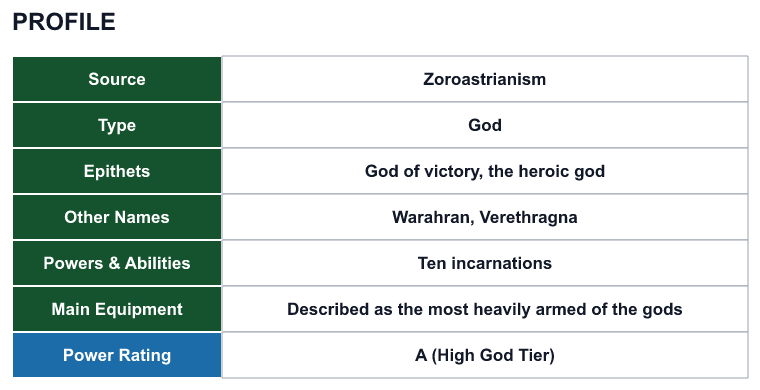
Verethragna is regarded as a divine warrior and hero god in Zoroastrianism, and is also said to be a deity who personifies “Victory” itself.
His defining power is the “Ten Transformations” — he can take on ten different forms: a 15-year-old youth, an armed warrior, a strong wind, a bull, a white horse, a camel, a boar, a phoenix, a ram, and a mountain goat.
Among these, he is most often depicted in the form of a boar guiding the contract deity Mithra.
Verethragna is ranked among the highest of the “Yazata” (lesser divine beings) of Zoroastrianism — alongside Mithra — but Zoroastrianism itself has almost no depictions of the gods fighting, and about all we can gather regarding Verethragna is that he, along with Mithra and the “Amesha Spenta” (higher divine beings), fought against Angra Mainyu and Azi Dahaka and drove them back.
Reason for This Ranking
Verethragna is the highest-ranking war god in Zoroastrianism, and his “Ten Transformations” are so iconic that they have been compared to the avatars of Vishnu in Indian mythology.
On the other hand, there are almost no episodes in the mythology in which he actually demonstrates his power — and since he is also one of the Yazata, who are ranked below the Amesha Spenta, he does feel somewhat lower in rank compared to the supreme gods of other mythologies.
Well, the Amesha Spenta are almost like fragments of the omniscient, omnipotent god Ahura Mazda, so being ranked below them may be unavoidable.
There are no clear scenes in the mythology showing his power, and much about the extent of the Ten Transformations remains uncertain — making his ranking position very difficult to determine. But considering his standing as the supreme war god of Zoroastrianism and his authority over Victory itself, he should be formidably strong in ordinary combat.
However, the evil dragon Azi Dahaka within the same mythology is described as a being not even the gods can destroy, which means Verethragna does not have the power to defeat Azi Dahaka single-handedly — taking this into account as well, I judged this position in the ranking to be appropriate.
About the Book
I wrote a book that compiles this entire ranking! The reasoning behind each placement is grounded in the actual lore and episodes from each mythology, so I think it makes for a fairly convincing read.
The book also contains many columns and extras not published on this blog, so if you are interested, please check it out below.

Also popular with readers
📚 Series: Mythology Power Ranking (Individual Characters) (48/100)