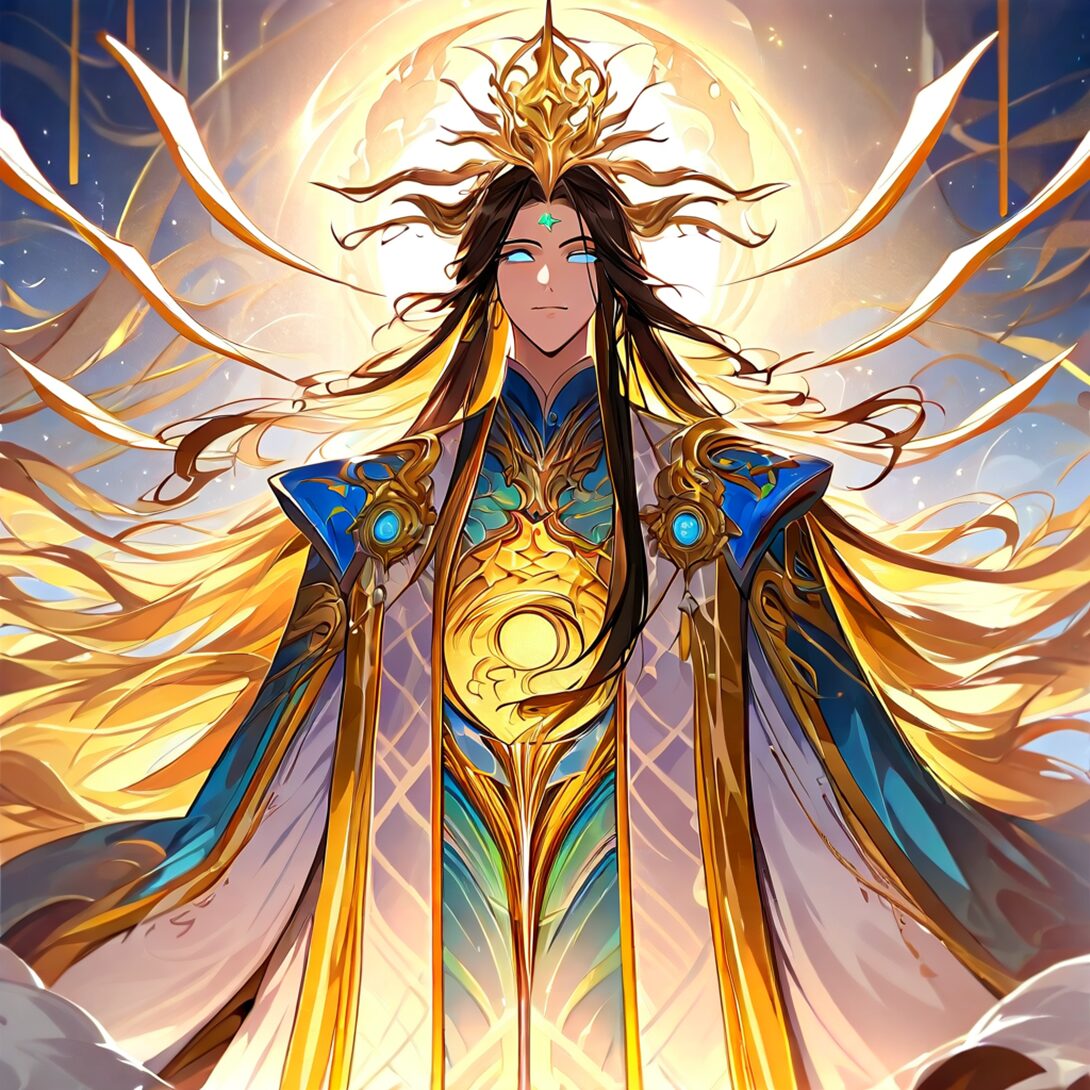
Mythology & Religion Power Ranking TOP100
This article introduces Rank 56: The Jade Emperor from the “Mythology & Religion Power Ranking TOP100”, which ranks the gods, monsters, and heroes of world mythology, religion, and legend in order of strength.
If you want to see the full TOP100 list and the criteria behind the rankings, check out the overview article below.
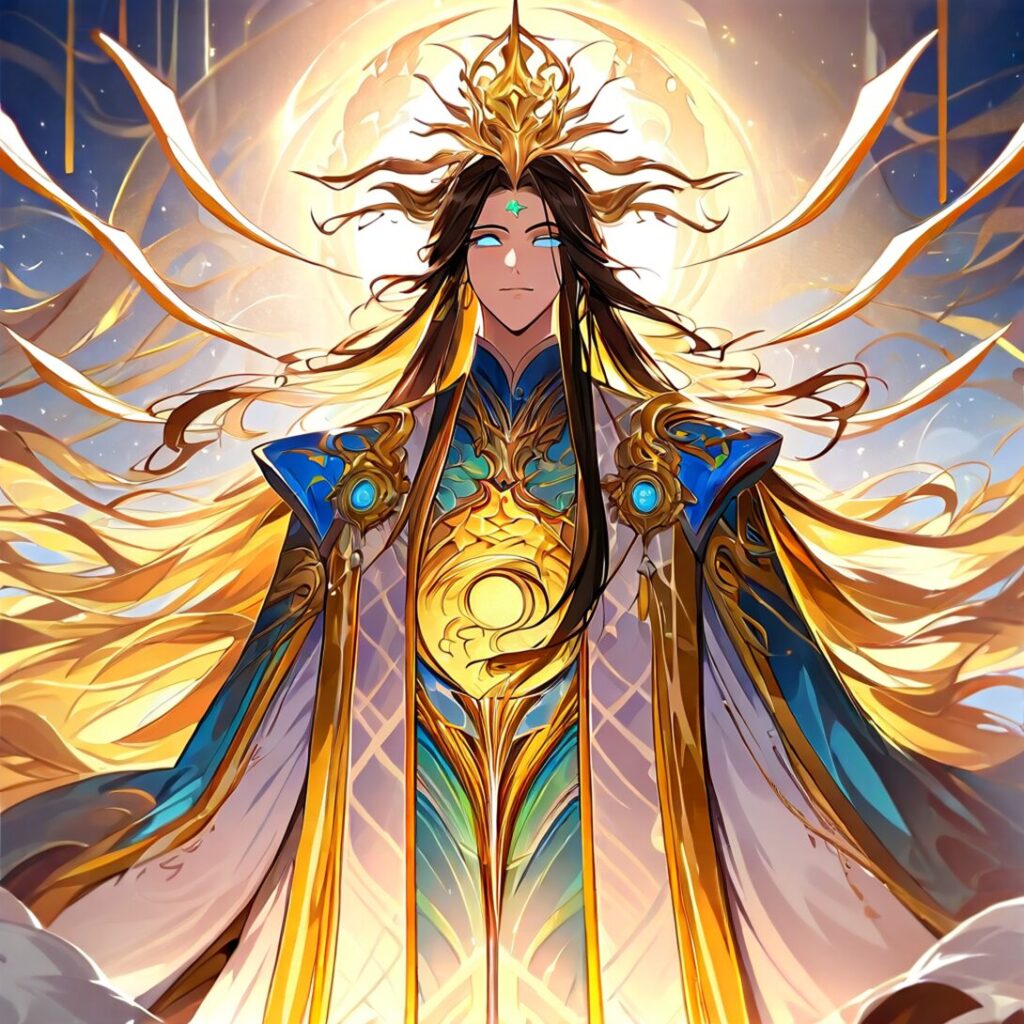
Rank 56: The Jade Emperor (Chinese Mythology)
🏯 What happens if The Jade Emperor fights the other gods?
I built a simulator that pits the 100 entries in this ranking against each other. It opens with The Jade Emperor already picked, and an opponent of the same tier chosen for you.
⚔ Send The Jade Emperor into battleOverview
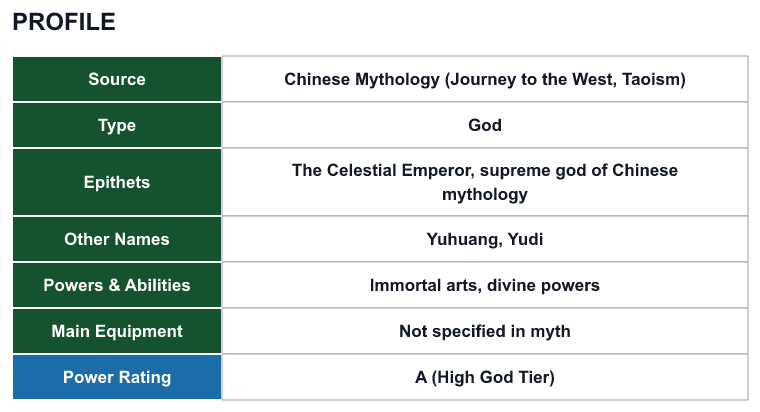
The Jade Emperor is the supreme deity of Chinese mythology and Taoism, governing Heaven (the realm of gods and immortals) and maintaining cosmic order.
However, while the Jade Emperor is the supreme deity of Heaven, there exists a higher divine authority above him: the “Three Pure Ones” (Yuanshi Tianzun, Lingbao Tianzun, and Daode Tianzun).
The Jade Emperor is the supreme ruler of Heaven, but the Three Pure Ones manage the universe as a whole and its fundamental laws — that is the premise of Chinese mythology.
In the mythology, the Jade Emperor often issues commands to his celestial army, but there are no scenes of him personally wielding his power — he is a deity whose symbolic authority is his primary characteristic.
However, if we treat “Journey to the West” as mythology, the episodes involving Sun Wukong do reveal something about his limits.
When the captured Sun Wukong — who had committed numerous outrages — could not be killed by any means including being hacked apart at the execution block or being burned in the Eight Trigrams Furnace, the Jade Emperor realized he was helpless and called on Shakyamuni Buddha for help.
As this shows, if the Jade Emperor’s power vastly surpassed Sun Wukong’s, he should have been able to kill or seal him himself — yet in practice he had to rely on a higher-tier being (Shakyamuni Buddha). This makes it clear that he at minimum does not possess the power to defeat Sun Wukong, and is undoubtedly weaker than Shakyamuni Buddha.
Reason for This Ranking
Much like Amaterasu in Japanese mythology, the Jade Emperor is a prime example of a deity with an extremely high mythological rank but uncertain combat ability.
He is extremely difficult to evaluate — based on the mythological depictions, one could even consider the possibility that he has absolutely no combat capability. Nevertheless, I think it would be a problem to simply exclude the supreme deity of Chinese mythology from the ranking, so let me think through his evaluation.
First, in Taoist tradition there is an account that the Jade Emperor accumulated merits through training as a human being before ascending to the position of supreme deity of Heaven (there is also a competing theory that he was a god from before the creation of the universe).
If the Jade Emperor genuinely attained the power to reign as supreme deity through earnest, step-by-step training, he must have reached the highest level of immortal arts among all the gods.
At the highest level, immortal arts are said to allow one to create unlimited clones, generate fire, lightning, water, and wind at a catastrophic scale, and even interfere with the laws of the universe (time and space).
The extent to which the Jade Emperor can wield these arts is unclear, but given the power it takes to rise to supreme deity, he should be able to easily overwhelm the majority of war-god-class opponents.
On the other hand, the fact that he cannot deal with Sun Wukong, combined with his non-combative nature compared to a fully martial deity like Erlang Shen, means his combat power is certainly a step below theirs.
Taking all of this into account, I placed the ranking at this position.
About the Book
I wrote a book that compiles this entire ranking! The reasoning behind each placement is grounded in the actual lore and episodes from each mythology, so I think it makes for a fairly convincing read.
The book also contains many columns and extras not published on this blog, so if you are interested, please check it out below.

Also popular with readers
📚 Series: Mythology Power Ranking (Individual Characters) (45/100)