Mythology & Religion Power Ranking TOP100
This article introduces Rank 6: Vishnu from the “Mythology & Religion Power Ranking TOP100”, which ranks the gods, monsters, and heroes of world mythology, religion, and legend in order of strength.
If you want to see the full TOP100 list and the criteria behind the rankings, check out the overview article below.
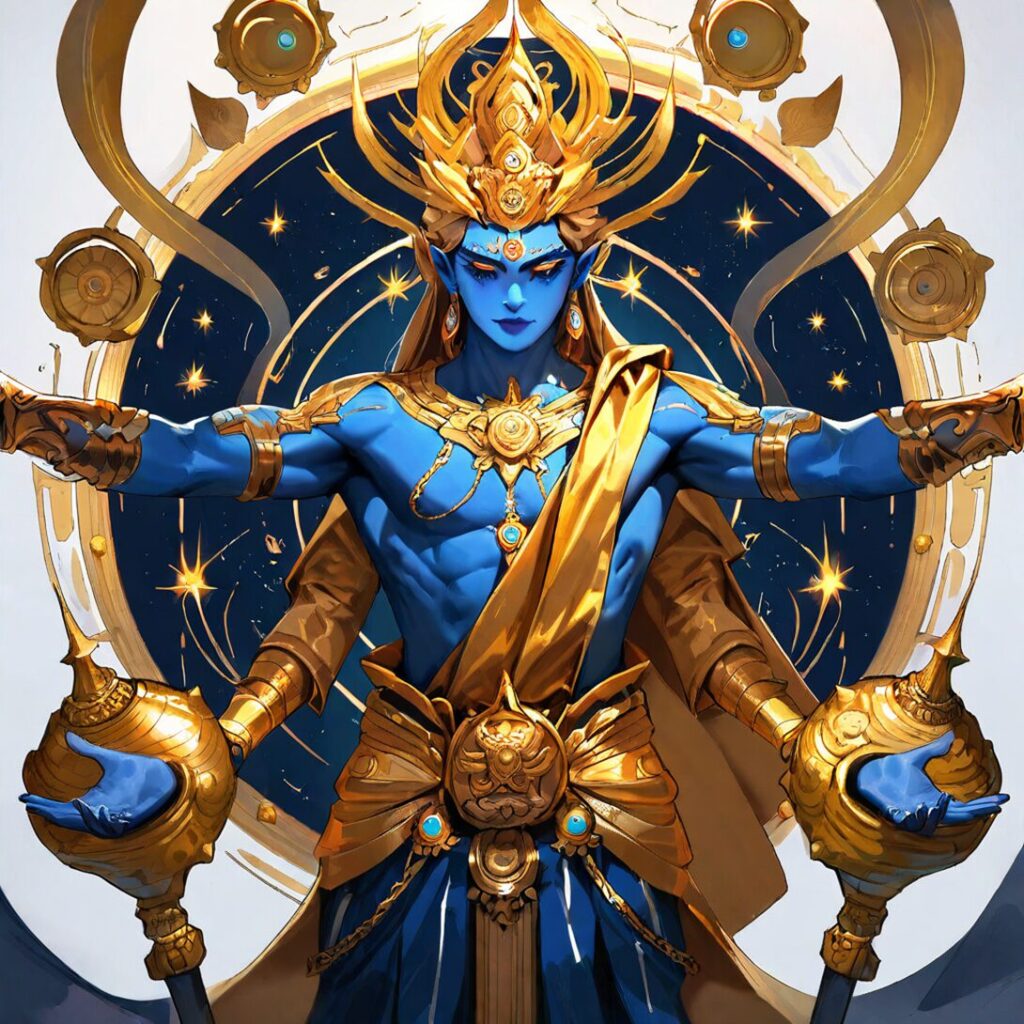
Rank 6: Vishnu (Indian Mythology / Hinduism)
🪷 What happens if Vishnu fights the other gods?
I built a simulator that pits the 100 entries in this ranking against each other. It opens with Vishnu already picked, and an opponent of the same tier chosen for you.
⚔ Send Vishnu into battleOverview
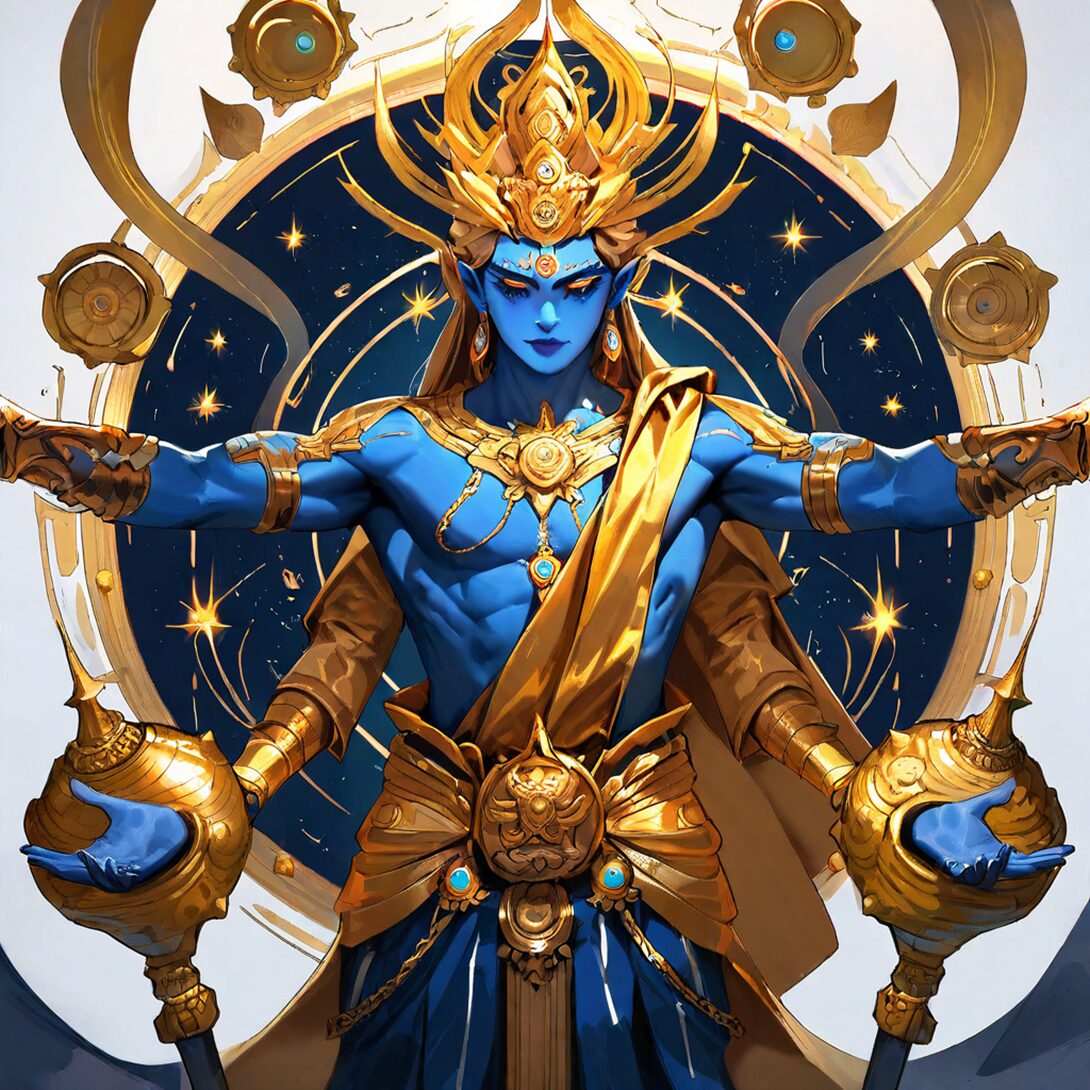
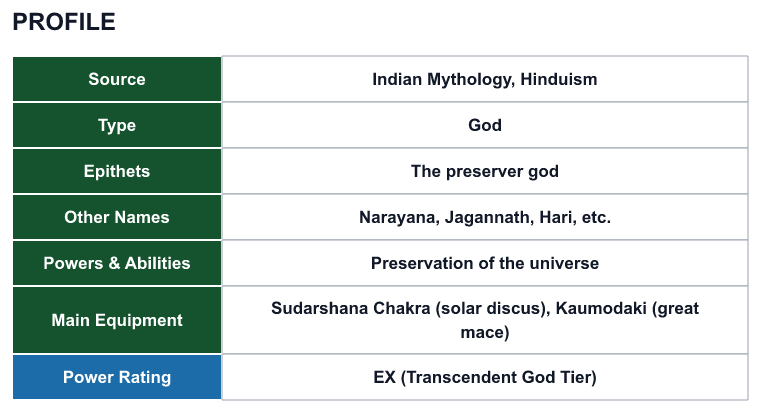
Vishnu is known in Indian mythology and Hinduism as the preserver deity — one of the three pillars of the Trimurti (the Hindu Trinity) alongside Brahma (the creator) and Shiva (the destroyer).
Vishnu’s primary role is to maintain the harmony of the universe and bring salvation when it faces the crisis of collapse.
When bringing salvation, he typically descends to the earth in the form of an “Avatara (avatar/incarnation).” In this ranking, avatars are treated as partial expressions of the original deity’s power, so the famous avatars of Indian mythology are considered extensions of Vishnu’s own strength.
One famous episode involving Vishnu: against the mighty Asura king Bali, who had defeated Indra and come to rule the three worlds (heaven, earth, and the underworld), Vishnu disguised himself as a dwarf and asked Bali for “as much land as I can cover in three steps.” Bali agreed, thinking three steps of a dwarf was nothing. Vishnu then revealed his true form and covered the heavens, the earth, and then pushed Bali down into the underworld with his third step. From this, Vishnu came to be worshipped as a god so mighty that three strides span the entire world.
Vishnu has countless avatars, but ten in particular are said to possess especially great power (the Dashavatara). Among the most famous of these are Prince Rama (the protagonist of the Ramayana) and Krishna (the hero who appears in the Mahabharata).
He has also manifested in animal forms, such as a fish (Matsya), a tortoise (Kurma), and a boar (Varaha). Interestingly, the Buddha — founder of Buddhism — is also considered one of Vishnu’s avatars, albeit in the role of a being who deceives and misleads demons.
Kalki, the tenth and final avatar, is said to wield power over time itself, destined to destroy all evil in the universe and usher in a golden age — making him an extraordinarily powerful being on a cosmic scale.
Ranking Reason
While Vishnu is considered equal to Shiva, episodes of Vishnu fighting directly are extremely rare in mythology. He typically acts through his avatars rather than descending personally, which makes his raw power harder to gauge compared to Shiva.
Krishna is the avatar who most fully embodies Vishnu’s power, and while he has defeated countless Asuras and armies, he has generally only demonstrated power on par with high-ranking gods rather than exhibiting something far beyond them.
However, when Krishna showed Arjuna the “Vishvarupa” — Vishnu’s true universal form — Arjuna understood that “within that god are contained infinite worlds divided in manifold ways.” Vishnu himself declared, “I am the force that destroys the world, and I am time itself.” This confirms that Vishnu, like Shiva, possesses both the power to destroy the world and the ability to transcend time.
There is even a theory that the current universe is nothing more than a fleeting dream Vishnu is having, which would place him far above the level of any world or universe.
Taking all of these factors into account, I placed Vishnu at this position in the ranking.
About the Book
I wrote a book that compiles this entire ranking! The reasoning behind each placement is grounded in the actual lore and episodes from each mythology, so I think it makes for a fairly convincing read.
The book also contains many columns and extras not published on this blog, so if you are interested, please check it out below.

Also popular with readers
📚 Series: Mythology Power Ranking (Individual Characters) (95/100)