Mythology & Religion Power Ranking TOP100
This article introduces Rank 61: Amaterasu from the “Mythology & Religion Power Ranking TOP100”, which ranks the gods, monsters, and heroes of world mythology, religion, and legend in order of strength.
If you want to see the full TOP100 list and the criteria behind the rankings, check out the overview article below.
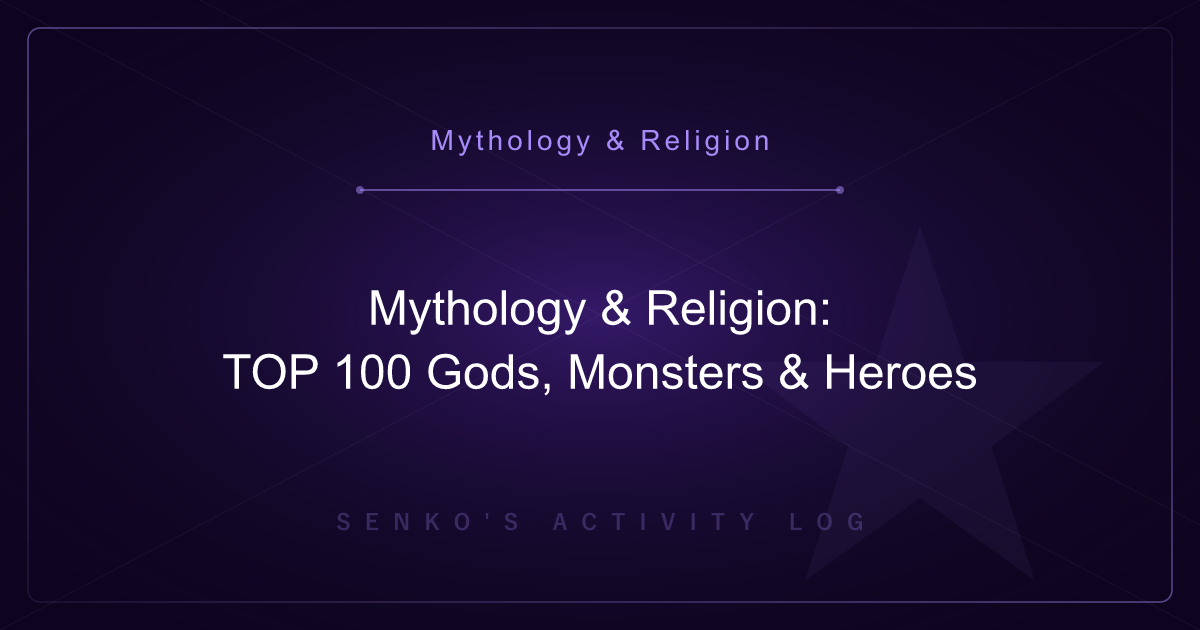
Rank 61: Amaterasu (Japanese Mythology)
🌅 What happens if Amaterasu fights the other gods?
I built a simulator that pits the 100 entries in this ranking against each other. It opens with Amaterasu already picked, and an opponent of the same tier chosen for you.
⚔ Send Amaterasu into battleOverview
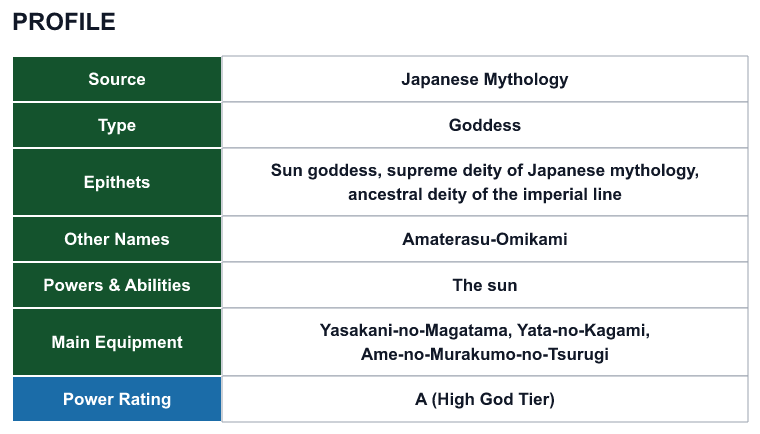
Amaterasu is the supreme deity of Japanese mythology. Among the gods born from Izanagi, she holds the highest divine rank as one of the “Three Noble Children (Mihashira no Uzu no Miko),” and she is also the goddess of the sun.
She rules over Takamagahara (the High Plain of Heaven), the realm of the gods, and is responsible for maintaining order throughout the entire world, including the earthly realm.
She is also revered as the ancestral deity of the imperial family, the symbol of Japan, who are said to be her descendants.
Although there are no scenes in the myths where she directly fights (in fact, Japanese mythology rarely depicts gods fighting at all), one episode that illustrates the magnitude of her divine power is the “Ama-no-Iwato” (Cave of Heaven) incident.
In this myth, Amaterasu became enraged at her brother Susanoo’s violent behavior and retreated into a cave called Ama-no-Iwato. The moment she withdrew, the sun disappeared and the world was plunged into darkness.
This makes it clear that in mythology, Amaterasu is not so much a deity who “controls” the sun, but rather is treated as the sun itself.
Why This Ranking
Amaterasu is a particularly difficult deity to evaluate. As the supreme deity of Japanese mythology, her divine status is equivalent to that of Zeus in Greek mythology, Ra (or Amun) in Egyptian mythology, or Odin in Norse mythology.
However, Japanese mythology has very few scenes where gods battle, and Amaterasu herself, rather than directly punishing her brother Susanoo for his rampage in Takamagahara, responds by angrily retreating into a cave — a reaction that feels very relatable to modern Japanese people.
This is said to reflect Japan’s cultural and religious worldview, which values harmony among the eight million gods (yaoyorozu no kami) above all else.
Coming back to the ranking: I considered excluding deities like Amaterasu who have no combat depictions entirely, but felt that omitting the supreme deity of a mythology altogether would be a problem, so I worked her into the ranking somehow.
The grounds for assessing Amaterasu’s strength include: “supreme deity of Japanese mythology,” “divine authority that can be equated with the sun itself,” “one of the Three Noble Children, the highest rank in Japanese mythology,” and “equal to or above Susanoo, the strongest war god and fellow member of the Three Noble Children.”
Incidentally, within her episode with Susanoo, when Susanoo arrived at Takamagahara, she misunderstood it as an attack and armed herself to meet him — so it is certain that Amaterasu is not entirely incapable of fighting.
In general, gods with higher divine rank and hierarchy in mythology tend to be stronger, but in the case of Japanese mythology, that alone makes it difficult to judge.
That said, a deity with little power would never be recognized as the supreme god by the other gods. And as a member of the Three Noble Children alongside Susanoo, the strongest war god of Japanese mythology, her power should be at a similar level. Above all, if she were to use her authority as the sun itself in actual combat, I believe she could likely destroy war-god-class deities without them even standing a chance.
Taking all of this into consideration, I placed her at this position in the ranking. It is also worth noting that in Japanese mythology, gods are said to possess both a “rough soul (aramitama)” and a “gentle soul (nigimitama)” — meaning gods have both a fierce and a peaceful side.
In the myths, Amaterasu only shows her “gentle side,” but in a real battle, her “rough side” would likely be unleashed.
If there had been a scene in the myths where Amaterasu displayed overwhelming power through her aramitama, her ranking would have been different — and her true power may well be on par with Zeus or Ra.
About the Book
I wrote a book that compiles this entire ranking! The reasoning behind each placement is grounded in the actual lore and episodes from each mythology, so I think it makes for a fairly convincing read.
The book also contains many columns and extras not published on this blog, so if you are interested, please check it out below.

Also popular with readers
📚 Series: Mythology Power Ranking (Individual Characters) (40/100)