Mythology & Religion Power Ranking TOP100
This article introduces Rank 64: Yamata no Orochi from the “Mythology & Religion Power Ranking TOP100”, which ranks the gods, monsters, and heroes of world mythology, religion, and legend in order of strength.
If you want to see the full TOP100 list and the criteria behind the rankings, check out the overview article below.
Rank 64: Yamata no Orochi (Japanese Mythology)
🐉 What happens if Yamata no Orochi fights the other gods?
I built a simulator that pits the 100 entries in this ranking against each other. It opens with Yamata no Orochi already picked, and an opponent of the same tier chosen for you.
⚔ Send Yamata no Orochi into battleOverview
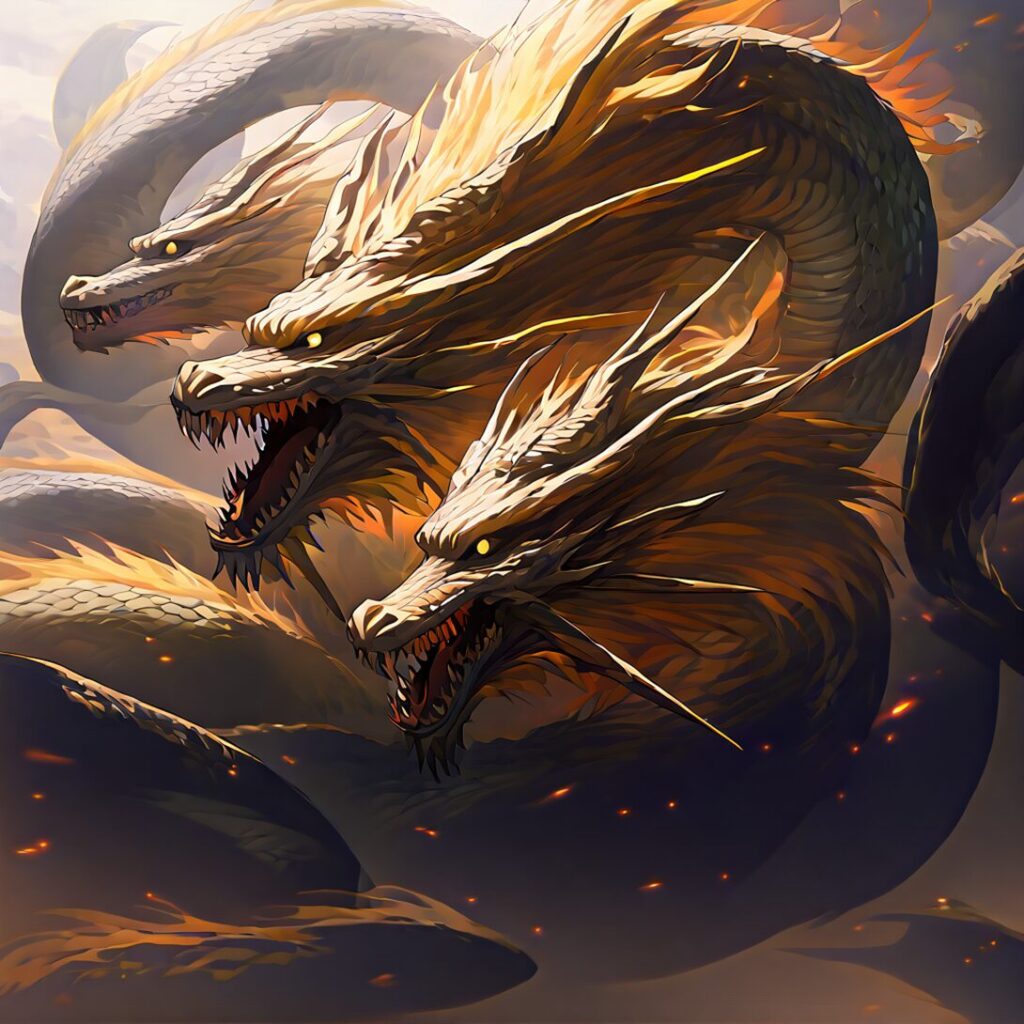
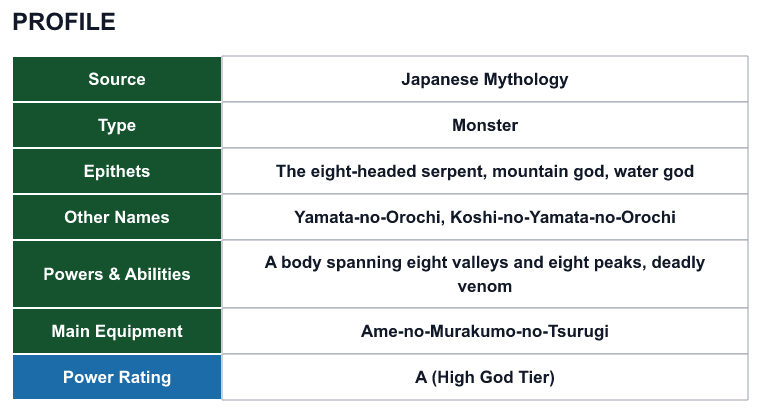
Yamata no Orochi is the greatest and most powerful monster in Japanese mythology, famous for its form as a giant serpent with eight heads and eight tails. Though commonly treated as a monster, it is said to have originally been a mountain god or water deity, and some traditions even claim it fathered children with humans.
Yamata no Orochi is described as “so vast it spans eight valleys and eight peaks,” with an estimated length exceeding 10 kilometers — making it a creature of unparalleled size even when compared to every mythology in the world combined.
According to some accounts, it could also breathe poison, potentially possessing the deadly toxic power of creatures like the Hydra.
In the myths, Yamata no Orochi is depicted as having an unmatched love of sake, and it was slain by Susanoo while it was drunk and sleeping — with each head and tail cut off one by one. For a creature that seems on paper to be an undeniable powerhouse, its defeat was decidedly undignified.
Japanese mythology rarely depicts gods fighting seriously, and this kind of “trick the enemy into lowering their guard” approach is standard, which is why the sheer power of these beings rarely comes through clearly.
Incidentally, inside Yamata no Orochi’s body (specifically its tail) was said to be the Ama-no-Murakumo-no-Tsurugi (also known as Kusanagi-no-Tsurugi), one of the Three Imperial Treasures of Japanese mythology. Some say that Yamata no Orochi’s abnormal size and power were influenced by this divine artifact.
Why This Ranking
Yamata no Orochi had been devouring young women of divine families in the Izumo region every year, and the fact that no gods could stop it tells us clearly that this was a monster beyond the reach of ordinary deities.
Its greatest characteristic is its impossibly vast body. A creature over 10 kilometers long would be extraordinarily difficult for even the gods of various mythologies to defeat in direct combat.
A similar monster in Greek mythology is the Hydra, but judging from its battle scenes with Hercules, the Hydra appears to be at most tens of meters long — the difference in scale is incomparable.
However, Yamata no Orochi has few notable traits beyond its sheer size. The fact that it was killed by having all its heads and tails severed suggests its immortality is even lower than the Hydra’s. The poison breathing, too, is barely described — so even if it existed, it was probably not as formidable as the Hydra’s venom (though it’s possible it simply had no effect against Susanoo).
Its direct combat capability is unclear in many respects, but given its colossal size and the fact that no gods other than Susanoo could defeat it, it’s fair to say that even an ordinary war god would be no match for it.
That said, with no weapons beyond its sheer bulk, it would struggle to defeat gods of high divine rank, and would likely fail to withstand the attacks of top-tier deities. For these reasons, I placed it at this position in the ranking.
It should be noted that its immortality and poison may have simply not been able to manifest because it was put to sleep by a special sake, so it’s possible it was actually much more powerful. However, due to insufficient mythological episodes, I cannot evaluate it any higher.
About the Book
I wrote a book that compiles this entire ranking! The reasoning behind each placement is grounded in the actual lore and episodes from each mythology, so I think it makes for a fairly convincing read.
The book also contains many columns and extras not published on this blog, so if you are interested, please check it out below.
Also popular with readers
📚 Series: Mythology Power Ranking (Individual Characters) (37/100)