Mythology & Religion Power Ranking TOP100
This article introduces Rank 83: Dagda from the “Mythology & Religion Power Ranking TOP100”, which ranks the gods, monsters, and heroes of world mythology, religion, and legend in order of strength.
If you want to see the full TOP100 list and the criteria behind the rankings, check out the overview article below.
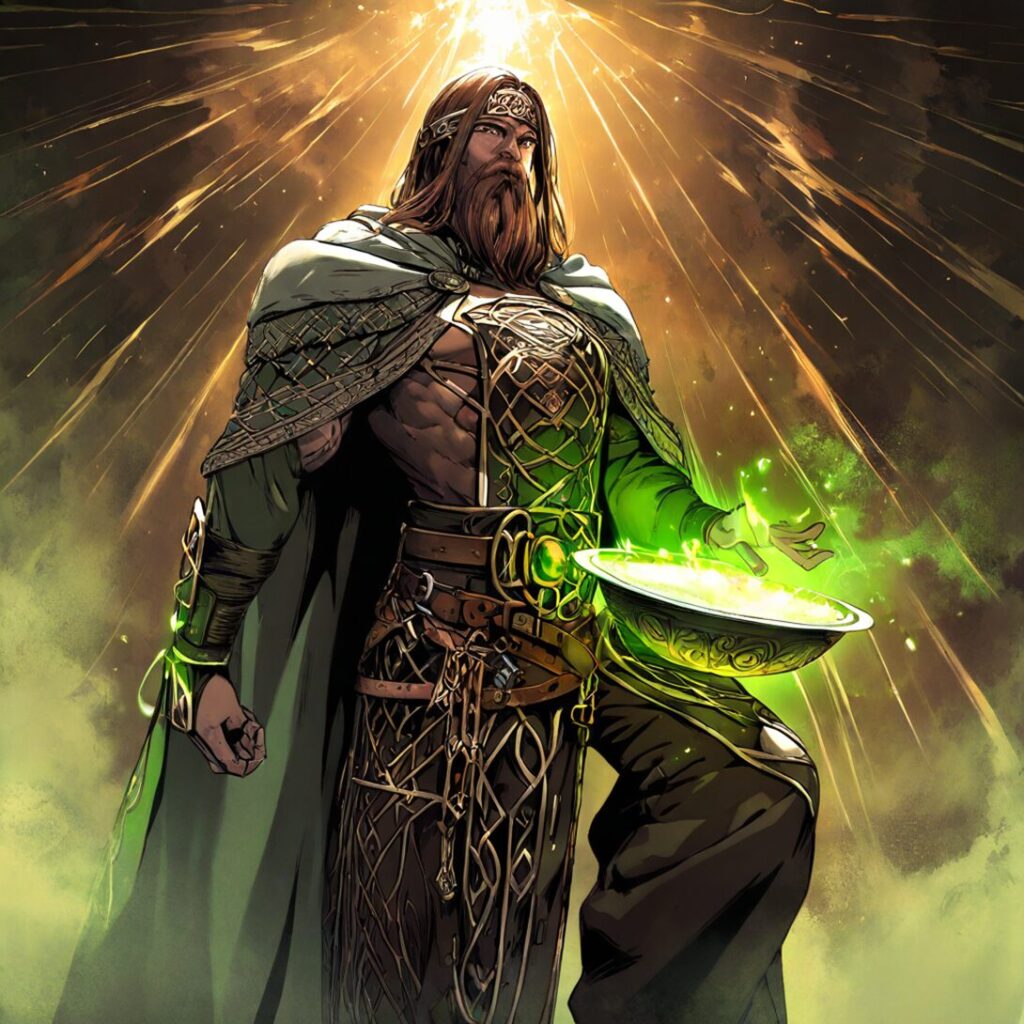
Rank 83: The Dagda (Celtic Mythology)
🍲 What happens if Dagda fights the other gods?
I built a simulator that pits the 100 entries in this ranking against each other. It opens with Dagda already picked, and an opponent of the same tier chosen for you.
⚔ Send Dagda into battleOverview
The Dagda is frequently treated as the supreme deity of the Tuatha Dé Danann (Tribe of Danu) in Celtic mythology, and his role as a king who oversees the druids (priests) is more heavily emphasized than his role as a warrior.
The gods of Celtic mythology are extremely long-lived (surviving for hundreds to thousands of years) but are not immortal, so leadership changes are relatively frequent.
Within the Tuatha Dé Danann, Nuada became the first king, followed by the god of light Lugh, then the Dagda, then further kings in succession, until the tribe was ultimately defeated by the Milesians and retreated underground. For this reason, Celtic mythology lacks a single undisputed supreme deity comparable to Zeus, Odin, Amaterasu, or the Jade Emperor.
As a result, the gods of Celtic mythology inevitably feel like little more than extended human beings, and their power tends to be evaluated on the lower end — though this is simply an inherent characteristic of this mythology.
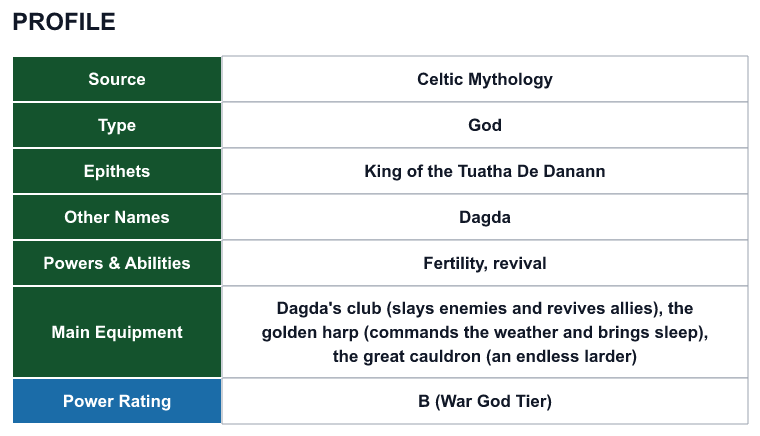
The Dagda has a less prominent martial aspect than deities like the god of light Lugh or Nuada, and in terms of pure combat power he is probably inferior to them. However, the Dagda’s club has one end that can kill with a strike and another end that can revive allies.
He also possesses a golden harp whose music can control the weather and put listeners to sleep. Additionally, the Dagda’s Cauldron — one of the Four Treasures of the Tuatha Dé Danann — can produce an infinite supply of food.
With these tools at his disposal, the Dagda served as a versatile deity who could handle everything from combat to music to food production single-handedly.
Why This Ranking
The Dagda occupies the position closest to a supreme deity in Celtic mythology, but that does not necessarily make him the most powerful deity.
He fought alongside Nuada and Lugh from the earliest battles against the Fir Bolg and Fomorians, but unlike them he displays little battlefield valor, and in terms of combat power he is likely somewhat below them.
Furthermore, while the effects of the Dagda’s club are impressive, it is an enormously large club — and since the Dagda is described as a fat, stout man, his speed is likely very low, making it almost impossible to land a direct hit on any opponent of comparable or higher ability.
And since Celtic gods have low immortality as well, taking all of this into consideration, I concluded that this position in the ranking is appropriate.
About the Book
I wrote a book that compiles this entire ranking! The reasoning behind each placement is grounded in the actual lore and episodes from each mythology, so I think it makes for a fairly convincing read.
The book also contains many columns and extras not published on this blog, so if you are interested, please check it out below.

Also popular with readers
📚 Series: Mythology Power Ranking (Individual Characters) (18/100)