Mythology & Religion Power Ranking TOP100
This article introduces Rank 88: King Arthur from the “Mythology & Religion Power Ranking TOP100”, which ranks the gods, monsters, and heroes of world mythology, religion, and legend in order of strength.
If you want to see the full TOP100 list and the criteria behind the rankings, check out the overview article below.
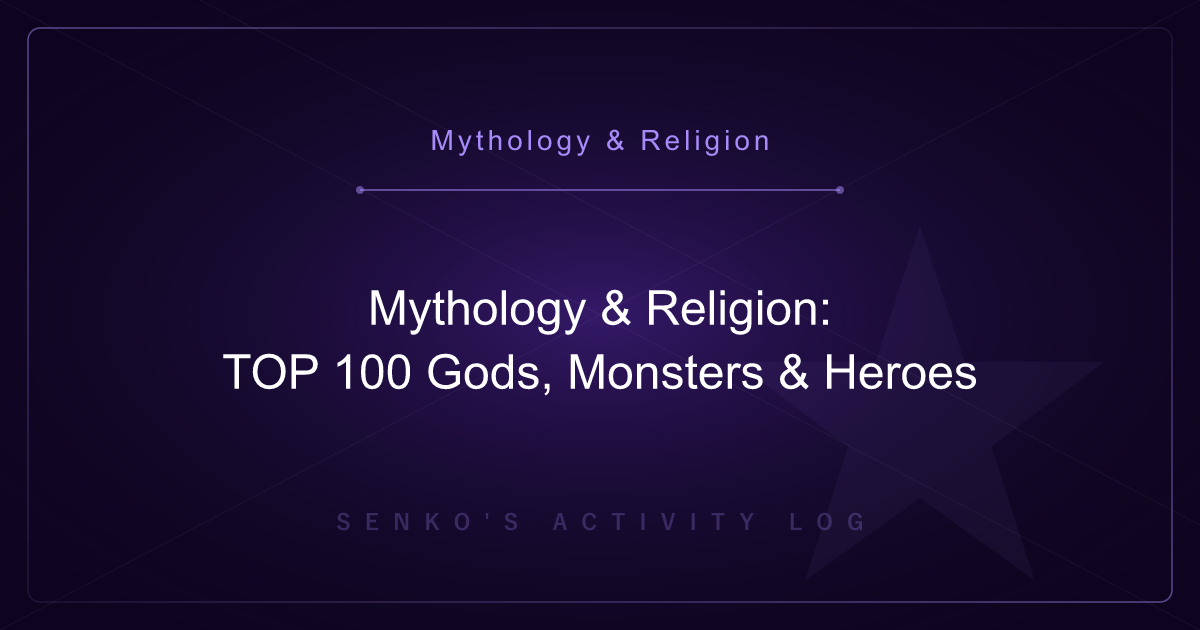
Rank 88: Arthur (Western Legend / Arthurian Legend)
👑 What happens if King Arthur fights the other gods?
I built a simulator that pits the 100 entries in this ranking against each other. It opens with King Arthur already picked, and an opponent of the same tier chosen for you.
⚔ Send King Arthur into battleOverview
Arthur is a legendary king of Britain (present-day England) who may have been a real historical figure.
He is also well known for the legend of drawing a sword from a stone to become king (the Sword in the Stone), and for leading a band of heroes called the “Knights of the Round Table” — tales that remain enormously popular to this day.
However, his legends are said to have been heavily embellished by later generations, and many elements drawn from Norse mythology were incorporated as well, which is why he has come to be passed down as a legend — occupying a middle ground between history and mythology.
King Arthur has relatively few legends showcasing his personal valor. In terms of pure knightly combat, he is often considered inferior to Lancelot, the greatest of the Round Table knights.
Even so, there are stories that establish Arthur himself as possessing superhuman strength: he single-handedly slew the giant of Mont Saint-Michel, whom even armies could not defeat; and in the Battle of Badon Hill against the Saxons, there is a legend that he personally killed 960 men — making it clear that he was without question a first-rate warrior.
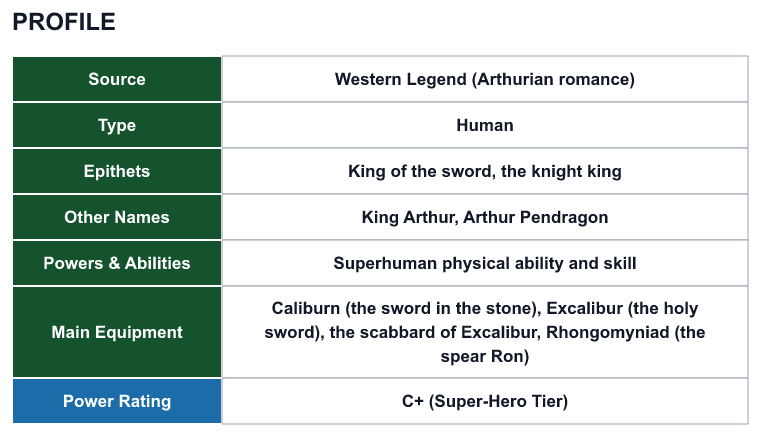
The “Holy Sword Excalibur” — famous in its own right, perhaps more so than Arthur himself — is a magical sword given to him by the Lady of the Lake. It never breaks, never loses its edge, shines like a thousand torches gathered together, and is said to cleave through anything.
Even more powerful than Excalibur is its scabbard, which renders whoever carries it “immortal.” In other words, whoever possesses both the holy sword and its scabbard becomes an invincible being.
Indeed, at the final battle known as the “Battle of Camlann,” the scabbard had been lost (reportedly stolen by an enemy), and Arthur fought with the spear Rhongomyniad instead — sustaining a fatal wound and later dying.
Why This Ranking
King Arthur is one of the most famous heroes in existence, but without his equipment his raw combat power is only at an ordinary hero level.
However, since this ranking evaluates characters at their peak, when King Arthur is assessed in a state where both the holy sword and its scabbard are fully available, he ranks among the very top of heroes.
The reason: Excalibur and the scabbard’s combined effects are extremely powerful, and even against superior opponents, using the brute force combination of maximum attack power and immortality gives a high likelihood of winning.
Even Lancelot, the strongest of the Round Table knights, would likely struggle to defeat King Arthur when the sword and scabbard are both present — technically Lancelot might outclass him, but ultimately the immortal Arthur would cut him down.
That said, the extent of the scabbard’s immortality is ambiguous, and since many beings in other mythologies are also considered immortal, it is likely a lower grade of immortality than theirs. Moreover, even immortality can be overcome through restraint or sealing by an overwhelmingly superior opponent. For these reasons, I believe his chances against war-god-tier opponents are slim.
Taking all of this into account, I evaluated him at this position in the ranking.
About the Book
I wrote a book that compiles this entire ranking! The reasoning behind each placement is grounded in the actual lore and episodes from each mythology, so I think it makes for a fairly convincing read.
The book also contains many columns and extras not published on this blog, so if you are interested, please check it out below.
Also popular with readers
📚 Series: Mythology Power Ranking (Individual Characters) (13/100)