Masahiro Sakurai, the creator of the Kirby and Super Smash Bros. series, shares a wealth of game-development know-how on his YouTube channel “Masahiro Sakurai on Creating Games”. This article summarizes and restructures the content of that channel by topic.
That said, a summary is only an entry point. So much of the value — Sakurai’s own words, his real-world examples, his pacing, and the footage itself — can only be gotten from the videos. So please don’t stop at reading the article; I strongly encourage you to also watch the original videos embedded under each topic.
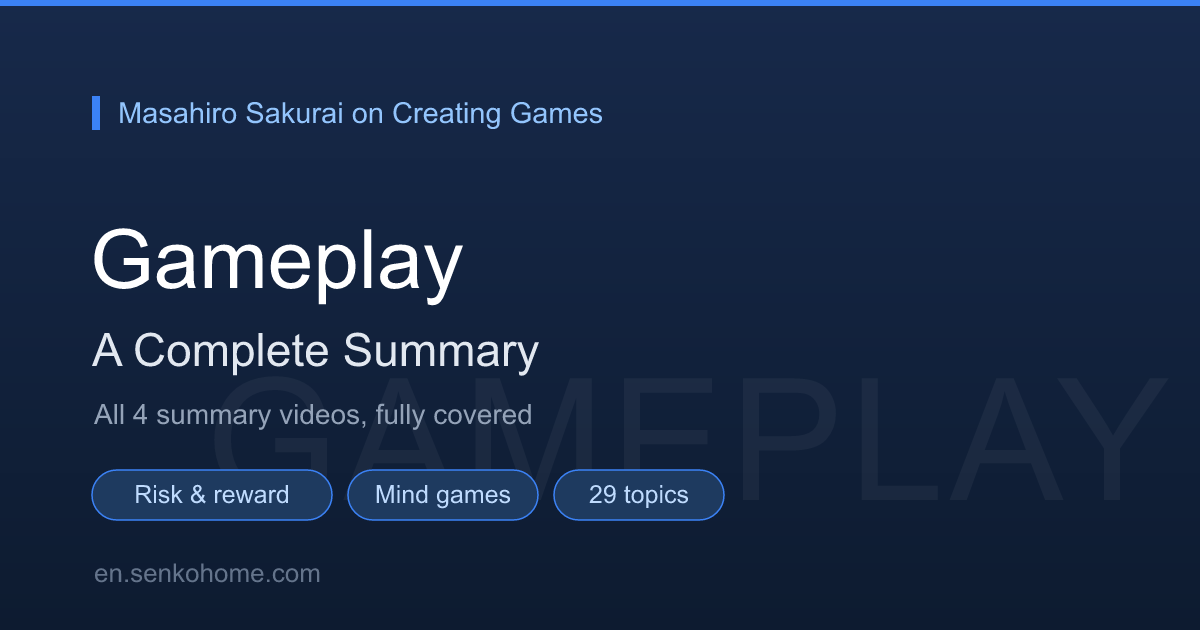
This category unravels the true nature of fun, anchored to the definition that “gameplay is risk and reward.” Here we bring together the key points of all 4 videos in the “Gameplay” category (29 individual topics), structured in 4 parts following the 4 source videos. Each part opens with its explanatory video, so please watch along.
Part 1: Reading game fun through risk and reward (#01–#06)
What is “gameplay”? This term tends to be vague, but Sakurai defines it crisply as “mind games — that is, risk and reward.” This category gets at the true nature of what makes games fun, and is especially important for developers.
https://www.youtube.com/watch?v=i7WJTzwEuFI
1. Risk and reward
“Gameplay” is a word expressing what makes a game fun. But its meaning was vague. Sakurai defines it as mind games — that is, risk and reward. This is a signature idea he has developed since going freelance around 2003.
A go-to example is Space Invaders, the shooting game that became a social phenomenon in 1978. You operate a cannon and shoot the invaders that move left and right — a simple game. Both sides fire straight, so if the horizontal axis is off, the chance of hitting is zero. He defines this state as no risk, no reward.
The closer the cannon gets to an invader, the higher the chance of being hit by their shots. Risk rises, but the chance of your attack landing — the reward — is also born. And only when you get close to the brink of death do you finally earn the reward of taking the enemy out. You take a risk to earn a reward. This is the essence of gameplay, and of mind games.
A strategy element comes in here too. If gameplay is “the fun of getting reward while holding down risk,” then strategy is “the ingenuity of getting reward while holding down risk.” It’s the difference between the system side and the player side. With Invaders, you can take them out with less risk by intercepting rather than chasing — that’s player-side strategy.
Sakurai also introduces the old-time technique “the Nagoya attack.” Just before the invaders land, it’s instant game over regardless of how many cannons remain — the maximum risk state. Yet if you get the cannon extremely close, you slip beneath where their shots emerge and don’t get hit. A sharp spec where maximum risk and maximum reward overlap (it’s likely actually a bug, but he finds it interesting that such mind games arose in this era).
The fun of “stomping enemies” in Super Mario Bros. is the same. The closer you get to an enemy, the higher the risk; jump and stomp at the peak, and only then do you get the reward of a kill. Risk and reward should be placed quite close together at an appropriate scale, woven in to be stimulating.
Note that Sakurai also holds the idea that “as gameplay rises, accessibility falls.” The original Kirby’s Dream Land, he says, is an example of deliberately lowering gameplay to raise accessibility. Gameplay is one facet of a game’s fun, not the whole thing — a point worth keeping in mind.
2. Squeeze it on, then release it fast
There’s a part of games that, on reflection, is strange. Applying stress and then resolving it is at the core of fun.
Stress itself isn’t fun. But by squeezing on stress and then releasing it fast, you get comfort and pleasure. Objectively, having no stress from the start should be more comfortable — but that wouldn’t be fun.
That said, you mustn’t pull the stress out like weeding a garden. Be it enemies, obstacles, or puzzles, give a wall you can’t pass without clearing, and provide relief by resolving it. That’s the first stage.
If you clear it well, it gets even better to hand out a reward that connects to more effective ways of resolving stress. Grow stronger with EXP and skills, outfit equipment with money, advance. Adding a little breadth of choice raises the gameplay further. Rather than imitating existing games, rethinking the original meaning can give rise to a more novel game.
3. The gameplay of RPGs
Role-playing games are a broad genre, but Sakurai narrows the gameplay discussion to two things: “movement” and “combat.”
First, movement. In an RPG, you need to step into danger zones. The deeper you go, the stronger and scarier the enemies. But because there’s a chance of greater reward, you push your luck. Push on, or retreat while it’s safe? Including the fact that being defeated means losing more loot, risk and reward hold together.
Types where you can return to safety anytime, or don’t need to think about resources, lean a bit casual. Even so, that doesn’t mean you can’t make tense play — just balance the whole, like raising the danger of a single battle.
For combat, you size up an enemy’s look and nature — “this one looks weak to fire” — and if your guess works out, it becomes experience. That’s the player’s experience. Hitting an enemy’s weakness to get a better result with the same force is strategy, and gameplay. But players won’t necessarily think that far, so when going casual, sometimes it’s better not to overdo it. Persona and the like are fine examples — landing a weakness lets you keep attacking, so the system itself encourages exploiting weaknesses, and it’s tuned with good rhythm.
4. Fun beyond gameplay
Something I want to convey early: the fun of a game does not equal gameplay. Gameplay is part of a game’s fun, and games have great diversity. Sakurai lists seven genres whose fun doesn’t rely on gameplay.
Briefly: ① the fun of the controls themselves, freed from real-world physics inside the monitor; ② adventure / sound novels where the fun of advancing the story comes first; ③ movies / story, which can be attached regardless of genre; ④ licensed / character works as products for fans; ⑤ recreating real-world motifs to enjoy make-believe in a pseudo-world; ⑥ crafting, fun just by building; ⑦ rhythm games rooted in a primal joy.
For example, in a ⑤ train game, sounding the door opening and footsteps of passengers when you reach a station — even though the program only plays one or two sound effects — lets the player sense the worldview beyond the monitor. By getting close to reality, players take in more information than is literally expressed.
The genre he excluded after deliberation is sports. Real sports always have some kind of mind game, and the moment you recreate one on a computer, it already possesses gameplay. Each kind of fun isn’t 0 or 1; they connect fuzzily, with no clear boundary. Being able to honestly feel and digest what’s fun broadens what you can make.
5. The Fiend’s Cauldron
For game difficulty, most let you pick from Easy, Normal, Hard. Against that, Sakurai made a sharp system from a gameplay standpoint in Kid Icarus: Uprising: the “Fiend’s Cauldron.”
At the start of a stage, the Fiend’s Cauldron appears and you set your Intensity. The baseline is 2.0. Pour in Hearts (money) and the Intensity keeps rising; difficulty rises and enemies get tougher, but in exchange, if you clear it you get more Hearts and stronger weapons and powers.
Make a mistake and you spill some of the cauldron’s Hearts; on continue, difficulty drops but rewards get harder to earn too. If it’s too hard, you can lower the Intensity to make it easier. Go high-risk and you get high reward — a novel system that folds risk and reward into difficulty selection. Since difficulty drops on its own when you lose, you rarely get stuck, and there’s no humiliating “shall we switch to Easy?” prompt.
He honestly reflects on its problems, too. There’s a constant sense of being pushed to the edge, so it doesn’t easily become casual. Stages too wide, too many enemies, and not enough communication that lowering Intensity also lowers difficulty. He wishes he’d done more to ease beginners in. Still, as one form of difficulty design, it remains a sharp mechanism worth referencing.
6. Allow cheating
Strategy is play about how the player can avoid losing out and come out ahead. Broken down, there’s also a way to play where you take a bigger loss in exchange for an even bigger gain. It roughly applies to any game with mind games — action, FPS, fighting, RPG, simulation, puzzle, and so on.
Here Sakurai makes an interesting point. Because games are made of complex combinations, a little “cheat” — a one-sided gain — can become possible. Like staking out a certain spot in Dark Souls where enemies self-destruct and you profit in souls.
Such balance-breakers tend to get carefully squashed during debugging. But these are the very things that turn out to be fun and memorable. Even Dragon Quest has the obviously lucrative Metal Slime hunting. Done poorly it can let you skip many battles, but it’s clearly fun and stays in players’ memories.
Players cheat desperately. Reset challenges — redoing until you win — could be called winning as a matter of course, but even that can become fun. While rewriting internal parameters is out of the question, it’s better to allow a certain degree of cheating possible within the game. Walking a perfectly flat road isn’t very fun.
Part 2: Designing float, rewards, and retries (#07–#15)
Building on the definition shown in the first half — “gameplay = risk and reward” — this part centers on concrete design: how to actually put it to use in making a game.
https://www.youtube.com/watch?v=bFS5BHu1n5A
7. A sense of float is born only by falling
When you want to stage “the joy of flying freely through the sky,” Sakurai first recommends adding mechanisms to fall, or penalties. At a glance it seems contradictory, but that’s the point.
In a flying game, you’d want to let players move comfortably in the air. But only by weaving in something opposed to that does the real feeling of flight arise. In a flying game, you make them fall; in a high-speed game, you add conditions that slow them down.
In the original Ace Combat, you get the urge to fly under a long bridge over the sea. Actually doing it feels great. That’s because there’s a risk — hit the bridge or the water and you’re out — and the sense of having slipped through it. In a game with only sky and nothing to hit, this tension can’t arise.
In Kirby Air Ride, kicking off a gap in the terrain sends the machine flying. The play of searching for kick-off points, and the mix of machines that can and can’t fly, deepens the joy when you do fly. Once you decide to put in some spec, put in its opposing element together. Risk and reward are two sides of the same coin.
8. Are enemies really necessary?
Quite a lot of games — aside from story-driven types, puzzles, and the like — feature “enemies to defeat.” To non-players it’s worrying how much you slaughter enemies. Is that really necessary?
Sakurai, holding that it’s good to question what’s become taken for granted, digs in. A typical game earns fun by applying stress and releasing it. Removing an obstacle (= stress) becomes a resolution, and feels refreshing. Further, getting stronger via rewards and experience is “growth,” and making the next obstacle easier to remove is “progress.”
The three joys — resolution, growth, progress — can’t hold without the initial stress. So obstacles do seem necessary. Undertale can be cleared without defeating enemies, but it firmly applies stress. If anything, a no-kill run can’t directly remove things, so stress increases — and the resolution is all the more special.
The conclusion: you can remove enemies, but you need the stress they correspond to and its resolution. And ideally, you should actively bring in growth and progress too.
9. Reward elements come first
Especially in games where you defeat enemies, it’s essential to include rewards on a kill or mission clear. Old games at least had a score, but today’s games want some kind of reward — power-ups, money, EXP, skill points.
You could say advancing itself is a reward, but that alone is too thin as motivation in today’s games. Rewards become the source of the desire to progress, so — depending on genre — once the skeleton is built, it’s fine to think about them first.
However, accumulating values like money or points won’t become good unless what you get by spending them is appealing. Gather materials to make something, build a collection, acquire characters or equipment. Such presentation must be designed as a set with spending. For example, if all Spirits in Smash Bros. Ultimate were available from the start, there’d be no joy in it at all.
10. Are versus games bound to get complex?
Diving into today’s competitive games takes some courage. Plenty of people feel they’re too complex to keep up with. So, can’t versus games be made simple?
Sakurai explains with fighting games. With no walking and only one kind of punch, no mind games arise. Add walking, kicks (more recovery than punches), jumps, guards, throws… and the game grows deeper and deeper.
But a game shouldn’t seek only depth. Being enjoyable casually matters too, and tuning “broad and deep” is very hard. In genres with long histories, it often happens that complex rules exist without generating much mind game. Once you’re used to it, it feels natural, but it’s best to review systems and rules every time you develop. Sakurai says he changes Smash’s jump spec entirely every time. You need the sensibility not to take the taken-for-granted for granted.
11. The gameplay of falling-block puzzles
There are many kinds of puzzles. A jigsaw has no mind game; its fun comes from the sense of accomplishment of completing it. On the other hand, the universally known Tetris has gameplay. The reason the original “pentominoes” had no gameplay while Tetris does is, again, because there’s risk and reward.
The risk of a falling-block puzzle is the stacking blocks. The more they pile up, the less time you have to think. Against that risk, neatly lining up and clearing lines lowers the risk. Clearing in bulk feels better the more danger you’ve drawn in. Specs like rising fall speed, or being able to shift after landing to hang on, also tie into the stimulation of drawing risk closer.
When Sakurai planned Meteos, it took just five minutes to arrive at the basic idea of “launching meteors.” That he could do it despite being bad at falling-block puzzles was because he’d first understood how this genre’s gameplay arises. If you grasp the principle of gameplay, you can think it through quickly even in a genre you’re weak at.
12. Does getting beaten feel refreshing?
A certain overseas study reportedly found that in competitive FPS, players feel anxiety when they defeat an opponent and relief when they’re defeated. Normally you’d think it’s the reverse. This means there’s a sense of release from stress — which is indeed a part of a game’s fun.
From here Sakurai lists a few insights. First, game characters aren’t necessarily objects of emotional projection. Next, if the restart is quick, you can move on without dragging the disappointment. And defeating an opponent isn’t itself the reward. Since the goal is ultimately to win, you can’t relax even the instant you defeat someone — perhaps you’re looking at a future where you get defeated.
What’s especially notable is this: if both the one who defeats and the one defeated can each find it fun, it’s the best as entertainment. Losing is frustrating, yet you can’t help playing again. Versus isn’t necessarily “the pleasure of domination.”
13. A monotonous slope isn’t mountain climbing
In games where characters grow, like RPGs, if you graph your character’s strength and the enemy’s strength, you tend to picture both rising in a straight diagonal — but you mustn’t do this.
Just climbing a flat slope of the same angle is merely painful. The scenery’s the same, rest points just appear at regular intervals. This produces no joy. It’s basically labor. Real balance is better made bumpy. There are hardships to overcome (walls = bosses) and somewhat easy flat ground too.
The point is not to place things by the theory “the boss is stronger than its surroundings,” but to lead into a flow where you place a hardship like a boss, make players think hard about strategy, and reward those who clear it accordingly. Not having enemies appear endlessly — deliberately making empty spaces — and appropriately placing lucrative spots, makes exploration more fun.
14. Make retries swift
When a player makes a mistake and you have them retry, the resumption should be as swift as possible. That raises the chance they’ll take on the challenge again without quitting.
The point is to hand over the baton of control before the player cools off. The time from the moment they think “I died, that was no good” until they can next act is time during which the player rapidly cools. The longer you leave it, the colder they get. If they can start controlling before cooling off, the urge to keep going returns as they advance a little.
That said, you mustn’t let infinite on-the-spot revival make players think they can clear without thinking. When they die, properly make them feel “I died.” The staging for that should be flashy in a short time. One second, or a few, is enough. And it’s better to avoid enemies attacking right after revival. Getting killed repeatedly without even touching the controls makes you hate even operating it.
15. Is there appeal worth redoing for?
Partly from the influence of Demon’s Souls and Dark Souls-type hits, high-difficulty games have increased since the late 2010s. Roguelikes and roguelites, where a mistake means a redo, are also commonly seen as a genre.
Just to be safe, let me sort out the difference. A roguelike has randomly generated dungeons and items, death means a redo, and ally and enemy turns alternate. Similar to the PC game Rogue; in Japan the Mystery Dungeon series is famous. A roguelite, meanwhile, incorporates those elements; if the genre differs (e.g. action), it roughly falls here. With snappy staging and random gear, items, and developments, it offers a different play experience each time.
This “redo” mechanism suits indie games that can’t make lots of resources. But, Sakurai asks: customers don’t want to keep redoing and playing the same thing forever. To advance a game you need motivation, and the main motivation is the desire to “see what’s ahead.” For that, you must show appeal — the in-game allure — toward what lies ahead.
Dark Souls and the like are propelled by a strong feeling of wanting to go forward. Yet titles that merely copy the system without providing the motivation to see what’s ahead can’t be played. Don’t assume “it’s fine because other games are high-difficulty, and a seasoned me can just barely do it.” When you make players stamp in place at the same spot many times, the creator should think hard about what scenery the player is seeing.
Part 3: Gameplay vs. accessibility, the Shoryuken input, what is play (#16–#23)
This installment, the close of the category, steps into the trade-off between gameplay and accessibility, an analysis of mind games in classic works, and even the fundamental theme of “what is play in the first place?”
https://www.youtube.com/watch?v=upBaBUDj_Jc
16. The gameplay of shooting games
He digs into the basics of mind games — “take a risk, get a reward” — with old-school shooters.
Darius puts few shots on screen and often runs out of bullets. Normally it doesn’t feel good unless bullets keep flying, but this generates mind games. Stay at the back of the scroll and you run dry; the closer to the front, or to enemies and terrain, the more rapid-fire works. Pull away from enemies to lower risk and fewer of your shots land, so reward is low; get right up against enemies and you can rapid-fire and take them down faster.
Even power-up types like Gradius create the risk and reward of getting close by placing power-ups beside terrain that means a miss if you hit it. If you can just defeat any enemy on screen, it’s refreshing but hard to generate mind games. If you want to make a game with a different flavor, rather than simply imitating, it’s good to think about why something is fun.
17. Gameplay and accessibility
Gameplay (risk and reward) makes a game stimulating, but Sakurai says you should be conscious that “raise gameplay too much and accessibility falls.”
The crux of Super Mario was the closeness of risk and reward — turning to a counter at the moment you close in on an enemy and risk peaks. The original Kirby’s Dream Land, on the other hand, can neutralize an enemy by inhaling before risk peaks even when it gets fairly close. With a health system you can endure up to six hits, and you can fly anytime. In other words, it has mechanisms that lighten risk for beginners.
Risk and reward, at a moderate balance, are roughly proportional. The harder the risk, the stronger the joy of avoiding it. Conversely, if risk is low, reward is low too. Kirby deliberately holds down the thrill, deeming it “good for its role” to be kind to beginners even at the cost of part of the fun. Where to aim depends on the game’s concept; there’s no single right answer. The good approach is to set your aim after understanding the logic by which gameplay arises.
18. The Shoryuken input
The Shoryuken, one of the most famous special moves in the game industry. Its input command (forward, down, down-forward + button) is extremely well made from a risk-and-reward standpoint — almost “too good.”
In the Street Fighter series, holding back guards. So inputting “forward” is the act of dangerously approaching the opponent. Next, crouching with “down” can’t anti-air guard, leaving you defenseless to aerial attacks. And “down-forward” is a state guarding nothing. As a stick posture, it’s maximum peril. Press the button there, and the anti-air-oriented Shoryuken bursts out.
Furthermore, the Shoryuken is invincible and strong at its root (startup), more advantageous the more you draw the opponent in. The closer to the opponent, the easier to take a counter, and the closer, the greater the chance of a comeback — a design true to risk and reward. Because the command’s difficulty, the peril when you whiff, and every sense of balance were assembled superbly, it generated big mind games.
By the way, Smash’s Ryu and Terry accept the Shoryuken command too. You can do it with a single button, but inputting the command gives preferential power and invincibility frames. Strictly by gameplay logic the command version should be even stronger, but widening the gap between those who can and can’t input commands too much makes it too hard, so it’s tuned to the current balance with casual play in mind.
Incidentally, composer Yoko Shimomura reportedly delighted in touching Smash’s Ryu — “I could do a Shoryuken too!” (with the one-button version, no command input, of course). The same input command has different aims depending on the game, so it’s good to set it while thinking about that meaning.
19. The merits and demerits of rankings
Online rankings have both good and bad sides. The good side is, above all, being able to give a sense of purpose. Just fighting and being done is boring. It matters that the fruits of effort connect to “motivation to aim higher.” It also serves as a matchmaking guideline to find people of similar skill.
The bad side, put dramatically, is gaining humiliation forever. Unless you reach #1 you never achieve it, so you could say you keep losing forever. Shown “400th” or “10,000th,” motivation hardly comes.
So Smash uses a mechanism called “Global Smash Power.” This is a reverse ranking that quantifies your strength within the world’s playing population. The lower it is, the better the rank, shown as a higher number. Because the denominator is huge, it doesn’t display “millionth,” and it doesn’t show the top tier — which also counters cheating. Add a “VIP room” to give the upper tier satisfaction while preventing an influx of upper-tier players. A reference case for escaping the conventional ranking.
20. So, what is play?
A frequently cited book for explaining the essence of game fun is Roger Caillois’s Man, Play and Games (1958). Sakurai says he doesn’t like leaning on others’ ideas, but introduces it because it’s useful. It defines play as having four elements.
Agôn (competition), Alea (chance), Mimicry (simulation), Ilinx (vertigo). Just hearing them, they all apply to today’s games. What Sakurai calls gameplay (mind games) mainly refers to Agôn (competition). Meanwhile, Alea — where randomness changes outcomes — Mimicry — which increases information — and Ilinx — the physiological pleasure of being launched or falling — are also abundant in his works.
Sakurai’s own view of play is shared, too. Play is like training for people to gain vitality and live. Movement, reflexes, reasoning, intellect, emotion, rules, society — the play we repeat from childhood gives various intangible values. We rejoice in meaningless things unrelated to production or work. That is by no means meaningless; he believes it may be the various attempts that let people live as people.
21. For character games, “likeness” comes first
So-called licensed works (character games) have long been said to be less fun than ordinary games. Sakurai thinks this is natural. The source material becomes a constraint on game design. Story and setting are hard to alter, and developments that trace the original are already spoilers. Reconciling the game with a separate story is extremely difficult.
On the other hand, there are fortunate cases where the original’s setting lives as the game’s core. The foremost is the Shin Megami Tensei series. The setting of summoning demons via a computer to fight was a superb fit for games.
So what’s most demanded of a character game? It’s “being true to the original,” answering fans’ “love.” Being one form of that work’s product lineup, and being able to release at the right timing. Being excellent in mind games as a game is low priority. Note that Smash is a fine character game too; even with a game as the source, you can’t change a character’s nature, so it has more constraints than an ordinary game.
22. The gameplay of action games
The gameplay of action games takes many forms. Looking with awareness of this program’s definition — “take a risk, get a reward,” i.e. that danger and chance are two sides of the same coin — everything can be organized.
- Jump: aiming at the very edge of a cliff lets you cross a bigger gap, but you fall more easily
- Dash: move fast, but it’s harder to control, creating openings and stamina drain
- Close attack: get close and you can attack, but the chance of getting hit is born too
- Projectile: attack one-sidedly, but you spend ammo and get shot back
- Dodge / parry: evade an attack at the last second, but your actions become restricted. The more you draw in, the more you turn high risk into high reward
- Hide: hold down risk, but you can’t attack, so reward drops too
It seems obvious, yet every action has risk and reward. Thinking about the meaning of each increases the chance of making it more fun. The goal is to go beyond imitation.
23. How to make a “chore game” fun
Even without mind games, a game can feel fun. Sakurai lists several games with little gameplay that are nonetheless fun: Car Mechanic Simulator, Cookie Clicker, House Flipper, PowerWash Simulator. Works you play silently and steadily, with no risk or penalty.
What these share is being a motif of something in the real world, something paying off, and being something you play silently and steadily. A real-world motif, just by itself, increases the information in your head. With renovation or washing, the sense of heading toward an image of completion generates the will to work.
And “something pays off” is an element to think of first. You get hooked on the flow of paying off → buying tools or skills that ease the work. Without this, a game’s lifespan drops drastically. People are wired to find simple tasks fun, so by synergy you can’t stop. Even without mind games, it becomes very game-like play. Best of all is when the balance of work, profit, and power-up is joined by the charm of make-believe.
Part 4: Better than unbeatable, strategy-SLG mind games, handicap tuning (#24–#29)
The close of Gameplay is themed on difficulty, penalties, and balance tuning. How to design between the kindness of “better than unbeatable” and a tense mind game is the subject.
https://www.youtube.com/watch?v=K7Padiiam0o
24. Better than unbeatable
A game delivers the highest catharsis right at the win-or-lose edge. But spending dozens of hours and then being unable to clear because the very end is too hard — this is something to avoid at all costs. An old-school RPG gives a path to victory through patient leveling (the root of why RPGs flourished). The problem is ordinary action games and the like, with no escape via reinforcement. Hoping for the growth of player skill only goes so far; beyond a point, players can’t endure.
There are games that offer to lower difficulty after repeated losses, and games that let you skip hard stages. The humiliation is high, but it’s better than being unable to clear. You might even say a game that can’t be adjusted mid-way and forces a redo has a design problem. As someone who’d been making the beginner-friendly Kirby from the start, Sakurai wants to be kind to players, yet as a heavy gamer there are moments he wants the edge. This time’s conclusion is to give some safety net within a non-humiliating range. Just being able to change difficulty mid-game already makes a difference. Of course, ignoring kindness and forcing a tense fight is also a concept. It’s better not to assume users will follow along no matter the game.
25. A sense of compulsion and strategy balance
In Nintendo’s works and the like, a boss’s strategy is sometimes clearly defined. Hit the eye at a specific timing, and slash with your sword when it flinches — this is a strategy path the creator carefully made. But Sakurai personally, as someone who plays games, prefers being let do things freely. When strategy has a sense of compulsion, it’s like a tutorial — you get the sensation of being clever, but you don’t want to be told “do this, do that.”
Still, that too is a correct form of game. Castlevania lets you tackle it freely with any weapon, so there are as many strategies as players — but it’s coarser than a manmade strategy, and harder to generate mind games. On the other hand, finding a solid strategy by trial and error and taking the boss down is a game, and probing a varied arsenal for what’s effective and taking it down is also a game. Neither is the right answer, but you do need to set your aim. Don’t just imitate some game — learn what you can, then strike a balance that suits that system. Incidentally, The Legend of Zelda: Breath of the Wild felt to have little sense of compulsion — perhaps also a result of reviewing Zelda’s taken-for-granteds.
26. The gameplay of strategy SLGs
He explains the gameplay (mind games) of strategy simulations from the standpoint of forces. Clashing equal forces in the same way is a draw — fair, but not fun. Changing combinations — like a rock-paper-scissors three-way standoff — by strategy to win decisively is the fundamental gameplay of strategy SLGs. A way of thinking transferable to MOBAs and card games too.
Rock can be made cheap and plentiful, paper has double attack, scissors can leap over and strike — differences in power and traits like these create depth. Infantry is weak to tanks, tanks to attack helis, helis to AA guns, AA guns to infantry… while staying true to “likeness,” you give depth via clear strengths and weaknesses and their costs. Many games use randomness to dodge attacks, but randomness gives a somewhat unfair impression and might hold up even if removed. Shogi and chess generate mind games not via force but via attack range — games of taking positions where your effect rises. When a strategy lands well, it feels great. For that feeling, he wants to vigorously pursue performance and matchups.
27. How good a thing did you do?
When deciding a game’s difficulty, rewards, and penalties, it’s good to keep in mind the idea of how good a thing the player did. When they do something irreversible, giving a big penalty is one option, but can it be recovered? How much ability does recovery cost? Regardless of the cost, it connects to various in-game reviews.
We tend to think by scenario convenience, but it’s necessary to reflect on whether the player really did something that bad. The idea is that achievements and failures should be reflected appropriately. In Smash’s example: a quick, low-recovery weak attack versus a smash attack that’s slow to come out and exposes openings. Since landing the latter is more impressive, give it commensurate power and launch force. Deciding points by enemy strength in a score-competing game, or damage varying by where you hit, can all be organized by this thinking. But overdo it and the game rounds off, dulling the stimulation, so only lightly wipe away the sense of absurdity. You can also boldly change the standard play, set an enemy that suddenly pays off big but is hard to beat, and give a rare sense of purpose.
28. Grow the strengths, and grow the weaknesses too
A talk on balance tuning. Smash’s fighter balance is tuned daily by the balancing team based on matches and online stats. A common pitfall there is, when some strength is too strong, shaving down that peak, and conversely trying to fill in the weakness. Sometimes it’s obvious and unavoidable, but that’s the road to ruin. Fighters approaching the same performance approaches a mirror match, and the game grows blander.
Sakurai’s games deem being bumpy a good thing. Having strengths but also weaknesses, with pros and cons, is natural — in fact it’s a problem without them. It’s a world where “someone thinks A is strong, someone thinks B is strong, so let’s settle it in a match.” There’s an impression it’s gotten harder to do with bias spreading via SNS and echo chambers, but you mustn’t flinch. Sharp contrast is the very vitality of a game, and dynamic range is best held boldly large within the possible range. Even a single attack has many factors — startup speed, duration, recovery length, hitbox size — so keep high attack power as an identity and tune by other means, like extending the follow-through or shrinking the hitbox. If there are many moves, it’s precisely by being bumpy that your favorites emerge.
29. Tune balance by adding handicaps
A talk on tuning game balance within a team. Put a little crudely, tuning a brutally hard “die-and-retry” game is actually not very difficult. The development staff are used to the game, so just make it so that developer can barely clear it. If someone who knows it inside out can just manage to win, it’s sure to be hard.
The problem is that if you tune for the truly skilled, everyone else who buys the game can’t reach the end. That’s no fun. Tuning for an average-skilled developer still leaves it hard, since they’re used to it. Bringing in someone unpracticed to play from the start is best, but there’s no time to take it through to the end, and the person you brought gets used to it too, so a second or third retry doesn’t work.
So, keeping in mind dropping the difficulty well below the seasoned developer, you devise handicaps on the controls. For example, play one-handed (even for the practiced, a backscratcher or such gives a certain handicap), reduce HP and other physical handicaps, tighten conditions, and so on. People’s skill gaps are vast and there’s no right answer, but when you’re used to developing, don’t think you’re the standard — lowering it more than you’d think is just about right. That was the talk.
Summary
We’ve now gone through all 4 videos and 29 topics of the “Gameplay” category. Finally, let’s recap the key points of each part (= each source summary video) by individual topic.
Part 1: Reading game fun through risk and reward (#01–#06)
| # | Topic | Key point |
|---|---|---|
| 01 | Risk and reward | Gameplay = mind games = risk and reward. The more sharply they overlap, the more fun |
| 02 | Squeeze and release | Don’t weed out stress. The pleasure of building it up and releasing it is the core of fun |
| 03 | The gameplay of RPGs | The risk of stepping into danger zones. Strategy = winning with the same force by exploiting weaknesses |
| 04 | Fun beyond gameplay | Beyond mind games, there’s feel, story, worldview — fun on axes other than gameplay |
| 05 | The Fiend’s Cauldron | The “Fiend’s Cauldron” raises rewards as difficulty rises. Care for easing in beginners is needed |
| 06 | Allow cheating | A one-sided “cheat” can be fun. It’s better to allow a degree of cheating |
Part 2: Designing float, rewards, and retries (#07–#15)
| # | Topic | Key point |
|---|---|---|
| 07 | Float is born by falling | Float comes from the risk of falling. Add a spec, add its opposing element too |
| 08 | Are enemies necessary? | You can remove enemies, but you need substitute stress and resolution (relief) |
| 09 | Reward elements first | Rewards first. They aren’t good unless what you spend them on is appealing |
| 10 | Are versus games bound to get complex? | Versus tends to get deep. Review the rules each time and keep it casual too |
| 11 | The gameplay of falling-block puzzles | The risk of stacking and the reward of bulk clears. Know the principle and you can plan it |
| 12 | Does getting beaten feel refreshing? | If both winner and loser can find it fun, it’s the best as entertainment |
| 13 | A monotonous slope isn’t climbing | No monotonous climbs. Have bosses, reward clears. Make balance bumpy |
| 14 | Make retries swift | Resume instantly. Don’t spawn enemies right after revival. Hand over control before they cool |
| 15 | Appeal worth redoing for | No one wants the same repetition. Provide value worth redoing (roguelites, etc.) |
Part 3: Gameplay vs. accessibility, the Shoryuken input, what is play (#16–#23)
| # | Topic | Key point |
|---|---|---|
| 16 | The gameplay of shooting games | Closing in lets you rapid-fire and kill faster, but you take more hits — a mind game |
| 17 | Gameplay and accessibility | Raise gameplay and accessibility falls. Give beginners mechanisms to lighten risk |
| 18 | The Shoryuken input | A masterful design where an anti-air comes from max peril. Don’t widen the command gap too far |
| 19 | Merits and demerits of rankings | Rankings give purpose but also eternal humiliation. Escape the norm via reverse rankings |
| 20 | So, what is play? | Play has 4 elements: competition, chance, simulation, vertigo. Also training to gain vitality |
| 21 | Character games: likeness first | ”Likeness” to the original comes first. The source becomes a design constraint |
| 22 | The gameplay of action games | Jump, dash, attack — danger and chance are two sides of the same coin |
| 23 | Making a chore game fun | Make chores fun via motif, “something pays off,” and quiet absorption |
Part 4: Better than unbeatable, strategy-SLG mind games, handicap tuning (#24–#29)
| # | Topic | Key point |
|---|---|---|
| 24 | Better than unbeatable | The win-loss edge is best, but avoid dead ends. Give a safety net without humiliation |
| 25 | Compulsion and strategy balance | Don’t over-bind strategy. Making a path, or letting players probe weapons, are both right |
| 26 | The gameplay of strategy SLGs | A standoff of infantry→tank→heli→AA and positioning. Beware randomness feeling unfair |
| 27 | How good a thing did you do? | Match reward/penalty to an action’s merit. A smash that’s impressive to land gets big power |
| 28 | Grow strengths and weaknesses | Shaving strengths and filling weaknesses goes bland (ruin). Bumps = vitality. Tune via other factors |
| 29 | Tune balance with handicaps | Die-and-retry tuning is easy (devs barely win). Don’t use yourself as the baseline; lower it |
There’s a lot here, but I hope you’ll revisit it starting from whichever part caught your interest. Please also check out the related categories.

Also popular with readers