Thank you for visiting this site. This article covers “What Is It Like to Be a Bat?”
A bat emits ultrasonic pulses and listens to their echoes, flying through a pitch-black cave without colliding with anything. So, how is the world “felt” from the bat’s point of view?
We can study a bat’s brain, its ultrasound, and its nerves in great scientific detail. And yet, perhaps, “how the world is experienced for the bat itself” is something we can never know, no matter how far science advances. This deceptively simple question strikes at the most awkward core of consciousness, and it has been debated in the philosophy of mind for half a century. This article unpacks the substance and reach of the argument.
Background
This comes from the 1974 paper “What Is It Like to Be a Bat?” by the American philosopher Thomas Nagel — one of the most cited papers in the history of the philosophy of mind.
When it was written, “physicalism” and “reductionism,” which sought to reduce the mind entirely to the physical workings of the brain, were gaining momentum in both philosophy and science. The view that “the mind is, after all, just the working of the brain-machine.” Nagel brought in the bat — an animal both familiar and utterly alien — to show that this reductionism drops the most essential part of consciousness.
Why a bat? Because a bat is clearly a higher animal that seems to possess some kind of consciousness, while its mode of perception is utterly unlike ours.
The Alien World of Echolocation
A bat’s primary sense is “echolocation.” It emits high-frequency ultrasound, inaudible to humans, and listens to the echoes bouncing back from objects. From the timing and strength of those echoes it instantly grasps the position, size, shape, motion, and speed of the insects, branches, and walls around it — all while flying.
This is a “third kind of perception,” fundamentally unlike human sight or hearing. We have no clue at all what it would be like to “see” the three-dimensional shape of the world through sound.
The Question “What Is It Like to Be…”
The heart of Nagel’s argument is one sentence:
“An organism has conscious mental states if and only if there is something it is like to be that organism — something it is like for the organism.”
It is a roundabout phrasing, but it means this: being you has “a feel of being you.” Being a dog probably also has “a feel of being a dog.” Being a stone, by contrast, has no feel at all — a stone has no subjective interior.
This “feel-from-the-inside of being that thing” is, for Nagel, the essence of consciousness. And if a bat has consciousness, there must be a subjective feel of “what it is to be a bat, for the bat itself.”
Here is the problem: that “feel-for-the-bat” is something humans cannot, in principle, know.
We can use imagination to consider “what if I were a bat.” We can picture ourselves flying in the dark emitting ultrasound. But that is only “how I, a human, would feel if I imitated a bat,” not “how the world is for the bat itself.” The two are decisively different. My imagination is, at every point, an imagination built out of human experience.
Objective Knowledge Cannot Reach the Subjective
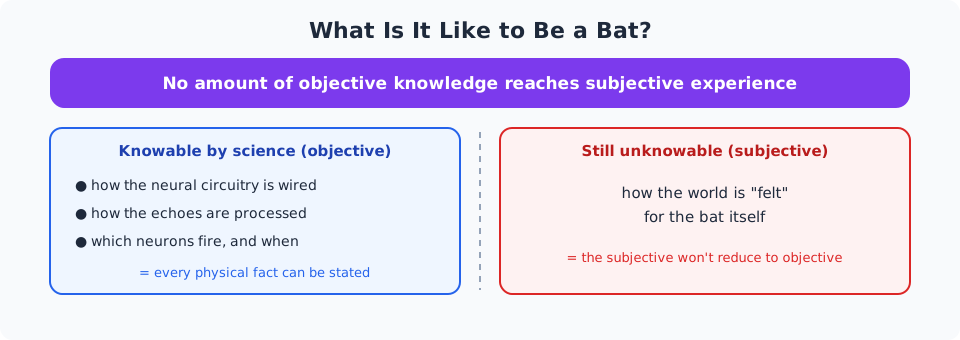
What Nagel sought to show is that no amount of objective scientific knowledge can reach subjective experience itself.
We can study almost anything about bats scientifically:
- How the neural circuitry of the brain is wired
- The frequency of the ultrasound, and how the echoes are neurally processed
- Which neurons fire, when, and in what order
All of these are facts statable from the “third-person point of view (objective)” — facts that come out the same no matter who observes them.
But pile up these objective facts as high as you like, and you never reach the “first-person point of view (subjective)” of “how echolocation is experienced for the bat.” Describe the firing pattern completely, and “how that firing feels” still does not emerge.
Nagel argued that here lies the fundamental difficulty of physicalism and reductionism. Science has advanced by aiming at the “objective point of view” — and that objectivity is its strength. But because the essence of consciousness is subjectivity itself, the more objectivity you pursue, the further you drift from the core of consciousness — a strange reversal.
Relation to Mary’s Room
This claim shares its concern closely with “Mary’s Room,” covered separately in this series. Mary’s Room asks “even knowing all the physics of color, can you learn what red looks like?”, while the bat argument asks “even knowing all the physics of bats, can you know the bat’s experience?” Both point to the same gap: there is an unbridgeable chasm between physical, objective facts and subjective experience. Nagel’s bat dramatizes it as a “barrier of species,” Mary’s Room as a “barrier of having-or-not-having experience.”
The Same Problem Among Humans
You might think “a bat is a special case.” But in fact this gap lurks quietly between humans too.
You cannot fully convey in words to a person blind from birth “what red looks like.” Nor can you ever verify that the “pain” you feel is the same in quality as the “pain” I feel. We merely infer from each other’s behavior and words that “they probably feel as I do.”
Subjective experience is a “closed, first-person world” accessible only to its owner. By taking the bat as an extreme example, Nagel’s thought experiment makes vividly visible the “barrier of subjectivity” that, in fact, separates us even from the people closest to us.
What the Question Throws at Us
Nagel did not deny the scientific study of consciousness. What he urged is that “if we truly want to understand consciousness, we need a new methodology for handling the subjective point of view.” The traditional, objectivity-only approach of science cannot, in principle, reach the core of consciousness.
This warning was carried forward into later debates about the “hard problem of consciousness” and underlies modern questions such as whether AI can be conscious and how we should treat animal minds. Until we can answer “what is it like to be a bat?”, perhaps we cannot say we truly understand consciousness.
Related Thought Experiments
These thought experiments in the philosophy of mind concern consciousness and qualia. Together, the shared theme of the gap between subjective and objective comes into clear view.

Summary
This article covered “What Is It Like to Be a Bat?”
Science has illuminated a staggering amount of this universe. And yet the region right next door — “the subjective experience of another” — remains out of reach. We cannot truly share even the “feel of pain” of the person beside us, let alone a bat’s experience.
How special, how strange, the phenomenon of consciousness is. Nagel’s bat teaches us this in an unforgettable way. If you see a bat flitting across the night sky, try imagining “what kind of world is unfolding in there?” The very fact that your imagination cannot reach it is the answer to this thought experiment.
Thank you for reading. We hope to see you in the next article.

Also popular with readers
📚 Series: Famous Thought Experiments (5/60)