Thank you for visiting this site. This article covers the “Boltzmann Brain.”
The world you see now, the body you feel, all your memories from birth until now — what if all of it had just assembled, an instant ago, from a chance fluctuation of the universe? What if your memories and the scenery before you were fakes fabricated the moment a brain came together, set to vanish the next?
It may sound like an outlandish daydream. But, frighteningly, this is no mere fantasy — it is a conclusion that follows seriously from the probability calculations of physics, and a genuine puzzle that troubles modern cosmology. This article explains the statistical-mechanics background, why “accidental brains” end up more numerous, and how physicists handle this troublesome result.
Background
The name “Boltzmann Brain” derives from the 19th-century Austrian physicist Ludwig Boltzmann. Boltzmann himself never argued for such a brain, but it follows from the “statistical mechanics” and the concept of “entropy” that he built — hence the name for this eerie consequence.
First, the physics background, kept as gentle as possible.
In statistical mechanics, entropy (the degree of disorder) plays a key role. As hot coffee cools and ink spreads through water, things left alone proceed toward “disorder (rising entropy).” A state in which everything has mixed completely, with no further change possible, is called “thermodynamic equilibrium (maximum entropy).”
But statistical mechanics teaches an important point: even from this equilibrium, very rarely, a chance “fluctuation” can momentarily produce order. Ink once spread through a glass of water could, with astronomically low probability but not zero, momentarily gather back into one spot.
One line of thinking (in Boltzmann’s era) held that, through such a “fluctuation,” an ordered universe like the one we see — with stars, galaxies, and life — might have arisen by chance within an otherwise high-entropy, dull cosmos. But a fatal trap lurked in this idea.
Are Accidental Brains More Numerous?
Here a decisive question arises: “If something can arise by chance through a fluctuation, what arises most easily?”
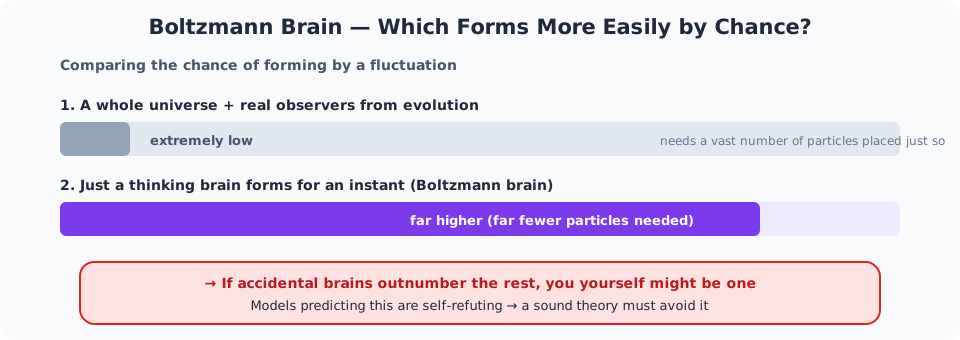
The probability of order arising by fluctuation has the property that the fewer particles required, the higher the chance; the more required, the more hopelessly low. Just as rolling two dice to match is vastly easier than matching a hundred.
Compare two things from this angle.
One is a whole ordered universe like ours — galaxies, the Sun, the Earth, 4.6 billion years of geology, the history of evolution, all of it. The probability that so grand an order arises by chance fluctuation is hopelessly, unimaginably low, because an immense number of particles must all fall into place just so.
The other is the case where “a minimal brain, thinking and observing this very moment,” assembles by chance, just one, out of the void. This too is extraordinarily improbable, but compared to building an entire universe, it requires far fewer particles, giving it an incomparably “better” probability. You need only a brain and a momentary consciousness in it; you need not prepare real galaxies and stars.
From this, a chilling conclusion follows. If the universe persists long enough (or infinitely), then lone, isolated brains assembled by fluctuation will be born far more numerously than “real observers” produced at the end of a long evolution. A brain, complete with memory, perception, and thought, appears for an instant in empty vacuum, mistakes itself for experiencing a world, then dissolves back into the void. This is the “Boltzmann Brain.”
Why It Is a “Troubling” Conclusion
Here is where it becomes truly unsettling.
If the universe holds Boltzmann brains overwhelmingly outnumbering real observers, then by probability it follows that “you, reading this text right now, are more likely a Boltzmann brain that just formed than a real human produced by evolution.”
Consider: the world around you, your life’s memories, your family and friends — all of it may be false memories fabricated at the instant the brain came together, “as if they had always been there.” And the next moment, the brain that is you may dissolve into the void without a trace.
This yields a skepticism much like “brain in a vat” and “Descartes’ evil demon.” But what makes the Boltzmann brain especially troublesome is that it is not a philosopher’s fancy — it follows seriously from physical theory and probability calculation. It is not “doubtable if you choose to,” but “predicted by the physics.”
Used as a “Sieve” for Cosmology
So how do physicists handle this awkward conclusion? They turn it around and use the Boltzmann brain as a kind of “sieve” for judging whether a cosmological model is correct.
The key idea is “self-refutation.”
Suppose some cosmological model, when worked out, predicts that “in this universe, Boltzmann brains outnumber real observers.” Then we, who are seriously examining that model, are likely Boltzmann brains. But if we are Boltzmann brains, our memories and observational data are all fabricated in an instant and untrustworthy. In other words, the very grounds (our observations and reasoning) for supporting that model become unreliable.
This is a logically broken situation in which “the basis for your own correctness undercuts itself” — a self-contradiction akin to the liar’s paradox of “this sentence is false.”
So most physicists reason: “a cosmological model that predicts Boltzmann brains as the majority is, at that point, broken — and should be rejected.” Conversely, a sound cosmology must be able to explain that “real observers produced by proper evolution outnumber Boltzmann brains” — a powerful constraint. This seemingly absurd “accidental brain” problem is thus deeply tied to cutting-edge debates in modern physics: how long the universe’s expansion lasts, the value of the cosmological constant (dark energy), and the far future of the cosmos.
Related Thought Experiments
These thought experiments question the makeup of the world and the reliability of reality itself. Together they show how far skepticism can reach.

Summary
This article covered the “Boltzmann Brain.”
That a question as seemingly absurd as “you may be a brain that just formed by chance” has become, in cutting-edge cosmology, a serious tool for testing the correctness of theories — this is a rare and beautiful case in which a thought experiment links philosophical skepticism (is my reality real?) with the front line of physics (which cosmological model is right?) in a single line.
Where Descartes’ demon and brain in a vat were “questions of philosophy,” the Boltzmann brain has a distinctive bite as a “question forced on us by the equations of physics.” That said, one reassuring note to end on: most physicists hold that “you are more likely a real being produced by evolution than a Boltzmann brain” — indeed, that this be so is a condition any sound cosmology must satisfy. So rest easy.
Thank you for reading. We hope to see you in the next article.

Also popular with readers
📚 Series: Famous Thought Experiments (52/60)