Thank you for visiting this site. This article covers “Laplace’s Demon.”
If an intellect existed that knew everything about the universe, could it predict tomorrow’s events, the world a hundred years hence, even your very next thought, all by calculation? Is the future, from the moment the universe began, already completely determined?
What symbolizes the physical worldview of “determinism” more vividly than anything is this “Laplace’s Demon.” And it goes beyond physics, reaching into a fundamental question of philosophy: “then what becomes of our free will?” This article explains the demon, the determinism it implies, why it is not a paradox, and the modern refutation along with the problem of free will.
What the Thought Experiment Says
“Laplace’s Demon” is a hypothetical intellect described by the French mathematician and physicist Pierre-Simon Laplace in his 1814 work A Philosophical Essay on Probabilities. Laplace himself never called it a “demon”; later generations gave it that name, meaning an intellect far beyond the human.
Against the backdrop of his era’s triumphant physics (Newtonian mechanics), Laplace reasoned:
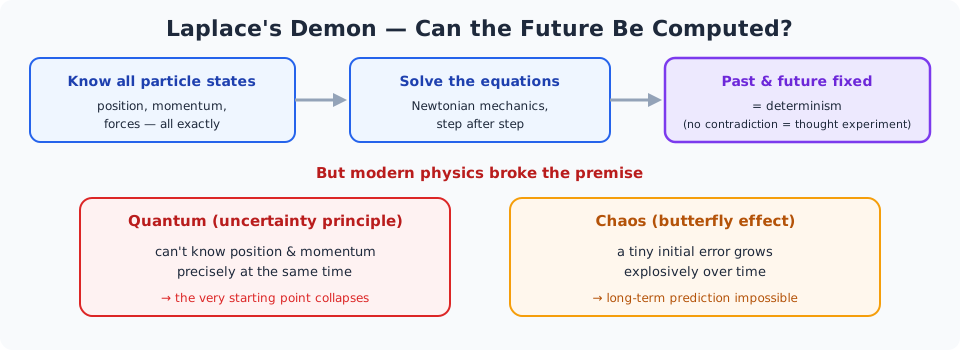
“Suppose an intellect knew, at a given instant, the position and momentum (speed and direction) of every atom in the universe, and all the forces acting on them, and was powerful enough to analyze all this data —”
then, to that intellect, the future and the past would be laid out before its eyes, just like the present.
Why can this be claimed? By the laws of Newtonian mechanics, if you know the complete state at one instant (all positions and velocities), the state at the next instant follows by the equations of motion. And from that newly computed state, the next instant can be computed. Repeat this and you can predict one second later, one year later, even to the end of the universe. Run the same calculation backward and you can recover every event of the past.
This all-knowing intellect, able to know the whole state of the universe and compute everything, is “Laplace’s Demon.” Picture being able to do, for the entire universe, what you could do on a billiard table — if you knew every ball’s position and motion, you could read the whole future of the game.
This Represents “Determinism”
What Laplace’s Demon represents is the worldview called “determinism.”
Determinism is the position that every event in this world is completely fixed, in exactly one way, by the prior state and the laws of physics. The universe is, as it were, a vast piece of clockwork wound at the start; given the initial state and the laws, what follows allows not the slightest freedom or chance.
This deterministic worldview carried great force in the 18th and 19th centuries, because Newtonian mechanics predicted the motions of planets and the returns of comets with frightening accuracy. If eclipses and planetary positions can be calculated years in advance, then in principle the whole universe must be calculable. Laplace’s Demon symbolized the immense confidence of the science of that age — “the world can be written out in equations.”
Why It Is Not a “Paradox”
Here let us make one thing clear. Laplace’s Demon is often introduced alongside famous paradoxes, but strictly speaking it is not a paradox. This point is, in fact, a major reason this series treats thought experiments separately.
To review, a paradox is a problem in which a seemingly valid premise or reasoning leads to a contradictory or sharply counterintuitive conclusion. Like “Achilles can never catch the tortoise,” its hallmark is a plainly strange conclusion.
But Laplace’s Demon produces no such contradiction. It merely paints, logically and vividly, one consequence: “if classical physics is correct, the world is deterministic.” The conclusion may feel strange, but there is no logical contradiction in it.
Something that sets up an imagined situation and reasons about what follows in order to illustrate a concept or position is called a “thought experiment.” Laplace’s Demon is a leading example of a thought experiment, embodying the worldview of determinism. Interestingly, the other famous “demon” — “Maxwell’s Demon,” which appears to break the second law of thermodynamics — does generate an apparent contradiction (a paradox), whereas Laplace’s Demon does not. This difference is itself an intriguing point that separates the two.
Refutation by Modern Physics
The complete determinism Laplace’s Demon depicted was deeply shaken in the 20th century, by physics itself. Two discoveries demolished the demon’s premises.
Quantum Mechanics (the Uncertainty Principle)
The most decisive was “quantum mechanics.” By the “uncertainty principle” at its heart, it is impossible in principle to know both the position and the momentum of a particle precisely at the same time. The more precisely you measure the position, the more uncertain the momentum becomes, and vice versa.
This is not a limit of immature technology but a fundamental limit built into nature itself. So the very starting point Laplace’s Demon assumed — “knowing the position and momentum of every particle” — is forbidden from the outset by natural law. The demon is stuck before it can even gather its data. Moreover, in quantum mechanics individual events are settled only probabilistically. The same conditions need not give one fixed result — fundamentally at odds with a deterministic picture.
Chaos Theory (the Butterfly Effect)
From another angle, “chaos theory” limits the demon’s powers. In chaotic phenomena, a tiny difference in the initial state grows explosively over time — the “butterfly effect” (a butterfly’s flap brings a distant storm). This is why weather forecasts hold only a few days out.
Even if the demon could measure the initial state to astronomical precision, the slightest error would balloon over time and render long-term prediction utterly meaningless. Perfect calculation needs perfect initial data, and that can never be had in reality.
But It Is Not Settled
That said, whether quantum mechanics has completely buried determinism is debated even among physicists. On the “many-worlds interpretation,” where every possibility is realized in a branching form, the universe as a whole can be regarded as deterministic. Like Einstein, who said “God does not play dice,” some have held that beneath quantum probability lies a deeper determinism. This debate is not yet fully resolved.
The Great Problem of Free Will
The most pressing question Laplace’s Demon throws at us is the problem of “free will.”
If the universe were completely deterministic, then your reading this article now, your choosing curry for lunch tomorrow, every decision you will ever make — all of it was already fixed from the instant the universe began 13.8 billion years ago. For your brain too is made of atoms, and the atoms merely obey physical law.
A dreadful question follows: is that sense of “choosing for myself” merely an illusion? Are you in fact choosing nothing freely, only acting out a script you were destined to perform while believing you chose it?
This question still torments philosophers and neuroscientists. Some hold “determinism and free will are incompatible”; others, the “compatibilists,” hold that “even if determinism is true, acting on your own will is free enough to count as freedom.” Neuroscience experiments reporting that “the brain begins to act before you consciously feel you have decided” make the debate ever more tangled.
The single demon Laplace painted over 200 years ago still quietly, sharply, asks us “what is freedom?” well beyond the bounds of physics.
Related Thought Experiments
These thought experiments ask about the fundamental principles of physics and the makeup of the world. Read together, the depth of the worldview science paints comes into view.

See also the paradox of Maxwell’s Demon, which appears to create order out of nothing.

Summary
This article covered “Laplace’s Demon.”
Laplace’s Demon symbolizes the grand worldview classical physics painted — “everything is determined.” Twentieth-century quantum mechanics and chaos theory forced major revisions to its complete form, yet the question of determinism and free will lives on, changing shape.
And the demon also exemplifies this series in being “not a paradox but a thought experiment” — it generates no contradiction. By positing a single hypothetical being, it opens a question of vast reach, from the worldview of physics to the meaning of human freedom. Laplace’s Demon shows beautifully the power of the thought experiment.
Thank you for reading. We hope to see you in the next article.

Also popular with readers
📚 Series: Famous Thought Experiments (50/60)