Thank you for visiting this site. This article covers “The Veil of Ignorance.”
Suppose you are about to design the rules of society from scratch — taxation, education, the distribution of wealth, the scope of liberty — all on a blank slate. But there is one condition. You do not know who you will be in that society. Whether rich or poor, healthy or sick, what talents or circumstances you will be born into — you have no idea.
In this state, what society would you choose? You might become a billionaire, or you might become a destitute person with no certainty of tomorrow. Thinking that way, what rules would people feel are “fair”? From this question, the political philosophy of the 20th century took its starting point. This article digs into the meaning of the setup, why the device produces fairness, the conclusions it yields, and the objections.
The Setup
“The veil of ignorance” was proposed by the American philosopher John Rawls in his 1971 magnum opus A Theory of Justice. The book is said to have single-handedly revived a stagnant political philosophy, and ranks among the most influential works of 20th-century thought.
The question Rawls took up was “what are the principles of a just society?” To consider it, he set up a special hypothetical scene called the “original position.”
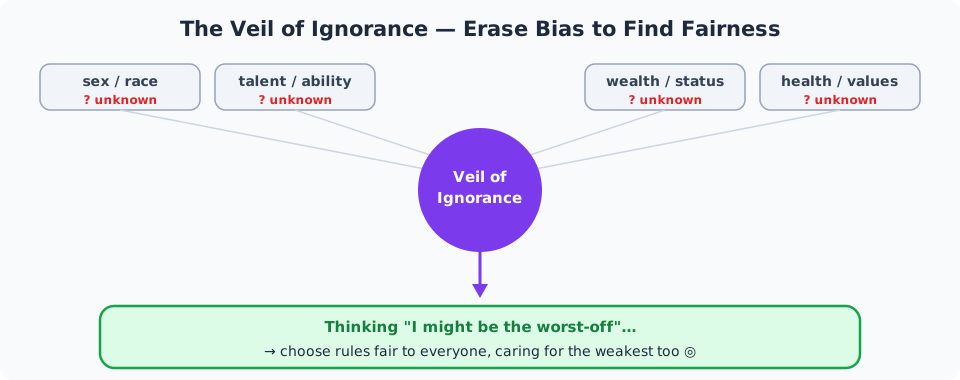
In this original position, everyone who is about to decide the rules of society wears a thin membrane called the “veil of ignorance.” While they wear it, they can know nothing specific about themselves:
- Their own sex, race, and age
- Their innate talents, abilities, and looks
- The wealth and social status of the family they are born into
- Their state of health, and whether they have a disability
- What values, religion, or life plan they will hold
With all of this entirely unknown, people reason and negotiate together over “what kind of society’s rules do we want to live under?” Only once the rules are decided is the veil lifted, and each learns their true circumstances.
Why Put on the Veil?
Why is so odd a device — hiding one’s own information — necessary? Rawls had a clear aim.
Recall what happens when we debate rules and institutions in the real world. Inevitably, people support rules that favor themselves. High earners want a society with low taxes; the healthy young tend to care less about healthcare and welfare; the majority tends to make light of the minority’s rights. Where you stand right now distorts your judgment without your even noticing.
So Rawls reversed the logic. If you make it impossible to know who you are, no one can choose “rules convenient only for me.” Not knowing whether you will be rich or poor, you cannot bring yourself to pick rules grossly favoring the wealthy, or rules grossly harming the poor. You are forced to choose what works out either way.
The veil of ignorance is thus an ingenious thought-device that turns the human tendency to “look out for oneself” into a means of drawing out rules fair to everyone. It applies to the design of society as a whole the idea that “a fair referee is better off not knowing which team they support.”
What Society Gets Chosen?
So what society do people behind the veil actually choose?
A person under the veil reasons: “when the veil lifts, I may be in the worst-off position in society.” Born into a poor family, perhaps; carrying a serious illness or disability; a discriminated minority. In the worst case, that hardest position is mine.
Rawls held that people would then follow the “maximin principle (the strategy of making the worst outcome as good as possible).” Rather than gamble on “if it goes well, I’m a billionaire,” they try to raise the floor as high as possible — “even at worst, this much is bearable.” A cautious choice that prizes the safety net of a fall over the dream of a jackpot.
From this reasoning, Rawls argued, people choose the “two principles of justice”:
- The principle of equal liberty: every person has an equal claim to basic liberties — speech, thought, religion, political participation. This takes priority.
- The difference principle: social and economic inequalities are permitted only if (a) fair equality of opportunity is secured, and (b) the inequalities improve the situation of the least advantaged.
The second, the “difference principle,” was especially groundbreaking. Rawls did not reject inequality outright. “Talented people earning high rewards” is allowed if it enriches the whole economy and lifts up the lives of those at the bottom too. Conversely, inequality that leaves the bottom behind is not justified, however much total wealth grows. This idea became a powerful theoretical basis for welfare and redistribution.
Debate and Influence
The veil of ignorance, though a purely abstract thought experiment, has had enormous influence on real policy debate. The shape of the welfare state, the justification of progressive taxation, equality of educational opportunity, the design of social security — wherever “fairness” is at stake, Rawls’ argument continues to be invoked.
There are, however, many strong objections.
The most famous comes from the American philosopher Robert Nozick. From a position prizing individual “rights” — especially the right to keep property justly acquired (libertarianism) — Nozick criticized Rawls’ redistribution: “for the state to seize and redistribute wealth gained by legitimate means, in the name of fairness, violates individual rights.” The Rawls–Nozick debate became one of the central axes of modern political philosophy.
There are also doubts about Rawls’ premises. “Do people really make the cautious, worst-case choice (maximin)? Might many gamble on a big success?” — an objection about human psychology. And from “communitarianism,” which prizes community and cultural ties, comes the criticism that “a ‘person under the veil,’ stripped of all values and circumstances, does not exist in reality — it is an empty abstraction.”
Even so, the core idea of the veil of ignorance — “set your own position aside for a moment and ask whether something is fair from anyone’s point of view” — lives on as a powerful tool for thinking about fairness.
The “Spirit of the Veil” in Everyday Life
The veil of ignorance is not only about grand matters like designing a state. It holds a universal wisdom you can apply to everyday judgments.
When deciding something, ask: “if I were in the other person’s position, would I feel this rule is fair?” Setting class rules, building workplace policy, dividing something at home — consider whether the decision is one you could accept no matter which side you end up on. This is exactly the spirit of the veil. The question “would there be no complaint even if positions were swapped?” is a simple, powerful yardstick for fairness.
Related Thought Experiments
These thought experiments in ethics and political philosophy ask “what is a just society?” and “what is justice?” Read together, the depth of reflection on justice comes into view.

Summary
This article covered “The Veil of Ignorance.”
If you did not know who you would be, you could set aside your own convenience and think about things far more fairly. From this seemingly simple device, Rawls drew powerful principles of justice — equal basic liberty and the difference principle that lifts up the least advantaged.
Fairness is born from “setting your own position aside for a moment.” That is the core lesson of the veil of ignorance. We always tend to see the world from where we stand. But before deciding something, forget your own circumstances for just a moment. That small act of imagination may be the first step toward a fairer judgment.
Thank you for reading. We hope to see you in the next article.

Also popular with readers
📚 Series: Famous Thought Experiments (49/60)