Thank you for visiting this site. This article covers the “Violinist” thought experiment.
You wake one morning to find a stranger connected to your body by tubes, and unless you stay connected, that person will die. Placed in such a situation, what would you do? And do you have a “duty” to keep this person alive?
This strange, memorable setup was in fact devised to discuss “abortion,” one of the most contested topics of our time. It illuminates an extremely hard problem — where “the duty to save another’s life” collides head-on with “the right to decide what happens to your own body” — in a form anyone can think through. This article walks through the setup, Thomson’s clever aim, the core of the argument, and the objections.
The Setup
This thought experiment was presented by the American philosopher Judith Jarvis Thomson in her 1971 paper “A Defense of Abortion.” It is among the most famous thought experiments ever to appear in an ethics paper.
The situation Thomson describes is this.
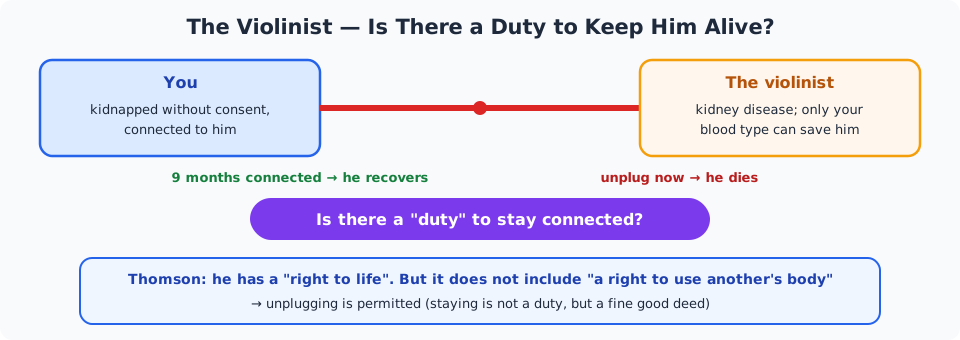
One morning you wake in an unfamiliar hospital bed. To your astonishment, a world-famous violinist is connected back-to-back to your body by tubes.
You learn the story. The violinist has a fatal kidney disease, and to purify his blood he must be hooked into the circulatory system of a person with a special blood type. On investigation, it turned out that yours is the only blood type in the world that can save him.
So the “Society of Music Lovers,” his devoted fans, kidnapped you in the night and, without any consent from you, connected his circulatory system to your body. By the time you noticed, it was already done.
The doctor tells you, apologetically: “If you stay connected for the next nine months, his kidneys will recover and he can be safely unplugged. But if you unplug now, he will certainly die.”
Here is the question: “Do you have a moral duty to remain connected to this stranger violinist for nine months to keep him alive?”
Most People’s Intuition
To this, most people feel that “it is a pity, but I have no duty to have my body used for nine months without my consent.” Of course, staying connected for nine months would be a wonderful thing to do. But being forced to do it as a “duty” seems wrong — most people sense that.
Even if the other is a celebrated musician whose death would be a loss to the world, that you must give up your body for nine months after being abducted feels excessive. This intuition is the starting point of Thomson’s argument.
Thomson’s Clever Aim
Why did Thomson devise such a strange setup? Because the thought experiment was built to discuss “abortion.” The connected violinist corresponds to the “fetus,” and you, the one connected against your will, to “a woman with an unwanted pregnancy.”
Here Thomson’s argument is very clever.
Arguments against abortion often take the form: “the fetus has a right to life, so abortion, which takes it away, is impermissible.” They lean on the fetus’s right to life, presupposing it is a person.
Usually the pro-choice side responds “no, the fetus is not yet a person.” But Thomson, to avoid that unwinnable tug-of-war, makes a bold move: for the sake of argument, she grants that “the fetus is a full person with a right to life.” She accepts the opponent’s strongest premise wholesale.
Then she asks in return:
“Granting that the fetus is a person with a right to life — does ‘having a right to life’ also mean ‘a right to use another person’s body’?”
The violinist certainly has a right to life. But that right to life does not include a right to use your body for nine months. That is why your unplugging does not violate his “right to life” — so Thomson argues.
The Right to Life and the Right to a Body Are Different
The core of Thomson’s argument lies in sharply distinguishing “the right to life” from “the right to use another person’s body.”
We usually think of “the right to life” as a very strong right. But Thomson points out that it is a “right not to be unjustly killed,” not “a right to obtain, by force from others, whatever one needs to go on living.”
Consider: even if a person needs, to survive, “the cool touch of the world’s best doctor’s hand on his brow,” that doctor has no duty to rush to him. Likewise, even if the violinist needs your body to live, no duty to give it up arises automatically.
What is crucial is that Thomson never says “you should unplug” or “staying connected is bad.” On the contrary, to remain connected for nine months would be an exceedingly fine, generous, praiseworthy good deed.
But — and here is the point — “being a fine good deed” and “being forced as a duty” are two completely different things. We may criticize someone who does not do a fine deed as “cold,” but we cannot punish them for “failing a duty.” This distinction between “duty” and “(supererogatory) good deed” is the foundation of Thomson’s whole argument.
Debate and Objections
The violinist thought experiment has provoked fierce debate for half a century.
Its defenders praise how it freed the abortion question from the hard-to-settle point of “is the fetus a person?” and broadened the debate toward the new issue of “bodily autonomy.”
Critics raise sharp objections. A leading one is that “the situations differ too much.” In the violinist case, you are an entirely innocent kidnapping victim. But many pregnancies (especially from consensual sex) are the result of voluntary action, and one may bear some responsibility for the consequence. Thomson responds with clever analogies — such as “you left the window open and a burglar (sperm) got in” — and further cases involving failed contraception.
There is also the objection over the distinction between act and omission: “isn’t unplugging and letting him die (killing) morally different from never helping in the first place?”
Whatever one makes of these objections, the thought experiment changed the very framework of the debate over the weighty topic of abortion, and has become an unavoidable classic of modern bioethics.
Related Thought Experiments
These thought experiments in ethics ask “what is the right thing to do?” and “what are rights and duties?” Read alongside the trolley problem, the complexity of our intuitions about duty comes into view.


Summary
This article covered the “Violinist” thought experiment.
Saving a person’s life is unquestionably noble. But should giving up your own body for it be forced as a duty? Accepting the opponent’s strongest premise (the fetus is a person), Thomson advanced the sharp point that “a right to life does not include a right to use another’s body.”
This thought experiment confronts us with the question of where the line lies between “a fine good deed done freely” and “a duty you are blamed for failing.” Beyond the particular topic of abortion, it is the universal question — close to our daily lives — of “how far is kindness to others free goodwill, and from where does it become an obligation that can be demanded?”
Thank you for reading. We hope to see you in the next article.

Also popular with readers
📚 Series: Famous Thought Experiments (32/60)