Thank you for visiting this site. This article covers “The Ring of Gyges.”
If you obtained a ring that made you invisible just by putting it on, what would you do? Even if no one could see you, you could never be caught, and no evidence would remain, would you keep behaving justly? Or would the desires you had kept locked away begin to stir?
This is a question Plato posed in ancient Greece. At first it sounds like a children’s fairy tale, but it cuts sharply into one of the deepest questions in ethics: “Is justice something we genuinely want, or merely a product of self-interest?” This article walks through the story, the challenge built upon it, Plato’s reply, and the link to today’s internet society.
The Story
“The Ring of Gyges” appears in Book II of The Republic, the masterwork of the ancient Greek philosopher Plato. The narrator is Glaucon (Plato’s own brother), one of Socrates’ interlocutors.
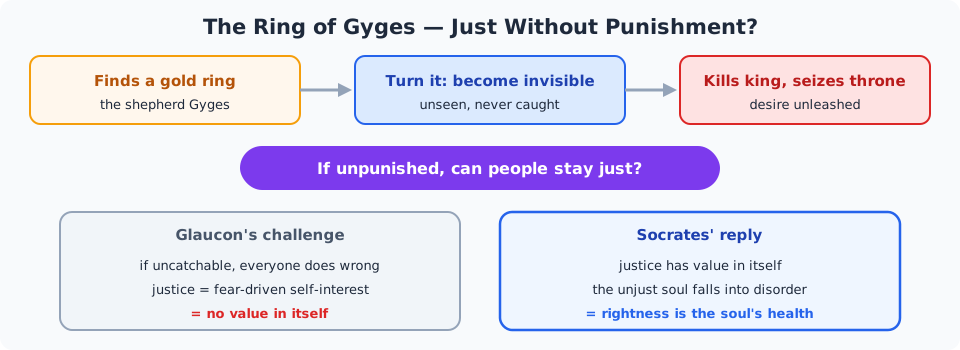
The story goes like this. In Lydia (in present-day western Turkey) there was a shepherd named Gyges. One day a violent earthquake and storm opened a great chasm in the ground. Out of curiosity he climbed down and found, in a hollow underground, a giant bronze horse, and inside it the corpse of a giant. The corpse wore a golden ring, which Gyges took and carried back up to the surface.
Some time later, at a gathering of shepherds, Gyges idly turned the ring’s setting toward himself (inward). At once his companions began saying, “Where did Gyges go?” He realized that turning the ring inward made him invisible to everyone. Turning it back out, he reappeared. He had gained the power to become invisible at will.
And what did Gyges do with this immense power? He did not hesitate. Using his invisibility, he slipped into the royal palace, seduced the queen, conspired with her to murder the king, and seized the throne of the kingdom for himself. A mere shepherd, using a power that placed him beyond capture, rose in no time to rule a nation.
Glaucon’s Challenge
Glaucon raises this story not as a mere fable but as a fierce challenge to Socrates. He asks:
“Suppose there were two such rings, one given to a ‘just person’ and one to an ‘unjust person.’ Would the just one alone restrain his desires and keep his hands off what belongs to others? I do not think so. Both would behave in exactly the same way.”
Glaucon’s claim is a cold, provocative view of human nature: as long as there is no fear of being caught, even the most “just” person will, in the end, act on desire. They would steal, seize, take whoever they wanted, and remove whoever stood in their way. Anyone who could turn invisible would surely do the same.
And here is the heart of it. If so, then when people normally behave “justly,” it is not because they genuinely love justice. The real reason is “fear of being exposed and punished, or of losing their reputation.” Justice, then, is a contract people grudgingly struck to “stop harming one another” — a “product of weakness and compromise” — with no value in itself. That was Glaucon’s blunt challenge.
He pressed further: “In fact, isn’t the person who does injustice while keeping a reputation for justice the happiest of all? And isn’t the truly just person, falsely branded a villain, the most miserable?” He demanded that Socrates “prove that justice has value in itself.”
Socrates’ (Plato’s) Reply
In fact, most of the long work that is The Republic is taken up with Socrates’ (Plato’s) grand attempt to answer Glaucon’s challenge. That is how weighty the question was.
Socrates’ position is clear: justice has value in itself, and being just makes a person genuinely happy. Not as a means to avoid punishment — justice is good in its own right.
To argue this, Socrates develops his famous “tripartite theory of the soul.” The human soul, he says, has three parts:
- Reason: the part that knows what is truly good and guides the whole
- Spirit: courage, pride, and anger — the part that assists reason
- Appetite: hunger, sexual desire, greed — the part that endlessly seeks satisfaction
When these three are in harmony, with reason ruling the whole well, the soul is healthy and the person is truly happy. This is what Socrates means by “justice.” Justice is, more than the keeping of external rules, a state in which the soul’s inner order is preserved.
And the one who, like Gyges, piles up injustice on desire? Reason is hijacked by appetite, and the soul’s order collapses. However much wealth, power, or pleasure he gains, his inner life falls into disorder, driven by limitless desire, never satisfied — truly unhappy. The wrongdoer with the ring may look like a success from outside, but his soul sickens from within. Justice is not a tool for escaping punishment; it is the “health of the soul” itself — so Socrates answered Glaucon.
A Question for Our Time
The Ring of Gyges is no mere ancient tale. In modern society its question has only grown sharper.
The clearest case is the anonymity of the internet — a modern “ring of invisibility.” Shielded by anonymity and freed from accountability, people write abuse they would never say otherwise, and spread rumors. The same person can be courteous on a real-name platform and aggressive on an anonymous board. This shows Glaucon’s claim — “people change when they cannot be caught” — playing out in reality.
It is not only anonymity. How we behave the moment we think “no one is watching” — the corruption of the powerful out of sight, running a red light on an empty road, a quietly broken rule, how we respond when the cashier forgets to charge us — is exactly the problem the Ring of Gyges posed.
“When no one is watching, when you cannot be punished, how do you behave?” The answer most honestly reflects who a person truly is. Across 2,400 years, the Ring of Gyges still sits before each of us as a mirror for testing our own integrity.
Related Thought Experiments
These thought experiments in ethics and political philosophy ask “what is the right thing to do?” and “what is a just society?” Together they reveal the breadth of the question of justice.


Summary
This article covered “The Ring of Gyges.”
When there is no punishment, can people stay just? And what is justice for in the first place? Glaucon provoked with “justice is just fear-driven self-interest,” and Socrates answered “justice is itself the health of the soul.” This clash has not aged a day.
This ancient thought experiment quietly but sharply probes the root of each person’s integrity. Now that everyone holds a “modern ring of invisibility” in the anonymity of the internet, the question may weigh more, not less. If you had a ring that made you invisible, how would you behave? And what would that answer say about you?
Thank you for reading. We hope to see you in the next article.

Also popular with readers
📚 Series: Famous Thought Experiments (31/60)