Thank you for visiting this site. This article covers “The Trolley Problem.”
A runaway train, five lives in its path up ahead, and a lever in your hand. Pull it and the five are saved — but a different person dies instead. Is it right to sacrifice one to save five?
This is arguably the most famous thought experiment in ethics, raised endlessly on TV and online; perhaps you have pondered it yourself. But its real aim is not to “produce an answer.” The trolley problem is a device for vividly exposing how complex, and at times self-contradictory, our moral intuitions are. This article walks through the basic setup, its famous variants, why intuitions clash, and the modern application to self-driving cars.
The Setup
The trolley problem was raised in 1967 by the British philosopher Philippa Foot and later developed, with new variants, by the American philosopher Judith Jarvis Thomson.
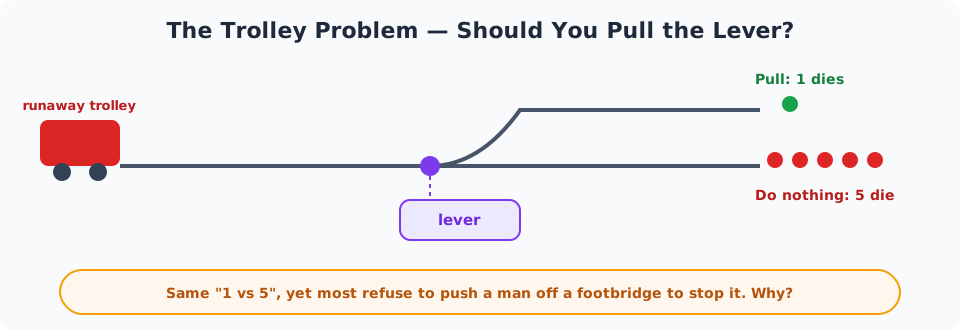
Here it is. A trolley (a tram) has lost its brakes and is hurtling along. If it continues, it will run over five workers on the track ahead, who cannot escape in time. They have not noticed the trolley.
You stand beside a lever at a junction where the track splits in two. Pull the lever and the trolley diverts onto a side track, saving the five. But there is one worker on that side track, who will be run over and killed instead.
Two options: do nothing and watch five die, or pull the lever and cause one to die.
“Do you pull the lever?”
To this, most people answer “yes, pull it.” The sacrifice of one is grievous, but since five will die if you do nothing, you should choose the smaller toll. This aligns with utilitarian thinking, which prizes “the greatest happiness for the greatest number.” A seemingly simple calculation: 5 > 1.
The Footbridge Variant
But consider Thomson’s famous variant, the “footbridge problem (the fat man problem),” and things suddenly grow tangled.
Now you stand on a footbridge spanning the track. The trolley is hurtling toward the same five. Beside you, leaning on the railing, stands a very large man.
By the physics, if you push this large man off the bridge onto the track, his big body will block the trolley and stop it, and the five are saved for certain. But the man you pushed dies (you yourself are too light to stop the trolley if you jump).
“Do you push this man?”
Now almost everyone answers “no, I won’t push.”
Here is the crux of the trolley problem. In both the lever case and the footbridge case, the structure is identical: “sacrifice one to save five.” Numerically nothing has changed. And yet our intuition returns the opposite verdict: pulling the lever is permissible, but pushing a person is not.
Why Do the Intuitions Clash?
If the arithmetic is the same, the verdict should be too. So why do our intuitions diverge? How to explain this gap has been the subject of long debate. Here are the main accounts.
Using a Person as a “Means” (Deontology)
The first account is deontological. The 18th-century philosopher Kant held as a basic moral principle that “never treat a human being merely as a means; always also as an end.”
Compare the two cases. In the lever case, the death of the one is “a side effect that arises from saving the five.” Even without that person there, the act of pulling the lever still stands. In the footbridge case, the large man’s body is directly used “as a tool to stop the trolley.” Without him, the very means of saving the five collapses.
In the latter, then, you are literally using a person as a “thing.” The strong resistance we feel on the footbridge may be a deep moral refusal of “using a person as a means.”
The Doctrine of Double Effect
A related classic idea, known since the Middle Ages, is the “doctrine of double effect”: “when an act produces both a good and a bad result, the moral evaluation differs depending on whether the bad result is the ‘intended end’ or merely a ‘foreseen but unintended side effect.’”
When you pull the lever, the one’s death is a foreseen side effect, not the intended end. When you push a person, that they become the stopper and die is precisely the intended end. This difference, the idea goes, draws the line between permissible and impermissible.
The Vividness of the Act (Psychology)
There is also a more psychological account: the bodily, direct vividness of “pushing a person with your own hands” triggers strong aversion. Pulling a lever places “the distance of a machine” between you and the victim, lowering the psychological hurdle. In fact, neuroscience studies report that different brain regions activate in the two cases — rational calculation and emotional reaction working separately.
A Clash of Ethics’ Two Great Currents
What these accounts show is that the trolley problem beautifully captures a scene where two great positions in ethics collide head-on.
| Position | Basis of judgment | Verdict on the trolley problem |
|---|---|---|
| Utilitarianism (results) | Does it maximize total happiness? | Save the five. Keep the toll at one in either case |
| Deontology (the act) | Is the act itself morally right? | Killing a person as a means is wrong, even with good results |
Utilitarianism asks “if the result is good, do the means matter?”; deontology insists “some things must not be done, even for a good result.” The trolley problem exposes how, depending on the situation, we switch unconsciously between these two principles. That is why digging into your own answer reveals the true shape of your moral outlook.
The Self-Driving Car: A Modern Trolley Problem
The trolley problem was long dismissed by some as “an unrealistic ivory-tower puzzle.” But lately it has surfaced as a genuinely practical problem: the “self-driving car.”
When a self-driving car can no longer avoid an accident with failed brakes, what should it do? “Go straight and hit five pedestrians, or swerve and hit one?” “Sacrifice the occupant — yourself — to protect pedestrians?” The AI must make such judgments in an instant, following criteria programmed in advance.
This is, quite literally, making a machine solve the trolley problem. Who decides the criteria? If there were “occupant-first” cars and “pedestrian-first” cars, which would people buy? When an accident occurs, who is responsible — the driver, the maker, the programmer? A large MIT study called the “Moral Machine” even revealed that people’s moral judgments differ markedly across countries and cultures.
A puzzle philosophers once turned over only in their heads has become a real-world problem that carmakers, lawyers, and society as a whole must face.
Related Thought Experiments
These thought experiments in ethics ask “what is the right thing to do?” Reading the trolley problem alongside them reveals many sides of our moral intuition.
See also the social dilemma in which “individually rational action produces collective harm.”
Summary
This article covered “The Trolley Problem.”
There is no single answer everyone accepts. But that is exactly its value. Digging into “why can I pull the lever but not push the man?” reveals whether your moral outlook prizes results (utilitarianism), the rightness of the act (deontology), or wavers case by case.
And this is no longer a question confined to the classroom. Now that AI has begun making decisions over human lives, the trolley problem confronts us all in the form of “what morality should we teach our machines?” Would you pull the lever? And why?
Thank you for reading. We hope to see you in the next article.

Also popular with readers
📚 Series: Famous Thought Experiments (29/60)