Thank you for visiting this site. This article covers “The Teletransporter.”
The instant-travel machine familiar from science fiction. One button, and you cross from Earth to Mars in an instant — wonderfully convenient. But if this really existed, would the person who appears at the destination truly be “you”? Or a completely different person who merely shares your memories and appearance?
“Obviously it’s me,” you might think. Yet with one small tweak to the setup, that conviction crumbles with surprising ease. The question leads us into a deep puzzle at the very root of the self: “What is it for me to be me?” This article digs into the setup, the shocking two-copies variant, and the philosopher Parfit’s bold conclusion.
The Setup
This thought experiment is famous from the British philosopher Derek Parfit’s 1984 magnum opus Reasons and Persons, where he examined it in depth. Because it uses the “teletransporter” of films and anime, anyone can picture it.
Imagine a “teletransporter” that lets you travel from Earth to Mars in an instant. It works like this.
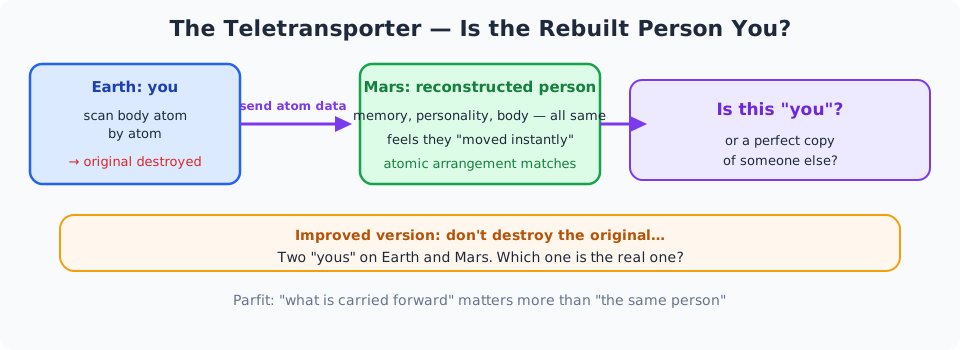
First, a scanner on the Earth side scans your body completely and precisely, down to every single atom. The state of your brain’s neurons, your memories, even the thought you were having at that moment — all are read out as data. That data is sent by radio to Mars.
On Mars, a device uses the arriving data to reconstruct your body, identical down to the atomic arrangement, from local materials. The person who results inherits your memories, personality, and knowledge — even every scar on your body — exactly. From the inside, it feels as though, the instant after entering the machine on Earth, you simply opened your eyes on Mars. “Ah, I arrived on Mars in an instant,” is all it feels.
There is, however, one crucial condition. During the scan, your original body on Earth is broken down to the atomic level and destroyed.
Here is the question: “Is the person who appears on Mars the same person as the you who was on Earth?”
Intuition Splits Right Down the Middle
Intuitions divide sharply, and neither side is easy to refute.
Those who think “of course it’s the same person” say: memory, personality, and bodily structure are perfectly continuous, so only the means of travel changed. Whether you go by plane or by teletransporter, the one who arrives on Mars is the same you.
Those who think “no, it’s a different person” reply: on Earth, the original body was destroyed — the original died, and what appeared on Mars is an exact copy carrying the original’s memories. No matter how perfect the copy, the fact that the original died does not change.
That intuitions split this cleanly on exactly the same facts shows how deep the problem runs. Would you happily step into this teletransporter? Or would you freeze, feeling “this is a suicide machine”?
When There Are Two Copies
Parfit sharpens the thought experiment until there is no escape.
Suppose the teletransporter is improved so that it no longer needs to destroy the original body on Earth. After the scan, you remain on Earth unharmed, while a reconstructed person also appears on Mars from that same data.
What happens? Two “yous,” with exactly the same memories and personality, now exist at the same time, on Earth and on Mars.
Both, the moment they wake, are convinced “I am the real you.” The Earth one thinks “I’ve been here all along,” the Mars one thinks “I moved to Mars in an instant.” Each has equal grounds to believe it is the original.
But both cannot be “the identical you,” for it is logically impossible for one person to be two separate bodies at once (if the Earth one falls and feels pain, the Mars one feels nothing).
So which is the real one? You want to say “the one on Earth, because it’s the original body.” But here something strange happens. If “whoever keeps the original body is the real one,” then in the first version — the teletransporter that destroys the original — the original person had died. That is, in the very same operation of “making the same person on Mars,” whether the Mars person is “the real you” or “a copy” depends on a fact about the Earth body that has nothing to do with the Mars person. However you look at it, that is hard to accept.
Parfit’s Answer: Identity Is Not What Matters
From these dead ends, Parfit drew a bold conclusion:
“The very question ‘is it really the same person?’ is, in fact, not important.”
He argued that our assumption that “personal identity” must settle into one of two options — “the original or not” — is itself mistaken.
What truly matters, Parfit held, is not “whether it is identical” but “psychological continuity and connectedness” — the unbroken inheritance of memory, personality, and intention. The Mars person is psychologically continuous enough with the Earth you. If so, there is no point in fussing over whether to call it “the same person.”
This shakes our ordinary view of “my survival” at its root. Parfit thought the question “will I survive?” is not as grave as we imagine. What matters is that “someone connected to me carries on my memories and values into the future,” not whether it is “strictly the same me.”
Tellingly, Parfit reported that reaching this view “eased his fear of death.” He came to feel that “my existence is not a special thing cut off from the world, but something open within a web of connections.”
The Link to the Ship of Theseus
The teletransporter problem connects, at a deep level, to the ancient “Ship of Theseus” paradox. It is the question “is a ship whose parts have all been gradually replaced still the same ship?” transposed from a “thing” to a “human.”
And this is not mere fantasy. The atoms making up our bodies are, through eating, metabolism, and cell turnover, said to be largely replaced within a few years (some tissues, such as neurons, are not renewed — the real picture is more complicated). Materially, a large share of the you of ten years ago and the you of today are different atoms.
So why do we feel we are “the same self”? Not because the matter is continuous, but because memory and personality are continuous — exactly the “psychological continuity” Parfit pointed to. The teletransporter is a thought experiment that brings this everyday hidden wonder abruptly to the surface through an extreme setup.
For the question of the identity of “things,” see the Ship of Theseus paradox as well.

Summary
This article covered “The Teletransporter.”
Is the one who appears at the destination the original or a copy? The more you think about it, the less clear the answer becomes. The “two copies” version, in particular, beautifully smashes the simple conviction of “what counts as the real me.”
But as Parfit showed, when you shift your gaze from “is it the same?” to “what gets carried forward?”, the self begins to look a little different. “I” may not be a hard point cut off from the world, but something spread gently across a web of memory and relationships. Would you step into that teletransporter? Take a moment to think it through.
Thank you for reading. We hope to see you in the next article.

Also popular with readers
📚 Series: Famous Thought Experiments (24/60)