Thank you for visiting this site. This article covers “The Ship of Theseus” paradox.
Rooted in Greek mythology, this paradox strikes at one of philosophy’s deepest questions: what does it mean for something to be the same thing? Because it touches themes so close to everyday life, once you start thinking about it the question tends to stick.
The Ship of Theseus
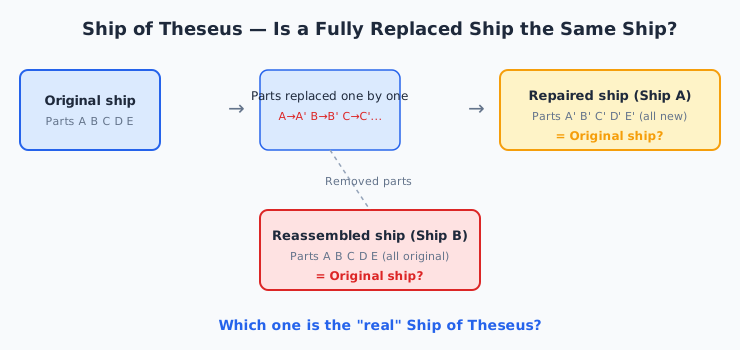
According to legend, the ship that carried the Athenian hero Theseus home after he slew the Minotaur on Crete was preserved by the Athenians for centuries as a memorial.
Being a wooden ship, it decayed with time. The Athenians maintained it by replacing rotting planks with fresh ones — one board here, a new rudder there. After enough cycles of repair, not a single piece of the original ship remained.
The question: Is the fully repaired ship still the Ship of Theseus?
A More Troubling Twist
The 17th-century English philosopher Thomas Hobbes made the puzzle even more vexing.
Suppose the removed old planks were saved rather than discarded, and eventually reassembled into a second ship. Now there are two ships:
- Ship A: The ship repaired plank by plank, still in harbour, having never left service as “the Ship of Theseus.”
- Ship B: A ship built entirely from the original planks of Theseus’s vessel.
Which one is the “real” Ship of Theseus?
Ship A has continuity: it never left service, it has always been called the Ship of Theseus. Ship B has the original matter: every piece of wood that once made up Theseus’s ship.
Both claims have merit — that is what makes this paradox so compelling.
Everyday Parallels
The Ship of Theseus may sound like a remote ancient puzzle, but the same problem appears in daily life.
Human body cells are said to be almost entirely replaced over roughly seven years (the actual biology is more complex, but the point stands). The person you were seven years ago and the person you are today share almost no physical matter. Yet we say we are the “same person.”
If your grandfather’s knife has its handle replaced, and then years later its blade replaced, is it still “grandfather’s knife”? If you swap every component of a smartphone one by one, is it still the same phone?
All of these questions share the same structure as the Ship of Theseus.
Philosophers’ Approaches
There are several major positions on this problem.
One is to prioritize continuity. So long as a ship’s existence as a continuous object is unbroken, it remains the same ship — even if every component is eventually replaced. This is why a Japanese temple regularly reconstructed on the same site is still considered the same temple.
Another prioritizes material composition. If identity is determined by physical constitution, then Ship B — built from the original wood — is the genuine article.
A third holds that “identity” itself is merely a convenient label humans apply. Nothing is ever perfectly identical over time; calling something “the same” is a practical decision driven by utility, not a metaphysical fact.
In the World of Programming
As a side note, this problem also arises in software. In object-oriented programming, if all properties of an object are changed, is it still the same object?
In databases, a record retains its identity as long as its ID stays the same, regardless of how its content changes — identity is equated with a unique identifier. This is a pragmatic solution to the paradox. The reason it works cleanly in software but not in the real world is precisely why the Ship of Theseus has remained unsolved for 2,000 years.
Four positions that give different verdicts
Philosophy has sorted the question of how identity is fixed into several positions. Applied to the ship of Theseus, they separate cleanly.
| Position | What it weighs | Is the repaired ship the same? |
|---|---|---|
| Materialism | the matter it is made of | it is a different ship |
| Formalism | its shape and structure | it is the same ship |
| Functionalism | the role it performs | it is the same ship |
| Spatiotemporal continuity | continuity through time | it is the same ship |
Only materialism answers “a different ship”. Apply that position to human beings, though, and it causes trouble.
The cells of the body are constantly replaced, and depending on the type they turn over completely in anything from days to years. Carry materialism through and the conclusion is that the person you were a few years ago is a different person from you now.
The fourth position, spatiotemporal continuity, avoids that difficulty. Even as the matter is exchanged, an unbroken connection makes it the same thing.
It has its own weak point over the ship rebuilt from the old parts, since that ship too is continuous with the original when traced part by part.
Perhaps looking for a single answer is the mistake
A position often taken in recent years is that identity is settled by context.
Legal ownership, the record in a history of shipbuilding, the attachment felt by the crew. On this view the answer is allowed to change with the standpoint from which the question is asked.
- The legal context: judged by continuity of registration and ownership
- The historical context: which is the ship with the pedigree
- The practical context: whether it can be used is the criterion
The diagnosis is that the answer would not settle because the question was incomplete.
Ask not “is it the same ship” but “the same for what purpose” and each setting yields an answer. For practical purposes I find this the most usable way of organising it.
Real ships of Theseus
The argument looks abstract, and there are plenty of real objects that face exactly this problem.
- Ise Grand Shrine: the shrine buildings have been rebuilt every twenty years for 1,300 years. Not a single piece of the original timber remains
- Hōryū-ji temple: repeated dismantling and repair has replaced a considerable share of its members
- Classic car restoration: competition rules divide finely over how many parts may be replaced before it counts as a different car
- Ships preserved in museums: many are kept going by substituting corroded members
The Ise example is a particularly interesting one. Materially it is entirely different, and nobody doubts that it is the same shrine.
What carries the identity here is not the building but the practice of continuing to rebuild it by the same procedure. A position close to formalism, put into effect as an institution.
European heritage conservation, by contrast, has mostly worked to retain as much original material as possible. That approach, typified by the Venice Charter, is closer to materialism.
The same word — preservation — names entirely different practices in different places. The contrast makes it plain that the ship of Theseus is not an abstract argument.
Related paradoxes of identity
Related paradoxes asking what it takes for something to remain the same thing.
Summary
This article covered “The Ship of Theseus” paradox.
What it means for something to be the same thing is a philosophical problem with no clear answer from ancient Greece to the present day. Perhaps the fact that the question has no definitive answer is exactly what makes it worth continuing to think about.
To return to the full list of paradoxes, follow the link below.
Thank you for reading. We hope to see you in the next article.

Also popular with readers
📚 Series: The World's Paradoxes (3/81)