Thank you for visiting this site. This article covers the “Abilene Paradox.”
A meeting where nobody actually supports a proposal passes it unanimously. A family that nobody really wants to visit ends up going there together. Everyone is against it, yet everyone agrees — this terrifyingly common organizational phenomenon is the Abilene Paradox.
The Story Behind the Name
This paradox was proposed by management scholar Jerry Harvey in 1974, based on his own experience.
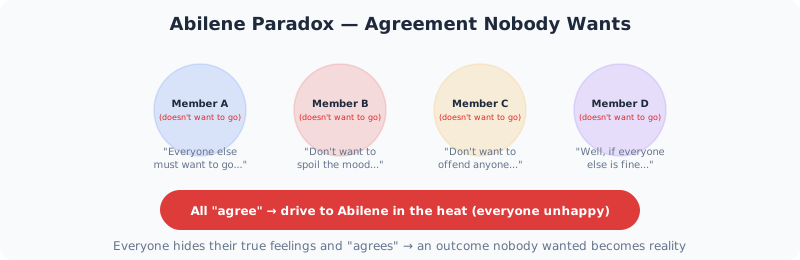
On a hot summer day in Texas, Harvey was relaxing at his in-laws’ home. His father-in-law suggested, “How about a drive to Abilene for dinner?” Abilene was about 85 kilometres each way — 170 kilometres round trip in the sweltering Texas heat, with no air conditioning in the car.
Harvey privately thought “No way, not in this heat,” but when his wife said “Sounds great, let’s go,” he went along with it: “Sure, let’s do it.” His mother-in-law chimed in: “Of course I’ll come.”
The result: a long, sweaty drive, a mediocre meal, and everyone exhausted on the way home.
Back home, Harvey admitted, “Honestly, I didn’t enjoy that much.” To his astonishment, his wife replied, “Neither did I. I only agreed because you seemed to want to go,” and his mother-in-law added, “I didn’t want to go either.” Finally, his father-in-law confessed: “To tell the truth, I didn’t really want to go. I just thought everyone was bored and would enjoy a trip.”
All four people didn’t want to go to Abilene — yet all four went.
Why Does This Happen?
Several factors cause the Abilene Paradox.
Fear of conflict: People don’t want to spoil the atmosphere by voicing dissent. This tendency is especially strong in cultures where group harmony is highly valued.
False assumptions: “Everyone else seems to agree, so maybe my objection is wrong” — individuals convince themselves their private view is the minority view.
Diffusion of responsibility: “Surely someone else will speak up” — everyone expects someone else to object, so nobody does.
Pluralistic ignorance: Each person believes they alone are opposed, unaware that in reality everyone opposes it. Each member misreads others’ silence as agreement.
Serious Business Consequences
The Abilene Paradox may be amusing at a family dinner, but in business settings it can cause serious damage.
In a project meeting, every stakeholder believes “this project will fail,” yet nobody objects — the project is approved and hundreds of millions are lost.
In a board meeting, everyone thinks “this acquisition is overpriced,” but because the CEO seems enthusiastic, nobody challenges it — and company value is destroyed.
Such cases happen regularly in real organizations. The Space Shuttle Challenger disaster (1986) is sometimes discussed in this context: engineers who knew about the risk of the O-rings reportedly struggled to strongly argue against the launch, and the paradox is cited as a contributing factor.
How It Differs from Groupthink
A related concept is “groupthink,” but the two differ in an important way.
In groupthink, the group’s cohesion is so strong that members genuinely come to believe the group’s position is correct — even individually.
In the Abilene Paradox, by contrast, individuals know the group’s conclusion is wrong but cannot bring themselves to say so. The problem lies not in “conformity” but in “silence.”
Prevention
To prevent the Abilene Paradox in an organization, building a culture that “welcomes dissenting opinions” is essential.
Practical measures include having everyone submit opinions anonymously before a decision is made, designating a “devil’s advocate” role whose job is to argue the opposite view, and explicitly stating at the start of a meeting: “Please don’t hesitate to voice any objections.”
How a conclusion nobody wants gets through
What makes the Abilene paradox awkward is that it happens where there is neither malice nor conflict. Everyone considers everyone else, and the group lands on something none of them wanted.
Break down what is happening and there are several stages.
| Stage | What each person thinks | What is actually said |
|---|---|---|
| Proposal | just filling the silence | ”how about we…” |
| First agreement | reluctant, but hard to be the one to object | ”sounds good” |
| Following on | agreement is already on the table | ”I’m in favour too” |
| Consensus reached | everyone was against it | ”settled, then” |
The second stage is what is called pluralistic ignorance: each person believes they alone hold the dissenting view, while in fact everyone believes the same thing.
From the third stage on, each additional agreement raises the psychological cost of objecting. The fact that whoever agreed first now finds it even harder to object later adds to it.
What actually works in a meeting
The known remedies all work in the same direction: lowering the cost to whoever speaks first.
- Write before speaking. Have everyone put their view in writing, then reveal it
- Assign the objector. Making dissent a role separates it from the person’s real position
- Senior people speak last. Once someone with standing states a view, the rest of the discussion converges on it
- Require reasons for agreement. Do not let “sounds good” pass; ask why it is good
The fourth is the one that bites hardest in practice, because the moment somebody tries to give a reason, both they and the room discover that they were not in favour.
Rather than the atmosphere that makes objecting hard, the real problem is that agreeing is too cheap. Framed that way, the remedy is easier to find.
I make a point of pausing on the proposals everyone agreed to. Mistaking an absence of objection for strength of consensus comes back later as nobody actually doing anything.
The difference from groupthink, again
The Abilene paradox and groupthink are easily confused, and their causes differ.
| Aspect | Abilene paradox | Groupthink |
|---|---|---|
| What each person actually thinks | they are opposed | they genuinely agree |
| What is happening | a failure to communicate views | a distortion of judgement itself |
| Group cohesion | happens without it | more likely in cohesive groups |
| Direction of the remedy | make it easier to say what you think | bring in an outside perspective |
Abilene is a communication problem; groupthink is a cognitive one.
With Abilene, ask everyone individually and you get the right answer. The information exists inside the group and simply has not been shared.
With groupthink, asking individually returns the same answer, because judgement really has shifted inside the group.
This is why the remedies differ. Anonymous collection of views works for Abilene and does nothing for groupthink: everybody genuinely believes the same thing, so anonymity changes no answers.
Even the proposer did not want it
The most interesting part is that even the person who proposed it was not keen.
In the original anecdote the father-in-law only suggested the trip because he thought everyone was bored. The proposer had no strong intention, and the proposal nonetheless became the default course.
- An offhand suggestion is made to fill a gap
- Nobody objects, because there is nothing to object to
- It becomes the default, and stopping it now requires a reason
Stopping something already in motion is harder than never starting it. That asymmetry does the work.
Most people have watched a casual suggestion turn into a decision. That the situation “the person who suggested it is the one suffering most” arises so often makes sense once you see the structure.
Related paradoxes of collective decision-making
Related paradoxes about groups failing to reach a decision that is rational as a group.

Summary
This article covered the “Abilene Paradox.”
“Everyone agrees” might actually mean nobody agrees. Simply keeping this possibility in mind can dramatically improve the quality of organizational decision-making.
To return to the full list of paradoxes, follow the link below.
Thank you for reading. We hope to see you in the next article.

Also popular with readers
📚 Series: The World's Paradoxes (64/81)