Thank you for visiting this site. This article covers the “Banach–Tarski Paradox.”
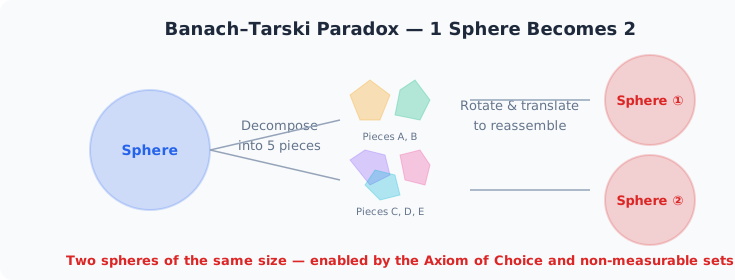
Cut a ball into five pieces, then reassemble them using only rotations and translations — and you end up with two balls of exactly the same size. Incredible as it sounds, this was mathematically proved with complete rigor in 1924 by Polish mathematicians Stefan Banach and Alfred Tarski.
It is widely considered one of the most counter-intuitive theorems in all of mathematics, and it raises profound questions about the very foundations of the discipline.
What Was Proved?
More precisely, the theorem states:
A sphere in three-dimensional space can be partitioned into a finite number of pieces, which can then be reassembled by rotations and translations alone to form two spheres each of the same size as the original.
Crucially, no “stretching” or “compression” is involved — purely rotation and translation. Yet the volume doubles. This appears to violate the laws of physics, but mathematically it is correct.
The minimum number of pieces required is five. It has also been proved that four pieces are insufficient. The fact that just five pieces suffice makes the paradox all the more startling.
How Is This Possible?
The trick lies in the nature of the “pieces” themselves.
When we cut a cake or an apple in everyday life, each piece has a well-defined volume, and the volumes of all pieces sum to the original. But the pieces in the Banach–Tarski decomposition are strange shapes for which the usual notion of “volume” cannot be defined. These are called “non-measurable sets” in mathematics — they exist as collections of points, but they are so infinitely complex in structure that no volume in cubic centimetres (or any unit) can be meaningfully assigned to them.
Because no volume can be assigned to the pieces, the rule “sum of volumes = original volume” does not apply. This is what makes the apparently volume-multiplying reassembly possible.
What Is a Non-Measurable Set?
To understand non-measurable sets, consider a one-dimensional analogy.
Take the interval of real numbers from 0 to 1. Choose points according to a certain special rule and group them: take exactly one point from each group — the result is a “Vitali set.”
The Vitali set cannot be assigned a length (the one-dimensional analogue of volume). If its length were 0, countably many translated copies would still have total length 0 — unable to cover the interval from 0 to 1. If its length were positive, countably many copies would have infinite total length — unable to fit within a finite interval. Both lead to contradictions, so assigning any length at all is impossible.
The pieces in the Banach–Tarski decomposition are a three-dimensional extension of this same idea.
The Role of the Axiom of Choice
Essential to the Banach–Tarski Paradox is a mathematical axiom called the Axiom of Choice.
Informally, the Axiom of Choice states that given any collection of non-empty sets, there exists a function that selects one element from each set. In everyday contexts this seems obvious, but when infinitely many sets are involved, it is a powerful claim.
The non-measurable pieces in the Banach–Tarski decomposition are constructed using exactly this axiom. Without the Axiom of Choice, such pieces cannot be built, and the paradox does not arise.
Because the paradox is so counter-intuitive, some mathematicians argued that “the Axiom of Choice should not be accepted.” But since the axiom is used to prove many important theorems — Zorn’s Lemma, the Tychonoff theorem, the existence of a basis for every vector space, and others — it cannot simply be discarded.
Modern mathematics generally accepts the Axiom of Choice, and the Banach–Tarski Paradox is recognized as a “counter-intuitive but correct theorem.” The paradox is regarded as the price one pays for adopting the Axiom of Choice.
Why Doesn’t It Work in Two Dimensions?
Interestingly, the Banach–Tarski Paradox holds only in three or more dimensions — it fails in one or two dimensions.
The reason is that the rotation group in three dimensions contains a structure called a “free group,” which can generate infinitely complex combinations and enables the “paradoxical decomposition” needed to construct the non-measurable sets. The two-dimensional rotation group lacks this structure, so the same approach cannot be applied.
Can It Be Physically Executed?
Naturally, duplicating a ball in the real world is impossible.
The reason is that the pieces in the Banach–Tarski decomposition are physically unrealizable shapes of infinite complexity — no knife, no matter how precise, could cut them out.
Because matter is made of atoms, physical cutting cannot go below the atomic scale. The Banach–Tarski Paradox exists only in the idealized mathematical world where matter is treated as “a set of points.”
Even so, the fact that a mathematically rigorous theorem can completely violate physical intuition poses a deep question about the relationship between mathematics and physics. Mathematics is a language for describing the physical world, yet mathematics contains concepts with no physical counterpart. The Banach–Tarski Paradox is the most dramatic example of this. It invites deep questions about how far mathematics corresponds to physical reality.
Whether to accept the axiom of choice
What makes the theorem hard to accept is the axiom of choice used in its proof. Mathematicians are not of one mind about it either.
With and without it
| Position | Axiom of choice | What you gain | What you lose |
|---|---|---|---|
| Standard mathematics (ZFC) | accepted | nearly all of modern mathematics can be developed | counter-intuitive theorems like Banach–Tarski |
| ZF alone | rejected | no non-measurable sets, so no such decomposition | many important theorems of linear algebra and analysis |
| Up to dependent choice | partially accepted | the main results of analysis survive | some general theorems become unavailable |
The second row is worth dwelling on. Discard the axiom of choice and the ball indeed stops multiplying, at far too high a price.
Basic properties go with it — that every vector space has a basis, that any two sets are comparable in size. A wide swathe of mathematics becomes unusable.
The mainstream position today is therefore to adopt the axiom of choice in full knowledge that strange conclusions follow.
Why it fails in the plane
As noted earlier, the theorem holds only in three or more dimensions. The reason lies in the nature of rotations.
- Rotations in the plane: the order makes no difference to the result. They form a commutative group
- Rotations in space: changing the order changes the result. They form a non-commutative group
The non-commutativity of spatial rotations is what creates room for the operations that take the ball apart and reassemble it. Plane rotations commute, so an area-preserving measure can be defined and nothing can be multiplied.
It is the nature of three-dimensional space itself that makes the theorem possible. That the dimension of the space we live in should carry mathematical significance in this particular way is an appealing thought.
The two mathematicians in the name
The theorem was published in 1924 by the Poles Stefan Banach and Alfred Tarski.
Banach laid the foundations of functional analysis and gave his name to the concept of a Banach space. Tarski, as a logician, is known for Tarski’s theorem on the definition of truth.
The Lwów school they belonged to was famous for a distinctive research culture. They gathered at an establishment called the Scottish Café, writing problems into a notebook and arguing over them.
The notebook is known as the Scottish Book, and its records include a live goose offered as the prize for an unsolved problem. Important results of modern mathematics were coming out of café conversation.
Tarski also left an unsolved problem in the plane: the circle-squaring problem, asking whether a disc can be cut into finitely many pieces and rearranged into a square of the same area. Miklós Laczkovich proved in 1990 that it can.
Related paradoxes of mathematical infinity
Related paradoxes about the counter-intuitive behaviour of infinite sets.



Summary
This article covered the “Banach–Tarski Paradox.”
The conclusion that a sphere can be split into two copies of itself is breathtakingly shocking, and it vividly exposes the strangeness lurking at the core of mathematics — infinity and set theory. Mathematical theorems need not be intuitively obvious; this paradox teaches that lesson with extraordinary force.
To return to the full list of paradoxes, follow the link below.
Thank you for reading. We hope to see you in the next article.
Also popular with readers
📚 Series: The World's Paradoxes (16/81)