Thank you for visiting this site. This article covers “Russell’s Paradox.”
In 1901, British philosopher and mathematician Bertrand Russell discovered a fatal contradiction lurking in set theory — then regarded as the foundation of all mathematics. The paradox sent shockwaves through the mathematical world and forced an overhaul of its very foundations.
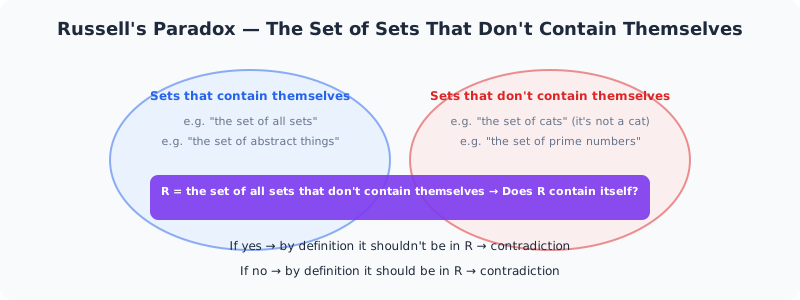
The Paradox
First, a brief note on sets. A set is simply a collection of objects. The set of fruits contains apples and bananas; the set of even numbers contains 2, 4, 6, …
Some sets contain themselves as a member; others do not. The set of all sets is itself a set, so it contains itself. The set of fruits is not a fruit, so it does not contain itself.
Russell then considered the following set:
R = the set of all sets that do NOT contain themselves.
The set of fruits does not contain itself → it belongs to R. The set of even numbers does not contain itself → it belongs to R.
Now the crucial question: Does R contain itself?
If R contains itself: R is a member of R. But R is defined as the collection of sets that do not contain themselves. If R contains itself, then by definition it should not be in R. Contradiction.
If R does not contain itself: R is not a member of R. But R is exactly the collection of sets that do not contain themselves. Since R does not contain itself, it should be in R. Contradiction.
Either answer produces a contradiction.
The Barber Analogy
Russell’s Paradox can be restated in everyday terms as the Barber Paradox.
In a village there is a barber who shaves all and only those men who do not shave themselves.
Does the barber shave himself?
If he does: he is shaving a man who shaves himself — but the barber only shaves men who do not shave themselves. Contradiction.
If he does not: he is a man who does not shave himself — but the barber shaves all such men. Contradiction.
The logical structure is identical to Russell’s Paradox.
The Shock to Mathematics
When Russell discovered the paradox, German mathematician Gottlob Frege was putting the finishing touches on the second volume of The Basic Laws of Arithmetic — an ambitious project to build all of mathematics rigorously on the foundations of set theory. The book was about to go to press when Russell’s letter arrived, pointing out the contradiction.
Frege is reported to have written that “arithmetic has been reduced to rubble.” To have the foundations of one’s life’s work collapse at the moment of completion is almost too painful to contemplate.
The Resolution
The paradox compelled mathematicians to rigorously respecify the rules for constructing sets.
The result was the Zermelo–Fraenkel set theory (ZF), first published by Zermelo in 1908 and later refined by Fraenkel. ZFC (ZF plus the Axiom of Choice) restricts how sets may be formed: instead of allowing any property whatsoever to define a set, new sets may only be formed by selecting elements from already existing sets that satisfy some condition.
Under these rules, “the set of all sets that do not contain themselves” cannot even be constructed — the paradox is blocked from the outset.
Modern mathematics is built on ZFC, and Russell’s Paradox does not arise within it. However, the consistency of set theory itself cannot be proven (this follows from Gödel’s Incompleteness Theorems), so the foundations of mathematics remain subtly uncertain.
The letter that reached Frege
Behind the paradox’s place in mathematical history is a famous episode.
On 16 June 1902, the 29-year-old Russell wrote to the German logician Gottlob Frege. Frege was then pursuing the grand project of deriving arithmetic from logic alone, and the second volume of its culmination, Basic Laws of Arithmetic, was already at the printer.
The letter pointed out that a contradiction could be derived within Frege’s system.
Frege’s reply is one of the most affecting passages in the history of mathematics. He wrote, in effect, that the contradiction Russell had found was the greatest surprise, indeed something close to consternation, since it shook the foundation on which he had meant to build arithmetic.
Frege added an appendix to the second volume acknowledging that his system was defective. A life’s work collapsed on the eve of publication.
He effectively abandoned the logicist programme thereafter and turned, in later years, toward seeking a foundation in geometry.
The man who pointed it out did not escape either
Russell, for his part, did not stop at pointing it out. He set about building a system that avoids the contradiction.
The result was Principia Mathematica, written with Alfred North Whitehead and published in three volumes between 1910 and 1913.
The famous detail is that proving 1 + 1 = 2 took more than 300 pages of the first volume. It stands as a monument to what happens when the obvious is built up without a single leap.
Two solutions that went separate ways
Approaches to avoiding the contradiction split broadly in two.
| Approach | Proposer and year | The restriction | Where it stands today |
|---|---|---|---|
| Type theory | Russell, 1908 | assign objects a hierarchy and forbid reference within a level | a side current as a foundation for mathematics |
| Axiomatic set theory | Zermelo, 1908 | new sets can be formed only from existing sets | the modern standard (ZFC) |
ZFC became the standard in mathematics, and type theory survived somewhere else entirely.
In the type systems of programming languages. Assigning types to values and forbidding operations whose types do not match is built on nearly the same idea as Russell’s hierarchy.
- Type checking: adding an integer to a string fails to compile
- Dependent types: advanced systems where types themselves depend on values
- Proof assistants: Coq and Lean verify mathematical proofs mechanically on a foundation of type theory
Machinery devised a century ago to prevent contradiction is now used to prevent bugs. The application changed; the job — using types to stop something from carelessly referring to itself and falling apart — did not.
Where naive set theory was too generous
One more level down into the cause of the contradiction.
Set theory at the time carried a premise called the axiom of comprehension: write a condition and the set of everything satisfying it exists.
It looks obvious enough. Write “is even” and you get the set of even numbers; write “is red” and you get the set of red things. It matches everyday intuition.
Russell put the condition “does not contain itself” into that axiom. Nothing about the condition is unusual, and the moment the corresponding set is formed, a contradiction appears.
The problem was not the content of the condition but the promise that any condition whatsoever yields a set.
The axiom of separation adopted by ZFC weakens that promise. Given a set A that already exists, only the part of A whose elements satisfy the condition is admitted as a new set.
You cannot summon a set out of nothing with a condition alone. Thanks to that restriction, the offending set cannot be constructed in the first place.
Related paradoxes of self-reference
Related paradoxes where meaning collapses the moment something tries to speak about itself.

Summary
This article covered “Russell’s Paradox.”
A single clever question shook the foundations of mathematics and forced the reconstruction of the entire subject’s basis. In terms of intellectual impact, this paradox ranks among the most consequential in the history of human thought.
To return to the full list of paradoxes, follow the link below.
Thank you for reading. We hope to see you in the next article.
Also popular with readers
📚 Series: The World's Paradoxes (15/81)