Thank you for visiting this site. This article covers “The Crocodile Paradox (the Crocodile’s Dilemma).”
On the banks of the Nile, a crocodile seizes a mother’s child. The crocodile says: “If you correctly guess what I will do with this child, I will return it.” When the mother answers “You will not return the child,” the crocodile finds itself unable to take either action.
Devised by ancient Greek logicians, this paradox continues to pose fundamental questions about logic more than 2,400 years later.
The Structure of the Paradox
Let us lay out the crocodile’s promise carefully.
“If the mother’s prediction is correct, the child will be returned. If wrong, the child will not be returned.”
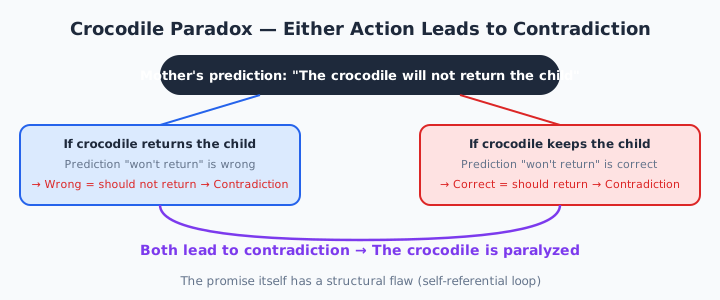
The mother predicted: “The crocodile will not return the child.” Now consider two cases.
Case 1: The crocodile returns the child. The mother’s prediction (“won’t return”) turns out to be wrong. Per the promise, a wrong prediction means the child should not be returned. But the crocodile is returning it. Contradiction.
Case 2: The crocodile does not return the child. The mother’s prediction (“won’t return”) turns out to be correct. Per the promise, a correct prediction means the child should be returned. But the crocodile is not returning it. Contradiction again.
Either action the crocodile takes contradicts its promise, leaving it paralyzed.
Why the Mother’s Answer Creates the Problem
What is notable is that a different answer from the mother would have caused no problem at all.
Suppose the mother had answered “You will return the child.” If the crocodile returns it, the prediction is correct and the promise is kept — no contradiction. If the crocodile does not return it, the prediction is wrong and the promise is also kept — no contradiction either. The crocodile is free to act.
The paradox arises only when the mother answers “You will not return it.” This answer precisely targets the structural weakness in the crocodile’s promise. Whether intentionally or by chance, the mother chose the answer that destroys the promise from the inside.
Relation to the Liar’s Paradox
The Crocodile Paradox shares the same structure as the Liar’s Paradox.
In the Liar’s Paradox, the sentence “This statement is false” generates a contradiction whether it is true or false. In the Crocodile Paradox, the mother’s answer refers to the crocodile’s action, and the crocodile’s action determines whether the mother’s answer is correct — a circular self-referential structure lies at the heart of the paradox.
But the Crocodile Paradox has a feature the Liar’s Paradox does not. The Liar’s Paradox is a purely linguistic problem; the Crocodile Paradox involves a “promise” — an act with real-world consequences. The logical contradiction manifests as an actual impossibility of action.
Ancient Origins
The paradox dates to ancient Greece. It was already known around the 4th century BC and is recorded as one of the “insoluble problems” discussed by Stoic philosopher Chrysippus.
The Roman rhetorician Quintilian also mentions it in his Institutio Oratoria, suggesting it was used in rhetorical education as a standard example of a “question that cannot be answered logically.”
In medieval Europe, the study of “insolubilia” (unsolvable propositions) flourished, and the Crocodile Paradox was debated repeatedly in that context. Oxford logicians of the 14th century systematically classified such self-referential propositions and laid groundwork that would eventually lead to Russell’s type theory and Tarski’s theorem on the indefinability of truth.
Analysis from Modern Logic
In modern logic, the Crocodile Paradox is understood as: “the conditional structure of the promise itself contains an inherent contradiction.”
Formally, the crocodile’s promise is a kind of “biconditional”: “Prediction is correct ↔ child is returned.” Once the mother predicts “won’t return,” this biconditional collapses into “won’t return ↔ will return” — a direct contradiction.
The problem lies not in the mother’s cleverness, but in the fact that the promise the crocodile constructed is logically inconsistent for certain responses. The crocodile made an unkeepable promise from the start.
This has legal implications too. A contract containing an internal contradiction — where fulfilling one clause makes it impossible to fulfill another — may be void. The crocodile’s promise is a classic example of such a “logically unenforceable contract.”
Similar Structures in Everyday Life
The Crocodile Paradox’s structure lurks in everyday situations as well.
The Unexpected Examination Paradox — where a teacher announces “I will give a surprise exam with no advance notice” — also has a self-referential structure: the teacher’s action (giving the exam) depends on students’ predictions, and students’ predictions depend on the teacher’s announcement.
In game theory’s “ultimatum game,” each player predicts the other’s action and decides their own based on that prediction. The circular dependency — your prediction shapes my action, my action determines whether your prediction was right — is embedded in many strategic situations.
An ancient lawsuit of the same shape
The crocodile story has a more realistic sibling: the anecdote of Protagoras and Euathlus.
Protagoras, a teacher of rhetoric in ancient Greece, made the following contract with his student Euathlus. Payment of the fee could be deferred, on the condition that it would be paid when Euathlus won his first case.
Euathlus, however, did not practise as an advocate after completing his studies. The fee went unpaid.
Losing patience, Protagoras sued him, arguing in court as follows.
If I win, he must pay by the judgement. If I lose, he has won his first case and must pay by the contract. Either way he pays.
Euathlus replied with the argument exactly inverted.
If I win, I need not pay by the judgement. If I lose, I have not won my first case and need not pay by the contract. Either way I do not pay.
From precisely the same situation, opposite conclusions follow with equal force.
What is missing is the order of contract and judgement
Seen with modern eyes, the cause of the deadlock is clear: it has not been settled which takes effect first, the contract or the judgement.
| Order of application | Protagoras’s argument | Euathlus’s argument |
|---|---|---|
| Judgement first | winning lets him enforce payment | winning means he need not pay |
| Contract first | losing still allows recovery by contract | losing still leaves no obligation |
| Order undetermined | both hold | both hold |
Legal practice specifies procedural order in detail precisely to avoid circles of this kind. Rules on when a judgement becomes final, on the standards for interpreting a contractual clause, on the point at which a condition counts as fulfilled — all of them exist to prevent this sort of deadlock.
- Conditional obligations: state explicitly the point at which fulfilment of the condition is judged
- Res judicata: limit the scope over which a final judgement takes effect
- Good faith: treat unfavourably a party who deliberately obstructed fulfilment of the condition
The crocodile stays a fable while the Protagoras anecdote has been told for centuries, because it carries the practical lesson that letting self-reference into a contract causes real trouble.
The danger of a promise with a prediction built in
What the crocodile story and the Protagoras anecdote share is building the other party’s prediction, or the outcome of a contest, into the condition.
An ordinary promise is conditioned on an external fact. “Cancelled if it rains” is settled independently of either party’s judgement.
The crocodile, however, made “if you guess what I will do” the condition — his own action. Since his action is part of the condition, judging the condition requires the action to be settled, and settling the action requires the condition to be judged.
- A safe condition: a fact fixed independently of the parties’ intentions
- A risky condition: the act of judging the condition affects the outcome
- A condition that cannot hold: judging the condition requires the result of that judgement
Similar problems arise in practice with performance-linked pay and success-fee contracts. Where the party being evaluated can influence the evaluation criteria themselves, the condition risks becoming circular.
When drafting a contract, check that judging the condition is independent of the parties’ own actions. The crocodile shows the need for that check in an extreme form.
Related paradoxes of self-reference
Related paradoxes where meaning collapses the moment something tries to speak about itself.
Summary
This article covered “The Crocodile Paradox.”
This paradox, which has puzzled people since antiquity, is a classic demonstration of how self-reference can destroy logic. When a promise or contract contains a reference to one’s own future actions, logically irresolvable situations can arise — a lesson delivered through a memorable and slightly absurd fable.
A question that remains as fresh as ever, 2,400 years on.
To return to the full list of paradoxes, follow the link below.
Thank you for reading. We hope to see you in the next article.
Also popular with readers
📚 Series: The World's Paradoxes (12/81)