Thank you for visiting this site. This article covers the “Liar’s Paradox.”
“This statement is false” — just this one sentence has troubled logicians and philosophers for more than 2,000 years. Neither true nor false, or simultaneously true and false. The strange problem this sentence poses has the power to shake the very foundations of logic.
What Is the Liar’s Paradox?
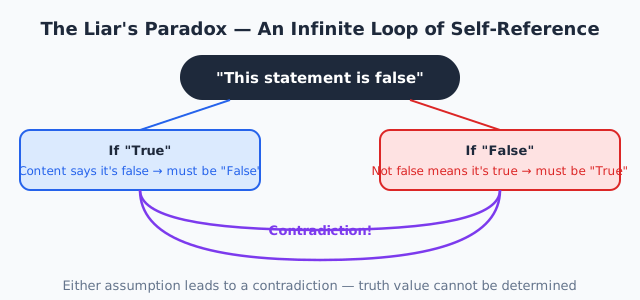
Consider the sentence: “This statement is false.”
Suppose the statement is true. Its content says “this statement is false,” so the statement is a lie — meaning it is false. We assumed it was true, but ended up with false.
Now suppose the statement is false. If “this statement is false” is itself false, then the statement is not a lie — it is true. We assumed it was false, but ended up with true.
Assuming true leads to false; assuming false leads to true. Neither conclusion is stable. This is the Liar’s Paradox.
The Ancient Greek Original
The oldest known version of this paradox is attributed to Epimenides, a philosopher from Crete in the 6th century BCE. Being a Cretan himself, Epimenides reportedly said, “All Cretans are liars.”
If his statement is true, then Cretans are all liars, so Epimenides — a Cretan — is lying, meaning the statement is false…
Strictly speaking, Epimenides’ version does not form a pure paradox. If “All Cretans are liars” is false, then some Cretans might be honest, and Epimenides could be among the dishonest Cretans without contradiction.
The purer form — “This statement is false” — is a self-referential sentence credited to the ancient Greek philosopher Eubulides.
The Danger of Self-Reference
The root cause of the Liar’s Paradox is that the sentence is talking about itself — it is self-referential.
An ordinary sentence, such as “Tokyo is the capital of Japan,” speaks about an external object — Tokyo. There is no difficulty assigning it a truth value.
But “This statement is false” talks about its own truth value. To evaluate whether it is true, we must refer to its own content; to understand its content, we need to know its truth value. This circular structure is what generates the paradox.
Is “I am a liar” a paradox too?
A question that may occur here: “surely it is the same if a person says it rather than a sentence?” If somebody says “I am a liar,” is that a paradox?
It is not. “I am a liar” is a claim about that person’s character or habits, not a reference to the truth of the utterance itself.
- Said by somebody who really does lie a lot → true, no contradiction
- Said by an honest person → false, no contradiction
Neither assumption produces a contradiction. Like “Tokyo is the capital of Japan,” it merely describes an external object — in this case one’s own habits.
So when does a person speaking produce the paradox? When they say “what I am saying at this very moment is a lie.” A person utters it, and it refers directly to the truth of that utterance, giving it exactly the structure of “this sentence is false.”
The heart of the paradox is therefore not “sentence or person” but whether the utterance refers to its own truth value. Whether the subject is “this sentence” or “what I am saying now,” the same contradiction appears as long as its own truth is at issue.
Impact on Modern Mathematics
The Liar’s Paradox is no mere word game — it had a revolutionary impact on 20th-century mathematics and logic.
Kurt Gödel’s Incompleteness Theorems, published in 1931, cleverly exploited the structure of the Liar’s Paradox. Gödel constructed a mathematical statement that says “This proposition cannot be proved,” and used it to show that within any sufficiently powerful formal system there must exist “true statements that cannot be proved.”
Alan Turing’s halting problem applies the same self-referential structure. Considering a program that judges whether it itself halts leads to a contradiction, proving that no universal halting-detection program can exist.
In this way, the “contradiction through self-reference” at the heart of the Liar’s Paradox connects to fundamental discoveries in mathematics and computer science.
Are There Solutions?
Several proposed solutions to the Liar’s Paradox have been put forward.
Bertrand Russell proposed “Type Theory,” which forbids a statement from speaking about itself. Statements may only refer to statements of a lower type.
Alfred Tarski introduced “levels of truth,” arguing that the truth of sentences in a language cannot be evaluated within that same language — it requires a higher-level metalanguage.
More recently, Saul Kripke’s 1975 “Fixed-Point Theory of Truth” has gained traction. It assigns a third value — “undefined” — to the liar sentence, neither true nor false. This avoids contradiction by abandoning classical two-valued logic.
Each solution has its merits, yet none has definitively dissolved the problem. Every approach carries a cost, and the Liar’s Paradox remains an active area of research in logic and philosophy.
Three-valued logic does not get away either
Of the solutions above, the one that admits a third value — neither true nor false — has a famous weakness.
The strengthened liar
Consider this sentence.
This sentence is not true.
The difference is “not true” rather than “false.” Three-valued logic supplies a value, undefined, that is neither true nor false.
- If the sentence is true, then as it says it is not true — contradiction
- If it is false, then it is not true, so its content is correct and it is true — contradiction
- If it is undefined, then it is still not true, so its content is correct and it is true — contradiction again
Supplying a third value does not help, because that value gets swept up into “not true” along with everything else.
This is called the strengthened liar, or the revenge paradox. Every time a solution is offered, a new sentence can be built that absorbs the solution.
The main solutions and their limits
| Solution | Proposer and year | Approach | Weakness |
|---|---|---|---|
| Type theory | Russell, 1908 | forbid a sentence from referring to its own level | far too rigid as a description of ordinary language |
| Metalanguage | Tarski, 1933 | truth can only be spoken of in a higher language | natural language has no such hierarchy |
| Three-valued logic | Kleene and others | admit a value that is neither true nor false | broken by the strengthened liar |
| Fixed-point theory | Kripke, 1975 | allow sentences with no settled truth value | seen from outside, the same problem recurs |
| Context dependence | Parsons and others | evaluation changes when the context changes | the shift of context is hard to formalise |
Each proposal struggles as soon as somebody builds a new liar sentence that presupposes it.
The liar has survived two thousand years not merely because it is hard, but because it has the property of being regenerated out of the very material offered to solve it.
It shows up in ordinary speech too
It looks like a matter of strict logic, and the same structure slips into everyday phrasing.
- “Don’t believe anything I say.” Believe it and you are not believing; disbelieve it and you are not complying
- “There is no rule without exceptions.” If that claim is itself a rule without exceptions, it contradicts itself
- “Never state anything categorically.” Stated categorically
- “Everything is relative.” Leaving the question of whether this one claim is absolute
In each case the meaning turns on whether the claim includes itself in its own scope.
Some of them are not strictly contradictory. “There is no rule without exceptions” holds together if you admit itself as an exception — at considerable cost to its force.
When a claim of this shape turns up in a discussion, simply asking “does that apply to what you just said?” tends to sort things out.
Related paradoxes of self-reference
Related paradoxes where meaning collapses the moment something tries to speak about itself.
Summary
This article covered the “Liar’s Paradox.”
A single sentence that shook the foundations of logic, and that connects to Gödel’s Incompleteness Theorems and the halting problem in computer science — this paradox stands as one of the most impactful contributions to humanity’s intellectual heritage.
To return to the full list of paradoxes, follow the link below.
Thank you for reading. We hope to see you in the next article.
Also popular with readers
📚 Series: The World's Paradoxes (6/81)