Thank you for visiting this site. This article covers “The Sorites Paradox (the Paradox of the Heap).”
This paradox is generated by vagueness itself — a logical puzzle arising from the fact that many concepts we use every day have no sharp boundaries.
The Paradox of the Heap
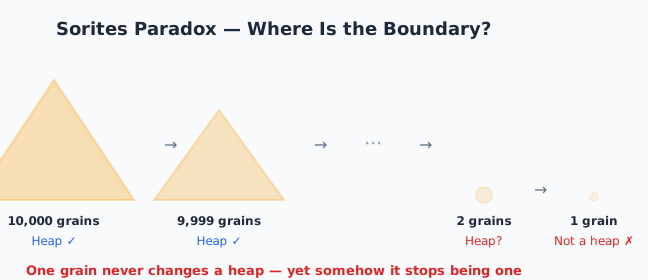
Suppose you have a heap of 10,000 grains of sand. Everyone would agree: that is a heap.
Remove one grain. 9,999 grains. Still a heap — obviously. One grain makes no difference.
Remove another. 9,998 grains. Still a heap.
And another. 9,997 grains. Still a heap.
Repeat this one-grain-at-a-time removal. Nobody disputes that taking away a single grain cannot turn a heap into a non-heap.
But carry the logic all the way to its conclusion and a single grain must also be a heap. Carry it further: zero grains — nothing at all — must also be a heap.
That is clearly absurd. But it is impossible to point to exactly where the absurdity crept in. That is the Sorites Paradox (sorites comes from the Greek soros, meaning heap).
The Same Paradox in Reverse
Interestingly, the paradox works from the other direction too.
One grain of sand: not a heap. Add one grain — two grains. Still not a heap. Add another — three grains. Still not.
If “adding a single grain can never turn a non-heap into a heap,” then no matter how many grains you add, you can never get a heap. But 10,000 grains obviously form a heap.
There must be some number at which a collection becomes a heap — but that line cannot be drawn anywhere. That is the core of the paradox.
Sorites Problems in Everyday Life
The Sorites Paradox is not merely a puzzle about sand. It exposes a fact about the vagueness inherent in language and concepts themselves.
A person with no hair at all is bald. Does one hair change that? Two hairs? A hundred hairs? Where is the boundary between bald and not bald?
Similarly: at exactly what height does a person become tall? At exactly what age does a person stop being young? Exactly where does red end and orange begin?
These predicates — called vague predicates or degree adjectives — fill human language. Concepts with perfectly sharp boundaries may actually be the exception.
Vagueness in Law
The most practically consequential arena for the Sorites Paradox is law.
Drink-driving limits, for instance, are set at a precise blood-alcohol concentration — say 0.03%. Below that: legal. Above that: illegal. Yet there is no meaningful difference in driving ability between 0.029% and 0.030%.
Law deliberately draws a sharp line where nature provides only a gradual transition. This may be a pragmatic response to the paradox. But the line always invites the question: “Why there and not somewhere else?”
Philosophical Responses
Philosophers have proposed several approaches.
Epistemicism holds that a sharp boundary between “heap” and “non-heap” actually exists — say, at exactly 4,327 grains. We simply cannot know where it is. There is an objective fact of the matter; human cognition cannot identify it.
Fuzzy logic assigns a degree of heaphood on a scale from 0 to 1. Ten thousand grains: heaphood 1.0. Five thousand: 0.8. One thousand: 0.3. Instead of black-or-white, truth is a gradient.
Supervaluationism considers every permissible way of drawing the boundary and counts a sentence as true only if it is true under all such sharpenings — an elegant technical solution, though not always intuitive.
None of these approaches has won universal acceptance. The paradox remains open.
How to handle a vague predicate
What makes the sorites awkward is that almost every word in ordinary language has the same property.
Tall, young, heavy, near, many — none of them has a clear boundary. In the sense that no line can be drawn where a difference of one millimetre flips the verdict, they all share the structure of the heap.
| Response | The claim | The difficulty |
|---|---|---|
| Epistemicism | the boundary exists and is unknowable to humans | nobody can say where it is |
| Many-valued logic | admit degrees between true and false | the boundaries between degrees are vague in turn |
| Supervaluationism | count as true only what is true wherever the line is drawn | individual verdicts stay suspended |
| Contextualism | the standard is fixed by context | fix the context and the problem returns |
Epistemicism runs against intuition, and it has the merit of leaving logic untouched. The claim is that there is an exact boundary at some particular number of grains, and humans simply have no means of knowing it.
Many-valued logic admits degrees such as “a heap to degree 0.7”. It is close in spirit to fuzzy control in engineering.
Since the boundary between 0.7 and 0.71 still has to be somewhere, though, the criticism is that the problem has only been pushed one step back.
Situations where a line has to be drawn
Theory aside, practical work cannot proceed without settling a boundary.
The age of majority, speed limits, the poverty line, disaster warning levels — every one of them draws a line across something continuous.
- The grounds for the line: it is fixed by operational necessity, not by correctness in any strict sense
- Handling the borderline: buffer it with exemptions and graduated bands
- The premise for revision: it is not the right answer, so it may move when circumstances do
What matters is whether whoever draws the line is aware that the boundary carries no necessity.
There is no essential difference between eighteen and seventeen years and eleven months. The line is needed all the same, which is exactly why the practice around it should allow some latitude. The sorites problem can be used as the grounds for that attitude.
Argument patterns that work by accumulation
The structure of the sorites is also used as a technique for winning arguments. Several of them have names.
- The slippery slope: claiming that conceding a small step leads to an extreme conclusion
- Accumulated precedent: using an exception once granted as grounds for the next
- Incremental demands: stacking small concessions to extract a large one in the end
- Gradual loosening of a standard: relaxing it slightly each time until it has become a different standard
All of them exploit the fact that each individual change is too small to give a reason for objecting to.
Remove one grain and the heap is still a heap. A single exception makes no great difference. Each claim is reasonable on its own, and repeated, they end up a long way from where they began.
One way to handle it is to judge not “is this instance acceptable” but “how many times are we going in this direction”. Estimating the cumulative effect up front stops the smallness of each step from carrying you along.
I use this view when requests to add features keep arriving. Judged one at a time they all get through, so the approach is to look at them together before deciding.
Related paradoxes of identity
Related paradoxes asking what it takes for something to remain the same thing.
Summary
This article covered “The Sorites Paradox.”
What this paradox reveals is that the concepts and words we use every day are far vaguer and less clearly bounded than we normally assume. That everyday life runs smoothly nonetheless may be because we have learned, without realizing it, to live gracefully with vagueness.
To return to the full list of paradoxes, follow the link below.
Thank you for reading. We hope to see you in the next article.
Also popular with readers
📚 Series: The World's Paradoxes (5/81)