Thank you for visiting this site. This article covers “Descartes’ Evil Demon.”
If an all-powerful demon existed and were cunningly showing your mind a false world, what could you hold to be “certain”? If the sky, the earth, your own hands, and even the sum “1 + 1 = 2” might be falsehoods planted by the demon —
This is no mere eerie fantasy. From this extreme thought experiment of “doubting everything to the very end,” modern philosophy took its historic first step. And at the end of it lies a line everyone has heard at least once: “I think, therefore I am.” This article traces, step by step, how Descartes deepened his doubt and reached that single point of certainty.
Background
This thought experiment was developed by the 17th-century French philosopher René Descartes in his 1641 work Meditations on First Philosophy. Often called the “father of modern philosophy,” Descartes was also a great mathematician, remembered for the Cartesian coordinate system.
In the Europe of his time, the old systems of learning long held as authoritative were beginning to wobble as science advanced. What Descartes sought was an absolutely certain starting point for knowledge — one beyond all possible doubt. Just as a castle built on sand collapses, learning too must be rebuilt on unshakable bedrock.
His method seems paradoxical: “in order to find what is certain, first doubt everything thoroughly.” He adopted the strict stance of “setting aside as false, for now, anything that admits the slightest doubt.” This is the “method of doubt.” The point is not to doubt the world for real, but to doubt as a “method” for sieving out what is certain.
Stage One: Doubting the Senses
Descartes sieves what we believe, from the weakest doubt upward, in stages.
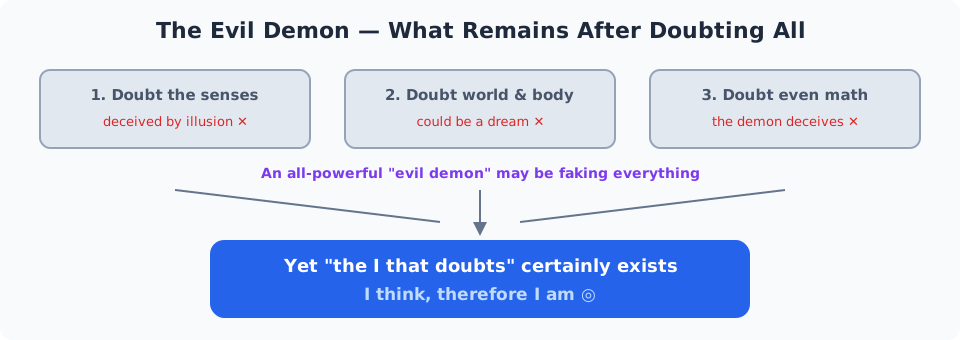
His first target is the “senses.” We ordinarily trust what we see and hear without question. But the senses often deceive us. A straight stick looks bent in water; a distant tower looks round but turns out square up close.
Descartes sets a strict criterion: “anything that has ever deceived me cannot be fully trusted.” Since the senses sometimes deceive, he sets all sense-based knowledge aside as unfit to serve as a certain foundation.
Stage Two: The Dream Argument
Still, can we doubt even the most ordinary and certain-seeming things, like “I am sitting here at my desk right now”? Here Descartes brings in “dreams.”
In dreams we have experiences as vivid as waking life, indistinguishable from it. In a dream we do not realize it is a dream and believe everything to be real. So how can we be certain that “this very moment is not a dream”?
Through this “dream argument,” even the existence of one’s own body and of the external world itself becomes doubtful. The room before you, your own hands — all might be a scene in an elaborate dream.
Stage Three: The Evil Demon and Doubt of Mathematics
Yet one thing still stands unshaken: mathematics. Whether in a dream or awake, “2 + 3 = 5” and “a square has four sides” seem to remain true.
Here Descartes introduces the ultimate supposition at the core of the thought experiment: the “evil demon (or deceiving god).”
“Perhaps there exists an all-powerful and malicious demon who, to deceive me, feeds every falsehood into my mind. The sky, the earth, everything I see and hear, and even my own body — perhaps all of it is a cunning illusion the demon shows me.”
And — frighteningly — if this demon is omnipotent, it could even arrange that “every time I compute 2 + 3, I am made to err.” The very certainty with which I am convinced that “2 + 3 = 5, this is absolutely certain” might be an error implanted by the demon.
Thus Descartes brings even mathematical truth, for now, within the scope of doubt. This is doubt as thorough as it can possibly be. Nothing certain seems to remain.
What Cannot Be Doubted
At precisely the moment when everything has become doubtful, Descartes arrives at one certain thing.
He asks himself: “I am, right now, doubting everything — the sky, my body, even mathematics, all possibly false. But can that very ‘I who doubts’ be said not to exist?”
Here is the decisive insight: however cunningly the demon deceives me, for me to be deceived there must first exist an ‘I’ to be deceived. If I am being fooled, the very “I” who is fooled exists beyond doubt. The fact of thinking and doubting is itself irrefutable proof that the thinking, doubting subject exists.
The demon can perhaps show me a sky and make me err at arithmetic. But it cannot reduce me to nothing in the very instant that “I am thinking that I exist.” This alone no all-powerful demon can overturn.
So came the most famous line in the history of philosophy:
“I think, therefore I am (cogito, ergo sum).”
This was the “bedrock of certainty” that survives all doubt. From this single foothold, Descartes went on to build a grand system — proving the existence of God, then rebuilding the existence of the external world.
Debate and Criticism
Descartes’ argument became the starting point of modern philosophy, but it has drawn sharp criticism. One is: “‘I think, therefore I am’ may establish the existence of ‘thinking,’ but does it really prove the existence of an ‘I (a self as substance)’ as the subject of that thinking?” Perhaps all that is certain is that “there is now thinking,” and Descartes simply presupposed a persisting “I who thinks.” When Descartes later uses God’s existence to rebuild the external world, his reasoning has long been charged with circularity — the famous “Cartesian circle.” The debate over these criticisms became a powerful engine driving later philosophy forward.
Why It Matters
Descartes’ evil demon marked a decisive turning point in two ways.
First, it sought the certainty of knowledge within “the thinking self (the subject)” rather than “the outside world.” Ancient and medieval philosophy typically started from the world or from God. Descartes reversed this, placing the subject at the starting point of philosophy with “what is first certain is the thinking I.” This was the dawn of “modern philosophy.”
Second is its enormous influence on later thought. “Brain in a vat,” the film The Matrix, and the “simulation argument” — covered elsewhere in this series — are all descendants of the “evil demon.” Descartes built the prototype of the question “is the reality I experience truly real?” in its sharpest form nearly 400 years ago.
Related Thought Experiments
These thought experiments in epistemology ask “what is reality?” and “is there certain knowledge?” You can see how Descartes’ demon was inherited by the modern era.

Summary
This article covered “Descartes’ Evil Demon.”
Having doubted the senses, then dreams, then even mathematics, the one thing that remained was “the I who is thinking.” By doubting everything thoroughly, one reaches a certainty that nothing can shake — this paradoxical path is one of the most vivid examples of what it means to think philosophically.
In daily life we accept the world around us without question. But once you ask, as Descartes did, “is this really certain?”, you notice how much of what seems obvious in fact stands on a surprisingly shaky foundation. And the certainty that survives that doubt — “I am, right now, thinking” — is fresh and startling no matter how many times you taste it.
Thank you for reading. We hope to see you in the next article.

Also popular with readers
📚 Series: Famous Thought Experiments (20/60)