Thank you for visiting this site. This article covers “The Chinese Room.”
When you chat with an AI like ChatGPT, it can feel as though the other side genuinely understands what words mean. Faced with an AI that answers fluently and even cracks jokes, some people feel “this thing must have a mind.” But does the AI really understand anything? Or is it merely manipulating an enormous pile of symbols with great skill?
This question was raised more than 40 years before ChatGPT appeared, by the thought experiment known as “The Chinese Room.” It is not just a dusty piece of old philosophy — it is, precisely now that generative AI has entered everyday life, one of the most urgent questions we face. This article walks through the setup, Searle’s aim, the many replies it provoked, and its contemporary significance.
The Background
The Chinese Room was proposed in 1980 by the American philosopher John Searle, in his paper “Minds, Brains, and Programs.”
Behind this argument lay a debate that was heating up at the time: “Can artificial intelligence have a mind?” The “Turing Test,” proposed by the mathematician Alan Turing in 1950, held that if a human conversing with a machine cannot tell it apart from a person, we may regard the machine as intelligent. As long as the behavior is indistinguishable from a human’s, the inside need not be questioned.
At the time, a philosophy called “functionalism” was also influential, viewing the mind as an information-processing “program.” On this view, the mind is like “software” running on the “hardware” of the brain. If so, running the same program on a computer ought to give rise to a mind there too. Searle devised one vivid scene to challenge this optimism head-on.
The Setup
It goes like this.
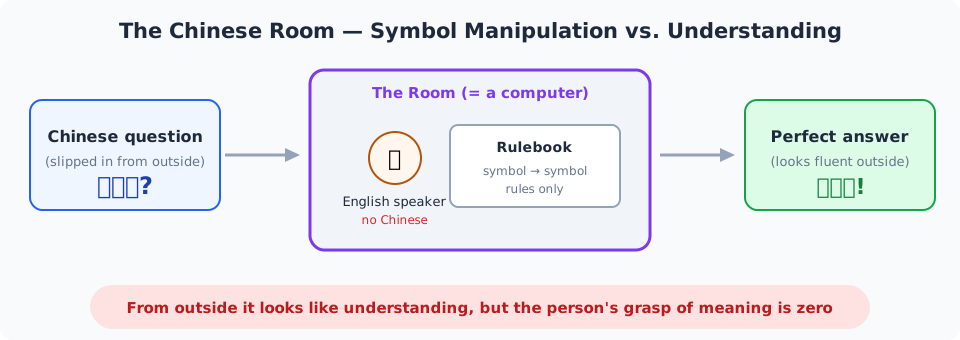
Inside a room sits a person who understands no Chinese at all — imagine Searle himself. To him, Chinese characters look like meaningless tangles of curves.
In the room there is a huge stack of cards printed with Chinese characters, and a thick manual, written in English, that gives detailed instructions of the form “if this symbol comes in, send out that symbol.” The manual says nothing about what any character means; it tells him only how to rearrange them based on their shapes.
Outside the room, a native Chinese speaker slips in questions written in Chinese — for example, “What is your favorite food?” — all in characters, of course. The person inside understands none of it, but he carefully follows the manual, combines the right cards as instructed, and passes the answer back out. The native speaker reads a perfect Chinese reply and becomes convinced that “there is someone in the room who understands Chinese.”
In reality, however, the person inside has not understood a single character of what he was asked or answered. He has merely matched shapes and shuffled symbols mechanically.
The Room Is Exactly a Computer
What Searle points out is that this room perfectly reproduces the operation of a computer.
- The Chinese questions coming in = the input data
- The thick manual = the program
- The person inside = the CPU (processor)
- The Chinese answers going out = the output data
In other words, the room behaves well enough to pass the Turing Test, yet inside it no understanding whatsoever is taking place. The person inside is doing exactly what a computer does when it runs a program.
If so, then a computer running the same kind of process — no matter how fluently it responds — understands nothing at all. That is Searle’s central claim.
Strong AI and Weak AI
Searle distinguished two stances toward AI.
“Weak AI” treats the computer as a “useful tool for studying the mind.” Simulating brain processes to aid research, for instance — Searle has no objection to this.
What he targeted was “Strong AI,” the view that a computer running the right program literally has a mind and genuinely understands things, just as a human does. The Chinese Room was built as a counterexample to Strong AI.
Syntax Does Not Yield Semantics
Stated more precisely, Searle’s argument runs:
- A computer program is fully defined by rules for manipulating symbols (syntax).
- The human mind has an understanding of what symbols mean (semantics).
- Semantics can never arise from syntax alone.
- Therefore a computer that merely runs a program cannot have a mind (understanding).
The person in the Chinese Room can manipulate (syntax) the symbols flawlessly, yet has no idea what they mean (semantics). Searle called this capacity to connect to meaning “intentionality.” A computer, he argued, lacks this intentionality.
When a human understands the word “apple,” it connects to a real apple, the color red, a sweet taste, memories of eating one. For the Chinese Room, by contrast, a character is mechanically linked only to other characters and connects to nothing in the world.
The Major Replies, and Searle’s Responses
The Chinese Room sparked fierce debate the moment it appeared. Searle’s paper itself anticipated several objections and answered them, and the argument has continued ever since.
The Systems Reply
The most famous objection is the “Systems Reply.” It argues that “even if the person inside does not understand Chinese, the whole ‘system’ — room, manual, cards, and person together — does understand.” Just as no single neuron in your brain understands English yet the whole brain does.
Searle answers: “Then let the person memorize the entire manual and all the cards, step outside, and do the whole task in his head. Now the person is the entire system — and he still understands not a word of Chinese.” Internalizing the system produces no understanding.
The Robot Reply
Next is the “Robot Reply”: “Put the room inside a robot and let it engage the world through cameras and sensors, and the symbols will become grounded in real things and acquire meaning.” The idea is that understanding arises once symbols are grounded in the world.
Searle counters: “The camera’s images, too, just enter the room as numbers (symbols). The person inside cannot tell whether they are images of the outside world or merely random symbols.” Adding sensors changes nothing, because the input is still symbolic.
The Brain Simulator Reply
The “Brain Simulator Reply” claims that “if you precisely simulate every neuron firing in a Chinese speaker’s brain, surely understanding must arise.”
Here Searle offers a striking image: “Suppose you build a vast system of water pipes and valves to reproduce the brain’s neural circuitry, and the person inside opens and closes valves to mimic the firing pattern. Who could believe that the plumbing understands Chinese?” Copying the mechanism does not make understanding appear.
Other Replies
Beyond these, many arguments have been exchanged — the “Other Minds Reply” (“we can only ever infer other people’s minds from behavior, so why single out AI?”) and variations like the “Chinese Gym,” in which many people share the processing. No final verdict has been reached, and the Chinese Room remains one of the most important and most contested themes in the philosophy of mind.
Its Meaning in the ChatGPT Era
With the arrival of large language models (LLMs), the Chinese Room has suddenly returned as a front-line topic.
An AI like ChatGPT generates human-like text by repeatedly choosing “the word most likely to come next” from vast amounts of data. It does not understand meaning; it arranges symbols according to statistical patterns — strikingly similar to how the Chinese Room matches symbols and returns replies.
For this reason, critics — including linguists and AI researchers — repeatedly argue that “LLMs do not understand the meaning of words. They are just a gigantic, sophisticated Chinese Room.” The phenomenon of an AI producing plausible sentences without meaning is sometimes mocked as a “stochastic parrot.” The problem that symbols are not tied to anything in the world is long known in AI as the “symbol grounding problem.”
There are also powerful counterarguments: “If behavior this sophisticated and flexible is possible, perhaps we should just call it understanding,” and more radically, “Isn’t human understanding itself just symbol-processing by neurons in the brain? If so, there is no essential difference between humans and AI.” The latter targets the way Searle’s argument relies on the premise that “only the human brain is special.”
The question the Chinese Room posed has only grown sharper now that AI is woven into daily life. Asking “what is it to understand?” is no longer just a problem about AI — it is a problem about the nature of our own minds.
Related Thought Experiments
These thought experiments in the philosophy of mind ask “what is the mind?” and “where does consciousness come from?” Reading them together brings the depth of the problem into view.
Summary
This article covered “The Chinese Room.”
Is flawlessly manipulating symbols the same as understanding their meaning, or something entirely different? Searle drew a hard line between the two with his slogan “semantics cannot arise from syntax.” Yet the objection persists that sufficiently sophisticated symbol manipulation may be indistinguishable from understanding.
What matters is that this thought experiment succeeds not at “producing an answer” but at “sharpening the question.” For those of us who exchange words with AI daily, “is this thing in front of me understanding, or just pretending to understand?” is no longer an idle puzzle. The next time you talk with an AI, try recalling the Chinese Room.
Thank you for reading. We hope to see you in the next article.

Also popular with readers
📚 Series: Famous Thought Experiments (2/60)