Thank you for visiting this site. This article covers “Mary’s Room.”
When a scientist who knows more about color than anyone in the world sees “red” for the very first time, does she learn something new? Or did she already know it all?
It sounds at first like making a fuss over the obvious. Yet this deceptively simple question leads straight to philosophy’s deepest puzzles: “What is knowledge? What is consciousness? Can the world be fully explained by the physical?” This article follows the setup, Jackson’s argument, the objections, and the surprising twist in which the original author later changed his own position.
The Setup
Mary’s Room is a thought experiment proposed in 1982 by the Australian philosopher Frank Jackson, in his paper “Epiphenomenal Qualia.” It is also called the “knowledge argument.”
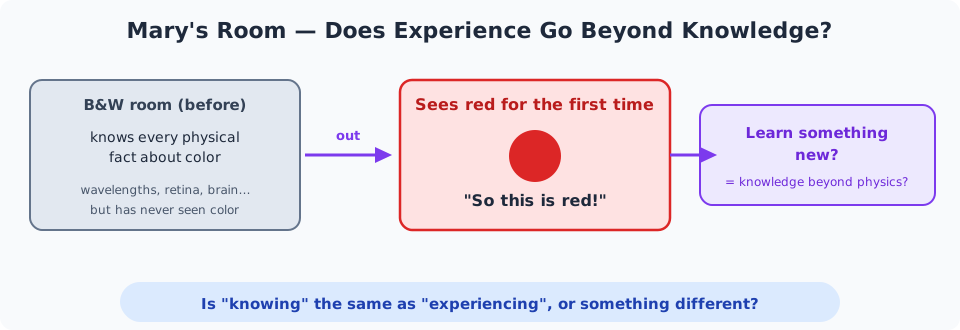
Mary is a woman who has never once seen color. She was raised in a room that is entirely black and white, and she knows the outside world only through a black-and-white monitor. We can suppose even her own body is kept color-free with gloves and paint.
But here is the crucial point: Mary is also the world’s foremost expert on color vision. Through black-and-white books and monitors, she has mastered the complete science of color perception:
- The wavelengths of light and which retinal cells they stimulate
- What signals travel along the optic nerve
- Which neurons in the visual cortex fire, and how
- Every physical and chemical process that occurs in the brain “when one sees a ripe tomato”
In short, Mary knows every physical fact about color perception — from the level of atoms to neuroscience, she can explain anything physics has to say about color.
One day, Mary leaves the black-and-white room for the first time. And for the first time in her life, she sees a real red tomato.
Here is the question: “Does Mary learn anything new at this moment?”
Intuition Says “She Learns”
Most people intuitively feel that “Mary learns something new.” The instant she steps out, she surely gasps and thinks, “Ah — so this is what it’s like to see red!”
This is decisive. Mary supposedly knew every physical fact about color, and yet she seems to learn something new — what red looks like. No matter how many times she read “light of 700 nanometers…”, the experience of actually seeing red was not contained in it.
This “experience of seeing red itself” — the subjective quality of the sensation — is what philosophers call “qualia.”
Jackson’s Argument
Jackson assembled this intuition into a single clear argument:
- Before leaving, Mary knew all the physical facts about color.
- Yet on leaving, she learned something new (what red looks like).
- So there was a fact she had not known.
- That fact is not a physical fact (she already knew all of those).
- Hence there exist facts in the world that cannot be captured by physical facts alone.
- Therefore physicalism (the view that everything is explicable in physical terms) is false.
The crux is the single point that “even knowing everything physical, there is still something new to learn.” If that is true, the claim that “physics is all there is” collapses. Mary’s Room is a remarkably sharp thought experiment aimed at showing that qualia cannot be exhausted by the language of physics.
The Major Objections
Physicalists have offered many objections. Here are the main ones.
The Ability Hypothesis
The most famous is the “ability hypothesis.” It holds that what Mary gained on leaving was not a new “factual knowledge” but a new “ability.” She acquired practical skills — the ability to imagine red, recognize red at a glance, recall red from memory — without learning any new fact about the world. Just as you learn to ride a bicycle with your body, she “became able to do something new.” If so, physicalism is unharmed.
She Learned an Old Fact in a New Way
Another strong objection: “she merely came to know the same fact in a new way.” Mary had grasped one and the same fact through scientific description; afterward she grasped that same fact through actual experience. The mode of presentation changed, but no new fact was added — much as “the morning star” and “the evening star” name the same planet Venus in different ways.
Would She Really Learn?
A bolder objection holds that “if she truly knew every physical fact, Mary could deduce in advance what red looks like, and so would not be surprised on leaving.” We feel “Mary must be surprised” only because we fail to imagine how staggeringly vast it would be to “know every physical fact.”
Jackson’s Own Change of Heart
This thought experiment has one of the most dramatic sequels in the history of philosophy.
The author himself, Frank Jackson, later abandoned the argument and converted to physicalism. Though he found his own knowledge argument compelling, he eventually concluded that physicalism was more plausible — partly on the grounds that treating qualia as having no causal power (no effect on behavior) leads to a more puzzling result.
To turn against an argument you yourself put into the world speaks to how stubborn and unresolved a puzzle Mary’s Room is. It is a thought experiment that kept even its own author wavering to the end.
Why It Matters
What Mary’s Room ultimately asks is the foundational question of modern philosophy and science: “Can everything in the world be reduced to physical facts?”
If the “experience of seeing red” cannot be fully written out in the language of physics, then there is a region of our minds that science cannot in principle reach. Conversely, if everything reduces to the physical, then a sufficiently advanced brain science will one day explain even “experience itself.”
This is no idle puzzle. No words can convey “red” to someone blind from birth; no description can convey a flavor to someone who has never tasted it. Perhaps experience contains something that cannot be put into words or equations — and Mary’s Room is groundbreaking for extracting that intuition in a form anyone can grasp.
Related Thought Experiments
These thought experiments in the philosophy of mind concern consciousness and qualia. Read together, they reveal the gap between experience and the physical in three dimensions.


Summary
This article covered “Mary’s Room.”
Is having complete knowledge of something the same as actually experiencing it, or different? The objections — “she only gained an ability,” “she knew an old fact in a new way” — are sharp, and the author himself switched sides, so there is no easy answer.
That is precisely what makes Mary’s Room so compelling. No other thought experiment so vividly illuminates the strangeness of “experience,” which science cannot quite carve up. The next time you see a vivid color — a sunset, autumn leaves — recall Mary stepping out of her black-and-white room. That “sense of seeing” is the front line of philosophy.
Thank you for reading. We hope to see you in the next article.

Also popular with readers
📚 Series: Famous Thought Experiments (4/60)