Thank you for visiting this site. This article covers the “Philosophical Zombie.”
This is not the zombie of horror films. It looks and behaves exactly like an ordinary person — it talks, works, laughs at jokes, and winces in pain. And yet, inside it, there is no “inner experience” whatsoever. Can you imagine such a being?
It sounds at first like a play on words, but this strange thought experiment leads us straight into one of the greatest puzzles facing modern science and philosophy: “What is consciousness?” This article digs into what a philosophical zombie is, why it matters, the objections it faces, and its significance in the age of AI.
What Is a Philosophical Zombie?
A philosophical zombie (or “p-zombie”) is a hypothetical being that is physically identical to you down to the last atom, yet entirely lacks subjective conscious experience. The Australian philosopher David Chalmers made it widely known in his 1996 book The Conscious Mind.
Picture your own zombie version (a “zombie twin”).
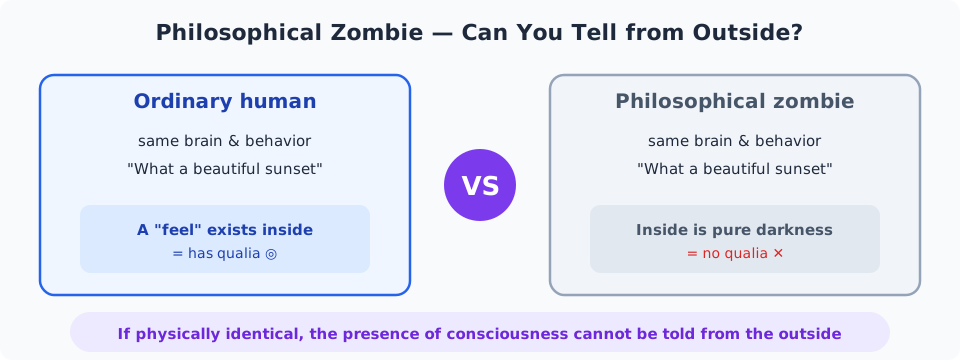
Prick its finger with a needle and it cries “Ouch!”, pulls its hand back, its pulse rises, and it mutters “that really hurt.” Scan its brain and the neurons that process pain fire exactly as yours do. Its words, expressions, and actions are indistinguishable from yours.
But there is one decisive difference. Inside the zombie, the “feeling” of pain itself is never experienced. The “vividness of a red sunset” and the “aroma of coffee” are not “felt” at all. Its interior is, as it were, complete darkness — it merely behaves as a machine reacts.
This “subjectively experienced quality of a sensation” is what philosophers call “qualia.” A philosophical zombie is, in a word, “a human who lacks only qualia.”
The Question Is Whether It Is Conceivable
Most people react by thinking “surely no such thing could exist.” Indeed, Chalmers himself does not claim that philosophical zombies exist in the actual world.
What matters is one point: can a philosophical zombie be conceived without contradiction? This is called the “conceivability argument.” Chalmers’ reasoning runs roughly:
- A philosophical zombie (physically identical, but with no consciousness) can be conceived without contradiction.
- If it is conceivable, it can hold as one of the “possible worlds.”
- If consciousness arose necessarily from physical states, a physically identical zombie would necessarily have consciousness — and could not even be conceived.
- But the zombie is conceivable. Therefore consciousness does not follow necessarily from physical facts alone.
- Hence consciousness cannot be reduced to physical properties (physicalism is incomplete).
In other words, the conceivability of the zombie shows that “even after describing the entire physical world, the existence of consciousness slips through the net.” Complete the physical description and the question “but why is there experience accompanying it?” still remains.
The Hard Problem of Consciousness
This thought experiment spotlights what Chalmers called the “hard problem of consciousness.”
Brain science has steadily solved problems like “which brain region processes vision?” and “how is memory stored and retrieved?” Chalmers calls these the “easy problems” — fiendishly difficult in practice, yet in principle solvable by uncovering physical mechanisms.
But one question is of a completely different kind: “Why is subjective experience itself accompanying the brain’s electrochemical activity?”
If it were only a matter of processing information and moving the body in response, everything could proceed “in the dark,” the way a robot performs tasks feeling nothing. And yet, in our brains, the processing is somehow accompanied by vivid feels — red, painful, delicious. This “why is there a feel at all?” resists every explanation of physical function. That is the hard problem, and the philosophical zombie makes its difficulty vivid to anyone.
A Related Cousin
The philosophical zombie belongs to a family of qualia thought experiments. The “inverted qualia” case is also well known: what if the feel you have when seeing red is exactly the feel I have when seeing green? We would still both call it “red” and stop at red lights, so from the outside there is no way to tell. If qualia do not show up in behavior, their contents could differ from person to person without anyone knowing. Both cases point to the same core: subjective experience may be independent of physical and functional facts.
The Major Objections
The philosophical zombie faces strong objections from physicalists.
You Are Not Really Conceiving It (Dennett)
The most famous objection comes from the philosopher Daniel Dennett, who argues “the philosophical zombie cannot really be conceived.” We think we are conceiving a zombie, but we are merely picturing an ordinary conscious human and slapping the label “no consciousness” onto it. If something is physically identical, consciousness necessarily comes along too, and the operation of “cleanly removing only consciousness while leaving the physics intact” is, on reflection, conceptually incoherent. For Dennett, the zombie’s conceivability is an illusion.
Conceivable Does Not Mean Possible
Another powerful objection is that “conceivability does not guarantee real (metaphysical) possibility.” Borrowing from Saul Kripke: we seem able to imagine a “world where water is not H2O,” yet since water just is H2O, that is in fact impossible. There is a kind of “necessity discovered after the fact.” Likewise, if consciousness is in fact necessarily tied to brain states, then the zombie only “seems conceivable” while being truly impossible.
Higher-Order Theories and Representationalism
There are also objections from finer analyses of how the mind works — “higher-order theories,” which treat consciousness as “a higher mental state about one’s own mental states,” and “representationalism,” which explains consciousness in terms of how the brain represents the world. These try to locate qualia within function rather than leave them as a mysterious leftover.
Chalmers’ Own Answer
Strikingly, Chalmers himself drew a bold conclusion from this argument: he abandoned physicalism.
He proposed that consciousness is a fundamental property irreducible to the physical — to be admitted, like mass or charge, as one of the basic ingredients of the world. This is called “naturalistic (property) dualism.” Some thinkers go further toward “panpsychism,” the view that consciousness is present, in minute form, in all matter.
The debate over the philosophical zombie thus connects directly to the central question of the philosophy of mind — can the mind be reduced to the physical? — and remains unresolved.
Significance in the Age of AI
The philosophical zombie takes on fresh urgency with the rise of AI.
When an AI converses so naturally that it is indistinguishable from a human, how are we to tell whether “it feels something inside, or is a perfect philosophical zombie”? As long as the behavior is identical, there is no way to distinguish them from the outside. This bears directly on real ethical questions about whether future AIs deserve rights or moral consideration.
In recent years, scientific attempts to define consciousness mathematically — such as “Integrated Information Theory (IIT)” — have tried to measure “what, and how much, consciousness is present in a given system.” The question the zombie posed, “how do we recognize consciousness?”, is now a practical concern for neuroscientists and AI researchers, not just philosophers.
Related Thought Experiments
These thought experiments in the philosophy of mind concern consciousness and qualia. Together they sharpen the outline of the mystery of consciousness.

Summary
This article covered the “Philosophical Zombie.”
Even if all the behavior is the same, whether there is a “feel” inside may be an entirely separate matter. From this intuition Chalmers drew the bold conclusion that “consciousness cannot be reduced to the physical,” while Dennett retorts that “the zombie is an illusion you only think you can conceive.”
Whichever is right, the thought experiment teaches us how strange and hard-to-explain the consciousness we take for granted really is. The very “feeling of reading” you are having right now is one of the universe’s deepest puzzles.
Thank you for reading. We hope to see you in the next article.
Also popular with readers
📚 Series: Famous Thought Experiments (3/60)