Thank you for visiting this site. This article covers “Brain in a Vat.”
The screen you are looking at right now, the sounds you hear, the feel of the chair or phone in your hand — if all of it were fake signals fed directly into your brain by a computer, could you see through it?
It may sound like a wild fantasy. But the moment you try to prove that “I am not being shown a fake world,” you find it astonishingly hard. Famous as the inspiration behind the film The Matrix, this thought experiment quietly but thoroughly shakes what we call “reality.” This article walks through the setup, why refutation is so difficult, and the philosopher Putnam’s ingenious counter.
The Setup
“Brain in a vat” became widely known through the American philosopher Hilary Putnam, who discussed it in his 1981 book Reason, Truth and History. The idea’s roots, however, go back to Descartes’ skepticism, which we touch on below.
Picture the following as concretely as you can.
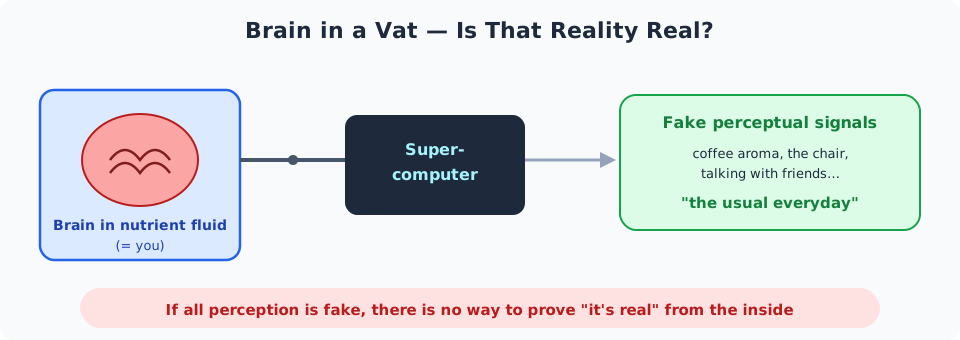
An evil genius scientist, while you sleep, performs an operation: he removes your brain from your skull and floats it in a vat filled with a life-sustaining nutrient fluid. Countless fine electrodes are attached to the severed nerve endings, all connected to a supercomputer.
This computer sends your brain electrical signals utterly indistinguishable from real experience, without the slightest flaw. You wake to an alarm clock, enjoy the aroma of fresh coffee, ride a packed train, laugh with colleagues at work, and gather around the dinner table with family at night — experiencing all of it vividly, in living detail.
In reality, however, you are a single brain bobbing in a vat of nutrient fluid in some corner of a lab. The coffee, the train, the colleagues, the family — all of it is an elaborate fabrication generated by the computer.
Here is the question: “Can you prove that you are not a brain in a vat?”
Why Refutation Is Astonishingly Hard
Intuitively, everyone wants to say “of course not — this is reality.” Yet the moment you try to prove it, you hit one dead end after another.
Suppose you think “I’ll look at my hand and pinch it. It hurts, so this is real.” But the sight of the hand and the pain of the pinch may both be signals fed in by the computer. Pain is no proof of reality.
Then “I’ll ask another person to confirm.” Unfortunately, that other person may also be a character the computer is showing you. “I’ll have an expert examine my brain” — the expert, the results, all of it may be part of the simulation.
The core of the problem is this: every means by which we know the world passes, without exception, through perception (signals) delivered to the brain. Sight, hearing, touch — all are ultimately processed as electrical signals reaching the brain. If those very signals are forged, we have, in principle, no way to see through it from the inside.
This is the deep, old problem in epistemology known as the “skepticism of the external world”: “Does a world really exist outside me, or is everything just an image within me?” Brain in a vat recasts that abstract question as a story anyone can picture, using modern apparatus.
The Link to Descartes’ Skepticism
Brain in a vat is, in effect, a modern version of the “evil demon” argued by the 17th-century French philosopher Descartes.
In search of a certain foundation for knowledge, Descartes doubted everything that could be doubted, arriving at the ultimate supposition: “perhaps an all-powerful demon is feeding all falsehoods into my mind.” The “evil scientist and computer” of brain in a vat simply replace that “evil demon” with modern neuroscience and computing.
After this thoroughgoing doubt, Descartes found one certain point: “I think, therefore I am.” Brain in a vat, too, arrives at the same bedrock — “even if the world is fake, the ‘I’ that doubts and experiences it exists.”
Putnam’s Reply
Here let us introduce the surprisingly ingenious counter that Putnam, who popularized the thought experiment, had ready against this skepticism. What he focused on was, of all things, the “meaning of words.”
Putnam held that for a word to refer to (point at) an object, there must be a causal connection to that object. This is the “causal theory of reference.” We can use the word “tree” to refer to real trees only because we have a history of causally interacting with real trees — seeing them, touching them.
Now consider a being that has been a brain in a vat its whole life. It has never once been in causal contact with a real brain or a real vat; it knows them only as images shown by the computer.
So when this being utters the words “vat” or “brain,” those words cannot refer to a real vat or a real brain. At most they refer to a “vat-as-image” generated by the computer.
From this, a curious result follows. Suppose the brain in a vat says “I am a brain in a vat.” But its word “vat” does not point at a real vat, so the sentence asserts nothing about a real vat. In other words, if it really were a brain in a vat, the statement “I am a brain in a vat” would (as a claim about a real vat) actually be false.
Therefore, Putnam argued, it is logically impossible to meaningfully and truly assert “I am a brain in a vat.”
Few philosophers, however, think this settles the matter. The argument rests on a premise about “the meaning of words,” which remains contested. It may show that “I cannot meaningfully say I am a brain in a vat,” yet whether it proves “I am in fact not a brain in a vat” is doubtful. The skepticism of the external world lives on.
From The Matrix to the Simulation Argument
The image of a brain in a vat fused powerfully with science fiction at the end of the 20th century.
The 1999 film The Matrix depicted a humanity enslaved by machines, living out their lives in vats while believing a virtual reality — the “Matrix” — fed into their brains is the real world. It is, in effect, the brain in a vat dramatized on a vast scale. The famous scene of the hero swallowing the “red pill” to wake from the false world stages the epistemological question vividly.
In recent years the question has developed further, into the “simulation argument” — that our universe itself may be a computer simulation run by an advanced civilization. Where brain in a vat asks “my perceptions may be fake,” the simulation argument asks “the universe itself may be computation” — an even larger scale.
The question “is the reality I experience real?” has drawn us in across the ages — from Descartes’ demon to brain in a vat, The Matrix, and the simulation argument — changing its apparatus with each era.
Related Thought Experiments
These thought experiments in epistemology ask “what is reality?” and “can my perception be trusted?” Read together, the breadth of skepticism comes into view.
Summary
This article covered “Brain in a Vat.”
Proving that the world you see is real turns out to be unexpectedly hard. Since all evidence passes through perception, once that perception itself is doubted, we lose our footing for any reply. Putnam attempted an ingenious counter from the meaning of words, but the skepticism of the external world is still unresolved.
This thought experiment makes us notice how unconditionally we usually trust “reality.” And even if we cannot fully prove it, the value of living the world before us as real is not diminished. Rather, thinking “this seemingly ordinary world may itself be an unconfirmable miracle” may make everyday scenery look a little different.
Thank you for reading. We hope to see you in the next article.
Also popular with readers
📚 Series: Famous Thought Experiments (19/60)