Thank you for visiting this site. This article covers “Einstein’s Elevator.”
Inside a windowless box, you feel a “weight” pressing your feet to the floor. Now, is that weight caused by Earth’s gravity? Or because the box is being accelerated by a rocket in outer space?
Astonishingly, no experiment you can perform inside the box can tell the two apart. This seemingly modest insight is what led Einstein to general relativity, one of the most beautiful theories in human history. Unlike other physics thought experiments, this one is special in that it has been “verified in reality, and is working in your smartphone every single day.” This article walks through the setup, the equivalence principle, the leap to general relativity, and the many confirmations.
The Setup
This is a thought experiment Einstein used from around 1907 in building what became general relativity. He later looked back on the flash of insight that started it as “the happiest thought of my life.”
The setup is simple. Imagine a person inside a completely sealed, windowless elevator (a box). The person cannot see outside at all. They have only a few simple tools — to drop objects, to stand on a scale.
Now consider two utterly different situations.
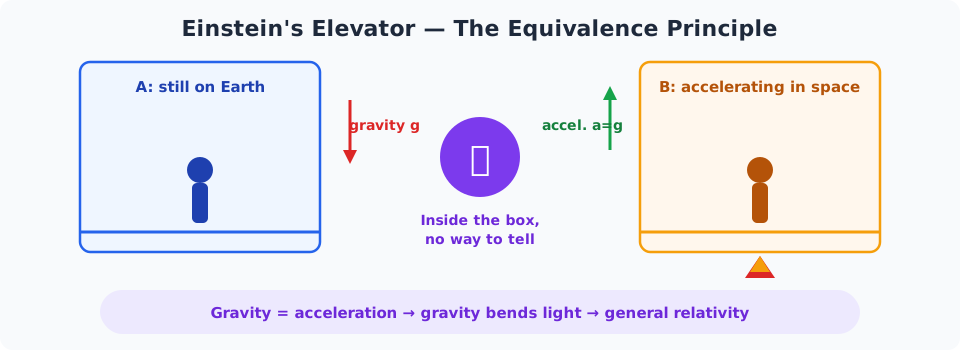
Situation A (gravity): The elevator sits still on Earth’s surface. The person stands firmly on the floor, pulled by gravity. Release an object from your hand and it falls.
Situation B (acceleration): The elevator is in deep space, far from any gravity, being accelerated upward by a rocket. The acceleration is exactly equal to gravity at Earth’s surface (about 9.8 meters per second squared). The accelerating floor pushes the person from below, so they feel pressed to the floor. Release an object and, as the floor rises to meet it, it again “appears to fall.”
Here is the point. In Situation A and Situation B, what the person inside experiences is exactly the same. The scale reads the same value; a dropped ball falls with the same acceleration; jump and you rise to the same height. No physical experiment done inside the box can distinguish whether you are “standing still under gravity” or “accelerating in zero gravity.”
The Equivalence Principle
Einstein saw that this “indistinguishability” reflects not a coincidence or illusion but a fundamental property of nature. This is the “equivalence principle,” the foundation of general relativity.
In simplest terms, the equivalence principle says “the effect of gravity and the effect of acceleration are, locally (over a small region), completely equivalent and indistinguishable.” Gravity and acceleration are, as it were, two faces of the same phenomenon.
The core of this idea becomes even more vivid in reverse. What if the elevator’s cable snapped and the box began to free-fall? Now box and person fall together at the same acceleration. The person loses the sense of being pressed by the floor, floats up, and feels no weight at all. Release a ball and it, too, falls at the same rate, so it hangs there before your eyes. This is indistinguishable from being weightless in space. Falling makes gravity “cancel out and vanish.”
Einstein said he reached this principle from the plain thought that “a person falling off a roof would not feel his own weight while falling.” In today’s terms, the “floating” sensation as a roller coaster drops, or the way training planes dive to create zero gravity, are exactly this “falling cancels gravity” in action. Hidden in a trivial everyday feeling lay the doorway to a fundamental law of the universe.
The Doorway to General Relativity
The equivalence principle gave a wholly new answer to the question “what is gravity?” The key was a thought experiment using light.
Inside the accelerating elevator (Situation B), shine a horizontal beam of light through a hole in one wall. As the light crosses the box, the elevator keeps accelerating upward. By the time the light reaches the far wall, it lands slightly below where it entered, by the amount the box has risen. So, to the person inside, the light’s path appears to bend slightly downward.
Here Einstein applied the equivalence principle. If acceleration (B) and gravity (A) are indistinguishable, then just as light bends in an accelerating box, gravity too must bend light. “Gravity bends light.” This was a bold prediction overturning the common sense that light travels straight.
Pressing on, Einstein reached a revolutionary conclusion: “gravity is not a force, but a distortion of spacetime (space and time) itself.” This is “general relativity” (1915).
On this theory, a massive body like the Sun dents the spacetime around it — like a heavy ball on a trampoline — and light and planets move along the contours of that warped spacetime. What we felt as “being pulled by gravity” was in fact just moving along the curvature of spacetime. An apple falling, the Earth circling the Sun — all of it is brought about by the warping of spacetime.
The Thought Experiment Predicted Reality
What makes Einstein’s elevator truly astonishing is that predictions drawn from a thought experiment done purely in the head were, one after another, confirmed by real observation.
The Bending of Light (the 1919 Eclipse)
A perfect chance to test “gravity bends light” was a total solar eclipse. Light from a distant star passing close to the Sun, bent by the Sun’s gravity, would shift the star’s apparent position slightly. Normally the Sun’s glare hides this, but during an eclipse it can be observed.
In 1919, an expedition led by the British astronomer Eddington confirmed exactly this shift. Einstein’s prediction was a direct hit. The news made front pages around the world, and Einstein became a global celebrity overnight.
Gravitational Time Dilation (GPS)
General relativity also predicts that “time runs slower where gravity is stronger.” And this strange effect is actually corrected for in our daily lives.
The prime example is GPS (satellite positioning), used by smartphones and car navigation. GPS satellites orbit some 20,000 km up, where gravity is weaker, so their clocks tick slightly faster than on the ground. The discrepancy is only tens of microseconds per day, but for GPS, which computes using the speed of light, it is fatal: without correction, your position would drift by about 10 km per day. We can know our exact location on a map only because Einstein’s thought experiment is at work this very moment.
That merely thinking about “the weight inside a box” could unravel the structure of the universe and, moreover, serve us daily in our pockets — there are few cases in the history of science where theory and reality have linked up so beautifully.
Related Thought Experiments
These thought experiments probe the foundations of physics and changed how we see the world. Read together, you glimpse how scientists explore the world inside their heads.


See also the relativity paradox in which a twin’s age changes after space travel.

Summary
This article covered “Einstein’s Elevator.”
“Inside a windowless box, gravity and acceleration cannot be told apart.” From just this insight, Einstein unraveled the fundamental structure of the universe — “gravity is the warping of spacetime” — and his predictions were perfectly borne out by the eclipse and by GPS.
How wide a door a great thought experiment can open — Einstein’s elevator is one of the most beautiful examples in the history of science. With no costly apparatus and no giant telescope, by deeply thinking through “what if I were inside the box,” humanity came to understand the universe a level more deeply. The next time you ride an elevator — or feel that “floating” on a roller coaster — recall this thought experiment.
Thank you for reading. We hope to see you in the next article.

Also popular with readers
📚 Series: Famous Thought Experiments (51/60)