
Thank you for visiting this site. This article covers “The Twin Paradox.”
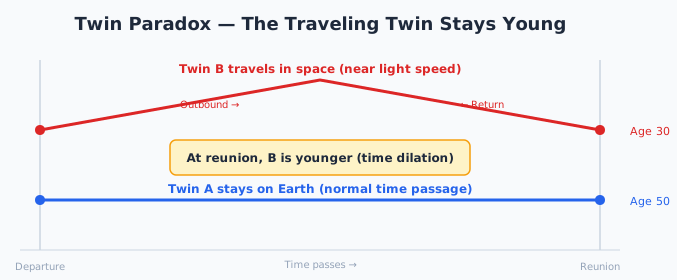
Suppose one of a pair of twins boards a rocket and travels through space at close to the speed of light, then returns to Earth years later. The twin who stayed on Earth will have aged more — the traveler is still younger. This is not a science-fiction premise; it is a physical conclusion derived from Einstein’s special theory of relativity.
The Setup
Call the twins Akira (the traveler) and Takeshi (the one who stays). Akira boards a rocket that flies at 90% of the speed of light (0.9c) toward a distant star and back. Takeshi waits on Earth.
Special relativity’s time dilation tells us that time in a fast-moving frame runs slow as seen by a stationary observer.
The calculation: at 90% of light speed, Akira’s clock runs at about 0.44 times the rate of Earth’s clock. Even after 20 years have passed for Takeshi, only about 8.7 years will have passed for Akira.
When Akira returns, he has aged roughly 8.7 years while Takeshi has aged 20 — the twins who started at the same age now differ by more than 11 years.
Where Is the Paradox?
So far this is simply a consequence of relativity, not yet a paradox. The paradox arises from the following question.
Special relativity holds that all inertial frames are equivalent. From Akira’s perspective, it is Earth (and Takeshi) that recedes at 90% of light speed and then returns.
Wouldn’t Akira then see Takeshi’s time running slow — meaning Takeshi should be younger? If the situation is symmetric, why is the outcome asymmetric?
That is why the scenario is called a paradox.
Resolving the Paradox
The answer is that the situations of Akira and Takeshi are not actually symmetric.
Takeshi remains in an inertial frame throughout — no acceleration, no deceleration, constant velocity (including rest).
Akira, on the other hand, accelerates at departure, decelerates and turns around at the distant star, then accelerates and decelerates again on the way back. Akira experiences acceleration.
Experiencing acceleration means Akira does not remain in a single inertial frame. This asymmetry is the source of the asymmetric outcome. At the turnaround point, Akira undergoes intense acceleration (deceleration → reversal → acceleration). During this moment, Akira’s definition of “simultaneous” shifts dramatically — and a large block of Takeshi’s time on Earth “jumps forward” all at once.
General relativity, which includes the effects of acceleration, gives the same answer from any frame of reference: Akira is younger.
Does the Age Difference Require Acceleration?
Interestingly, acceleration is needed to resolve the paradox — but it is not the cause of the age difference.
Even if the turnaround is made instantaneous (a sudden reversal), the age difference barely changes. The gap is determined mainly by the speed and duration of the constant-velocity phases. Acceleration’s role is purely to break the symmetry between the two frames.
More precisely: it is not that “the one who accelerates ages more slowly” but that “the one who switches inertial frames ages more slowly.”
Experimental Confirmation
The twin paradox is not a thought experiment only. Its effects have been directly measured.
The Hafele–Keating Experiment
In 1971, Joseph Hafele and Richard Keating flew four cesium atomic clocks around the world on commercial aircraft — once eastward, once westward — and compared them to ground-based clocks. Differences of tens to hundreds of nanoseconds were observed, in close agreement with relativity’s predictions.
The eastbound plane flew in the same direction as Earth’s rotation and thus moved faster relative to the ground — its clock ran slightly slow. The westbound plane moved opposite to Earth’s rotation and thus moved slower — its clock ran slightly fast. The results matched the combined predictions of both special and general relativity (gravity also dilates time).
GPS
GPS satellites must correct for relativistic time differences to function accurately. Satellites move fast (special relativity slows their clocks) but orbit in weaker gravity than the surface (general relativity speeds their clocks). The net effect is that satellite clocks gain about 38 microseconds per day relative to ground clocks.
Without the correction, position errors would accumulate to over 10 kilometers per day. The twin paradox is not an abstraction; it affects the technology we use every day.
Real Astronauts
Astronauts who have spent extended time on the International Space Station (ISS) are fractionally younger than they would be if they had stayed on Earth. The ISS orbits at roughly 7.7 km/s, causing a time difference of about 0.01 seconds per year of residence.
Russian cosmonaut Gennady Padalka, who spent a cumulative 879 days in space, is calculated to be about 0.02 seconds “younger” than he would otherwise be — a tiny but real-world instance of the twin paradox.
What happens without any acceleration
Explanations of the twin paradox often bring in acceleration as the key: the traveller accelerates at the turnaround, so their clock is the one that falls behind.
That is a slightly crude way of putting it. Acceleration is not itself what slows time.
More precisely, the two of them travel paths of different length through spacetime. Even with the same start and end points, a different path in between means a different amount of proper time elapses.
- The twin who stays on Earth: travels straight through spacetime, and this path has the maximum proper time
- The twin who travels: takes a bent path, and the proper time is necessarily shorter
On a plane, the straight line between two points is the shortest. In spacetime this reverses, so that the straight path is the longest.
Acceleration is merely the means of bending the path. It is the shape of the path, not the magnitude or duration of the acceleration, that determines the answer.
Producing the same situation with no acceleration
To confirm this, a setup with three participants was devised.
One person stays on Earth. Rocket A flies out at constant velocity to a distant point and, as it passes, hands its clock reading to rocket B, which is travelling back at constant velocity. B carries on to Earth and reports the value.
Nobody has accelerated. Each is simply in an inertial frame. The relayed clock reading is nevertheless behind Earth’s clock.
The asymmetry arises without any acceleration. What creates it is not acceleration but the change from one inertial frame to another partway through.
- The Earth side: stays in the same inertial frame throughout
- The relay side: switches to a different inertial frame partway
Switching inertial frames makes the judgement of “what is happening far away right now” jump at that instant. That jump is what the missing time consists of.
Because the relativity of simultaneity is doing the work, this is structurally identical to the garage paradox. That most of the paradoxes of relativity come down to this in the end is one of the interesting things about them.
Following it through with numbers
Putting actual values in makes it easier to grasp.
Consider a journey at 80 percent of the speed of light to a star four light years away, turning round immediately and coming back.
| Item | Earth side | Rocket side |
|---|---|---|
| One-way distance | 4 light years | 2.4 light years (contracted) |
| One-way time | 5 years | 3 years |
| Round trip total | 10 years | 6 years |
| Age difference on arrival | — | 4 years younger |
From the rocket, the distance itself appears contracted. The speed is the same, so covering a shorter distance at the same speed takes less time. That is the rocket’s account.
From Earth, the distance is unchanged and the rocket’s clock is running slow. That is Earth’s account.
The words of the two explanations differ, and the age difference at the reunion matches exactly. That agreement is what shows relativity to be a consistent theory.
Raise the speed further and the gap widens sharply. At 99 percent of light speed, a round trip of about eight years for the traveller corresponds to 57 years passing on Earth.
Why only the Earth side is special
Even here, the feeling that each should see the other’s clock running slow tends to persist.
The answer is that the two positions are not symmetric. The Earth twin is in a single inertial frame from beginning to end; the travelling twin necessarily turns round.
At the instant of the turnaround, the traveller’s notion of “Earth right now” jumps forward, because simultaneity in the outbound frame and in the return frame do not agree.
Include that jump in the calculation and the elapsed time on Earth as seen by the traveller comes out at exactly ten years. There is no contradiction anywhere.
What looked like a paradox came from isolating the part where the other clock runs slow and leaving the shift in simultaneity out of the account.
Related paradoxes of relativity
Related paradoxes where everyday intuitions about length and simultaneity stop working near the speed of light.




Summary
This article covered “The Twin Paradox.”
The fact that time flows at different rates for different observers — a consequence of relativity — overturns the everyday intuition of time as an absolute backdrop. The paradox is resolved, but the reality that time is not absolute remains as astonishing as ever.
We already live in a world where astronauts return from orbit 0.02 seconds younger than they would have been.
To return to the full list of paradoxes, follow the link below.
Thank you for reading. We hope to see you in the next article.

Also popular with readers
📚 Series: The World's Paradoxes (38/81)