Thank you for visiting this site. This article covers “Schrödinger’s Cat.”
Probably the most famous paradox in all of physics. A cat sealed in a box is, until the box is opened, simultaneously in a “living” state and a “dead” state — or so quantum mechanics seems to say. But can a cat really be alive and dead at the same time?
The Thought Experiment
Austrian physicist Erwin Schrödinger devised this thought experiment in 1935.
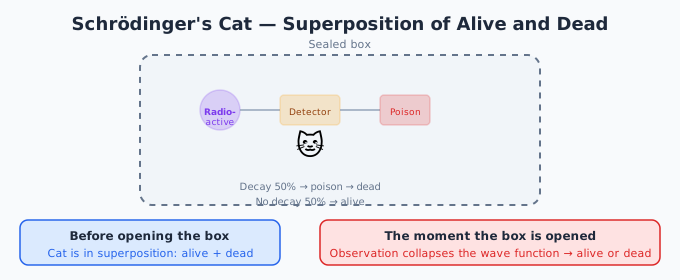
Inside a sealed box, place the following:
- One cat
- A radioactive substance (50% chance of decay within one hour)
- A Geiger counter (radiation detector)
- A poison gas device (releases poison when the Geiger counter triggers)
After one hour, if the radioactive substance has decayed the poison is released and the cat dies; if not, the cat lives.
The question is: What is the state of the cat before the box is opened?
What Quantum Mechanics Says
According to the standard interpretation of quantum mechanics (the Copenhagen interpretation), a radioactive atom is in a superposition of “decayed” and “not decayed” until it is observed.
If the atom is in superposition, the poison device connected to it is in a superposition of “triggered and not triggered,” and the cat is in a superposition of “alive and dead.”
When the box is opened and an observation is made, the superposition “collapses” and the cat is fixed as either alive or dead. Following the theory of quantum mechanics strictly leads to this conclusion.
Schrödinger’s Intent
Crucially, Schrödinger devised this thought experiment to criticize quantum mechanics, not to celebrate it.
His point: applying the Copenhagen interpretation of quantum mechanics literally to the everyday world leads to the absurd conclusion that a cat can be alive and dead at the same time. This absurdity is evidence that the interpretation of quantum mechanics has a problem.
The paradox was intended as a reductio ad absurdum — a demonstration that the standard interpretation cannot be carried over naively from the quantum scale to the macroscopic world.
The Measurement Problem
The fundamental issue Schrödinger’s Cat raises is: where is the boundary between the quantum world of the microscopic and the classical world of everyday experience?
A single atom can enter superposition — experiments confirm this. What about a molecule? A virus? A bacterium? A cat? A human?
Somewhere there must be a boundary between the quantum and classical worlds, but where that boundary lies remains unclear. This is called the quantum-classical correspondence or the measurement problem — one of the deepest unsolved problems in physics.
Competing Interpretations
Physicists have proposed several ways to handle the cat.
The Copenhagen Interpretation holds that the superposition collapses at the moment of observation — but leaves “observation” undefined, which is part of the problem.
The Many-Worlds Interpretation (Everett) holds that opening the box causes the universe to branch: one branch where the cat is alive and one where it is dead, both equally real. The superposition never collapses; the observer becomes part of the superposition.
Decoherence theory explains that macroscopic objects constantly interact with their environment, causing superpositions to vanish almost instantaneously (decohere). An object as large as a cat cannot maintain a superposition for any measurable time. This is currently one of the most widely accepted explanations, though critics argue it does not fully resolve the measurement problem.
Cultural Impact
Schrödinger’s Cat has become a cultural icon far beyond physics — quoted in anime, novels, films, and games.
The image of “all possibilities coexisting until a choice is made” has drifted from any precise physical meaning, but it works beautifully as a philosophical metaphor.
Why the cat is never in superposition
The practical answer modern physics gives is decoherence.
A superposition can only be maintained in complete isolation from the outside world. Air molecules, photons, thermal fluctuations — let any of them so much as touch the system and the information about the superposition leaks away into the environment.
- A single electron: isolate it in vacuum and the superposition holds
- Large molecules: at low temperature and high vacuum, superposition can be confirmed in the laboratory
- Something the size of a virus: an area of active research
- A cat: emits countless photons from its body heat alone; isolation is impossible in principle
A cat is constantly exchanging information with its surroundings through the heat it gives off. The calculated time before its superposition collapses is astoundingly short.
That does not mean superposition does not occur. It means it disappears many orders of magnitude before a human could observe it.
Has decoherence solved the measurement problem?
This needs care. Decoherence explains why we never see superpositions in daily life; it does not explain why one outcome is selected.
Once entangled with the environment, the live cat and the dead cat no longer interfere with each other. Both possibilities have not gone away; they have merely stopped mixing.
Why exactly one of them is what gets observed is answered differently by each interpretation. Many-worlds says both happen; Copenhagen says observation settles it to one.
So decoherence disposed of half the problem experimentally, and the other half remains where it was, in philosophical argument.
In the laboratory, large things are put in superposition
Unimaginable in Schrödinger’s day, macroscopic superpositions — “cat states” — are now actually produced.
From around 2000, experiments reported currents in superconducting circuits placed in a superposition of clockwise and anticlockwise flow. The circuits are of visible size, and billions of electrons take part in the current.
Molecular interference experiments have advanced too, with double-slit experiments reported for giant molecules of some 2,000 atoms.
The cat is still distant, and the boundary is pushed further out year by year. How large it can be made remains one of the main questions in experimental physics.
What each interpretation does with the cat
How the main interpretations handle this cat:
| Interpretation | State of the cat | Wavefunction collapse |
|---|---|---|
| Copenhagen | undetermined until the box is opened | occurs on observation |
| Many-worlds | splits into a world where it lives and one where it dies | does not occur |
| Bohmian mechanics | settled one way from the start | does not occur |
| Objective collapse | settles spontaneously above a certain size | occurs as a physical process |
| Relational | depends on whose state it is | occurs relative to an observer |
The part I find interesting is that every interpretation predicts exactly the same experimental results. The equations you compute with do not change, so no experiment separates them.
The exception is the fourth. Objective collapse predicts something slightly different from ordinary quantum mechanics, and attempts to test it experimentally are under way.
So far no difference has been detected.
Schrödinger himself was not persuaded
Presenting this thought experiment as a celebration of quantum weirdness is quite far from its author’s intention.
Schrödinger wanted to show that applying the Copenhagen view straightforwardly to large objects produces a ridiculous conclusion. In his 1935 paper the cat appears in a critical context.
Einstein published the EPR paper the same year. The two corresponded, sharing doubts about the completeness of quantum mechanics.
The people who built quantum mechanics resisted its interpretation most strongly.
Schrödinger received the Nobel Prize in 1933 for his wave equation, and is said never to have been satisfied about what his own equation meant.
Related paradoxes of quantum mechanics
Related paradoxes where quantum mechanics’ demands stop meshing with our naive picture of the world.


Summary
This article covered “Schrödinger’s Cat.”
Humanity’s most precise scientific theory, applied to the everyday world, generates the bizarre conclusion that a cat is alive and dead at once. The paradox reminds us that even now we do not fully understand the fundamental workings of nature — a humbling thought and a reminder of how much physics still has to discover.
To return to the full list of paradoxes, follow the link below.
Thank you for reading. We hope to see you in the next article.
Also popular with readers
📚 Series: The World's Paradoxes (37/81)