Thank you for visiting this site. This article covers “The Two Children Problem.”
A family has two children. You are told: “At least one of them is a boy.” What is the probability that the other child is also a boy? Most people answer one-half, but the correct answer is one-third.
Working Through the Problem
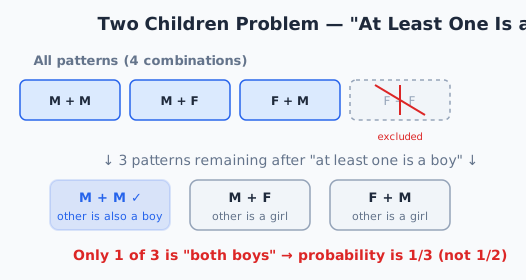
Distinguishing birth order, there are four equally likely combinations of two children’s sexes (M = male, F = female):
- First child M, second child M
- First child M, second child F
- First child F, second child M
- First child F, second child F
Each combination has probability 1/4.
The information “at least one is a boy” eliminates the FF (both girls) case. Three patterns remain:
- First child M, second child M
- First child M, second child F
- First child F, second child M
Of these three, only one (MM) has the other child also being a boy. Therefore, the probability that the other child is also a boy is 1/3.
Why Intuition Fails
Most people answer 1/2 because they unconsciously interpret the statement as “a specific child is a boy.”
If told “the older child is a boy,” the younger child’s sex has two equally likely outcomes (M or F), so the answer is indeed 1/2. But “at least one is a boy” does not specify which child is the boy. This ambiguity keeps additional possibilities alive and changes the probability.
The key is the difference in specificity. “The older child is a boy” describes a particular child, leaving the other’s sex as a free variable. “At least one is a boy” identifies neither child specifically, so you must enumerate all patterns that satisfy the condition and count.
How Phrasing Changes the Answer
The most important lesson here is that the same underlying situation yields different probabilities depending on how the information is stated.
“You visit a family with two children and a boy greets you at the door. What is the probability the other child is also a boy?” — The answer is 1/2, because the child who greeted you is a specific individual; the structure is the same as “the older child is a boy.”
“You are told about a two-child family that at least one child is a boy. What is the probability the other is also a boy?” — The answer is 1/3.
The underlying situation is identical, but the way you obtained the information changes the answer. This is the heart of the paradox, and it divided mathematicians when the problem was first widely discussed.
The Tuesday-Born Boy
There is a surprising variant. Change the condition to: “At least one is a boy born on a Tuesday.”
The probability that the other child is also a boy becomes 13/27 (roughly 48%) — a large shift from 1/3 (roughly 33%).
An apparently irrelevant piece of information — the day of birth — changes the probability. The more specific the identifying information becomes, the more the particular child is pinpointed, freeing the other child’s sex to vary — and the probability rises toward 1/2.
As an extreme example, if told “at least one is a boy born at 3:17:42 a.m. on May 29, 2026,” that child is almost uniquely identified and the probability approaches 1/2 arbitrarily closely. The more specific the information, the closer the answer moves from 1/3 toward 1/2.
The same trap waits in professional life
The problem looks like a game with numbers, and the same structure turns up constantly in workplace judgements.
- Hiring: hearing “this department produced an outstanding person” means something different from an employee picked at random turning out to be outstanding
- Defect reports: one case found by inspecting everything and one case that happened to catch somebody’s eye imply different overall defect rates
- Medicine: information obtained by asking every patient about family history carries different weight from information a patient volunteered
- Measuring effects: a good week picked after looking at the whole period means something entirely different from the figure for a week chosen in advance
What they share is the distinction between whether the information is the result of a search or the result of a chance encounter.
The first is a report made after surveying the whole set, so it appears whenever even one case satisfies the condition. The second is a remark about one particular case, so the subject has already been narrowed down.
The number itself may be identical, and the interpretation turns on how that number was arrived at. The two-children problem exhibits the difference in the smallest possible setting.
When a report comes in, check whether everything was examined or whether this is what happened to be noticed. That alone prevents a great many misreadings.
Connection to the Monty Hall Problem
This problem shares its structure with the Monty Hall problem: new information updates the sample space, and intuition cannot keep up.
In both paradoxes, the act of receiving information changes the sample space, leaving human intuition behind. Our cognitive tendency to mishandle conditional probability is what gives these paradoxes their bite.
How the information arrives decides the answer
What makes this problem confusing is that the same words — “one of them is a boy” — mean different things depending on how they reached you.
The answer for each way of asking
| How you learned it | Possibilities remaining | Probability the other is a boy too |
|---|---|---|
| Told the elder child is a boy | BB, BG | 1/2 |
| Told at least one is a boy | BB, BG, GB | 1/3 |
| A boy answered the door when you called | BB, BG, GB (BB counted as two cases) | 1/2 |
| At least one is a boy born on a Tuesday | 13 of 27 cases | 13/27 |
For the same “there is a boy”, the answer changes according to whether it was reported after surveying the whole family or whether you happened to meet one child.
The second row is information about the family as a whole. BB, BG and GB remain equally likely, so the answer is 1/3.
The third row is information about one particular child. The case splits according to whether the child at the door was the elder or the younger, so a BB family is counted twice. That brings the answer back to 1/2.
Why adding Tuesday moves it toward 1/2
The Tuesday version in the fourth row makes no sense the first time you see it. Why should an apparently irrelevant fact about the day of the week move the probability from 1/3 to 13/27?
The reasoning runs like this. The condition “a boy born on a Tuesday” is very narrow, so families in which two children satisfy it are extremely rare.
- Families where exactly one child satisfies it: the other is a girl, or a boy born on a different day
- Families where two children satisfy it: vanishingly few
That raises the relative share of families with exactly one matching child, which brings the situation closer to pointing at one particular child.
So all that the extra condition does is change the character of the information, from a report about the family as a whole to a remark about one particular child. The answer is sliding between the second and third rows of the table above, and Tuesday has stopped it partway.
The ambiguity of the wording is the real subject
Most of the argument around this problem comes not from the probability calculation but from the wording failing to specify the situation.
The sentence “a family has two children, and it is known that one is a boy” does not say which of the following happened.
- All families satisfying the condition were collected and one was drawn from them
- One particular family was asked whether it has a boy and answered yes
- Somebody called at the house and the child who came out happened to be a boy
All three are mathematically computable, and the answer comes out as 1/3 in one and 1/2 in another. The problem is incomplete; the intuition is not necessarily wrong.
When somebody sets the puzzle without noticing that ambiguity and declares “the answer is 1/3”, the argument stops connecting. The same kind of crossed purposes ran through the Monty Hall controversy in 1990.
When writing a probability problem, state how the sample was selected. It sounds obvious, and it is a step that in practice often gets left out.
The same “there is a boy” yields a different answer depending on how you came to know it. That is the most interesting thing about this problem.
Related paradoxes that defy probabilistic intuition
Related paradoxes where the arithmetic is correct and the answer refuses to sit with intuition.



Summary
This article covered “The Two Children Problem.”
The fact that the phrasing of information can dramatically change a probability is a textbook example of probability clashing with intuition. A simple-looking setup conceals a deep structure of conditional probability beneath it.
To return to the full list of paradoxes, follow the link below.
Thank you for reading. We hope to see you in the next article.

Also popular with readers
📚 Series: The World's Paradoxes (36/81)