Thank you for visiting this site. This article covers the “Monty Hall Problem.”
Named after an American TV game show, this problem caused a massive public controversy when it was published — mathematicians and even Nobel Prize winners gave the wrong answer. It is one of the most famous paradoxes in the history of probability theory.
The Setup
The rules of the game are as follows.
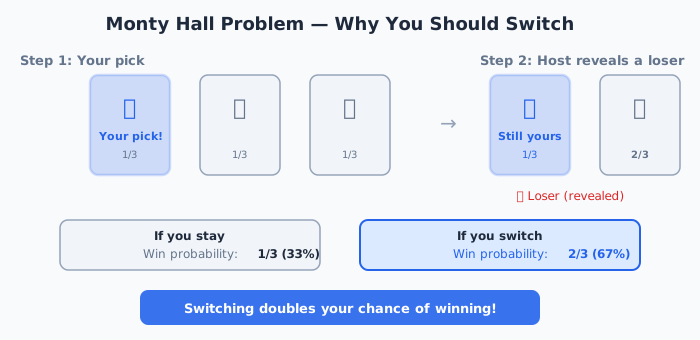
Three doors — A, B, and C — stand before you. Behind one door is a new car (the prize); behind the other two are goats (losing). You choose one door. Let’s say you pick Door A.
Now the host, Monty Hall, steps in. Monty knows what is behind every door, so he opens one of the doors you did not choose that “definitely has a goat.” Let’s say he opens Door C to reveal a goat.
Monty then asks you: “Would you like to switch? Stay with Door A, or switch to Door B?”
Should you switch?
Most People’s Intuition
Most people think, “It doesn’t matter — there are two doors left, so the probability is 50-50.”
This is wrong.
The correct answer is “you should switch.” Switching gives you a 2/3 probability of winning; staying gives you only 1/3. Switching doubles your chances.
Why 2/3?
Here is the simplest explanation.
When you first picked a door, the probability of being right was 1/3, and the probability of being wrong was 2/3.
Monty’s act of opening a losing door does not change “the probability that your original pick was correct.” Your chosen door still has a 1/3 chance of hiding the car.
The other two doors collectively had a 2/3 chance of containing the car. Monty revealed one of those doors as a loser — so that entire 2/3 probability concentrates on the one remaining door.
That is why switching wins 2/3 of the time.
Writing Out All Possibilities
For those not yet convinced, let’s enumerate every scenario. Suppose you first chose Door A.
| Car location | Door Monty opens | Stay result | Switch result |
|---|---|---|---|
| Door A | B or C | Win | Lose |
| Door B | Door C | Lose | Win |
| Door C | Door B | Lose | Win |
Of the three equally likely scenarios, staying wins in 1 case while switching wins in 2. Switching is twice as advantageous — plain to see.
The Great Controversy
This paradox burst into public debate in 1990. When columnist Marilyn vos Savant published the correct answer — “switch” — in her magazine column, roughly 10,000 letters of protest poured in.
Among the critics were many mathematicians and PhDs. They wrote, “Your answer is wrong” and “The probability is obviously 50-50.”
Computer simulations run tens of thousands of times, however, confirmed that switching wins approximately 2/3 of the time, proving vos Savant correct.
Knowing the answer and still not wanting to switch
The interesting part is that plenty of people hesitate to switch even after they have understood that 2/3 is correct. Something other than probability is at work.
- Asymmetry of regret. Losing after switching feels worse than losing by standing pat
- The endowment effect. Attachment forms to the door you picked, making it hard to give up
- Action bias. Failing through inaction is easier to accept than failing through action
- A single throw. Probability only bites over repetition. Once only, a 2/3 chance still loses when it loses
The fourth cannot be waved away. In a one-off attempt, switching correctly still loses one time in three. And when it does, what the person is left with is the fact that standing pat would have won.
A choice that is clearly favourable in expectation can go against you as an experience. The same happens in investing and in medical decisions, and it leads to the lesson that a good decision and a good outcome are different things.
Experiments with pigeons have reported that the frequency of switching rises over repeated trials. Learn from experience rather than reasoning and you arrive at the right answer. Perhaps humans struggle here because we try to generalise from a single experience.
Why Does Intuition Fail?
The main reason people get this wrong is that they overlook the fact that “Monty’s action provides new information.”
Monty follows a strict rule: he always opens a losing door. He is not opening doors at random. If your initial choice is wrong (probability 2/3), Monty has only one losing door he can open — which means Monty’s action indirectly signals that the other door is likely the winner.
If Monty had no knowledge of the doors and opened one at random — only to reveal a goat by chance — then the probability really would be 50-50. Whether or not Monty knows the contents changes the conclusion, which is another fascinating aspect of this problem.
Make it a hundred doors and it becomes obvious
When the reasoning will not go down, one explanation works better than any other: increase the number of doors.
Suppose one prize is hidden behind one of a hundred doors. You pick one, and the host then opens 98 of the remaining 99, showing goats behind all of them. Two doors are left: the one you picked, and the one the host declined to open.
Asked now whether to switch, the answer is obvious. The chance that your original door hides the prize is still one in a hundred, and essentially all the remaining weight has collected on the single door left standing.
- Your original door: picked blind from a hundred. 1 percent
- The door left standing: left by a host who knows the contents, after eliminating 98. 99 percent
Three doors have exactly the same structure, with the ratio merely 1/3 against 2/3. Raising the count makes visible what is doing the work: the host is choosing what to open, and he knows.
The host’s rule changes the probability
The other thing worth grasping is that the answer depends on the rule the host is following.
| The host’s behaviour | Chance of winning by switching |
|---|---|
| Always opens a losing door (the standard rule) | 2/3 |
| Opens at random and it happens to be a goat | 1/2 |
| Opens only when the contestant picked the prize | 0 |
| Opens only when the contestant picked a goat | 1 |
The second row matters. If the host opens without knowing and it happens to be a goat, the probability really is even. The common objection that “it’s 50-50” is correct — for that situation.
The third and fourth rows are hosts who steer or rescue the contestant. Under the setup known as “Monty from Hell,” the offer to switch comes only to contestants who picked the prize, so switching always loses.
The problem is therefore less a calculation of probability than a problem of reading the other party’s rule. Part of why opinion split so badly in the 1990 controversy is that the question as posed never stated the host’s rule.
What the show actually did
Less well known: on the real programme, Let’s Make a Deal, the rule was not always applied.
Monty Hall himself said in a later newspaper interview that depending on what lay behind the contestant’s first pick, he decided on the spot whether to open another door or to offer cash instead.
There was no guarantee on the show that the host would always open a losing door. He was free to apply pressure only when the contestant had picked the prize.
- Monty Hall as a mathematics problem: the rule is fixed, so the answer is 2/3
- Monty Hall as a television programme: the host has discretion, so no probability is defined
The two things sharing a name are, in fact, different things.
Hall told his interviewer, in effect, that he was no mathematician but that reading the contestant was his job. That a problem famous as a teaching device for probability began life as a game of second-guessing is a pleasing detail.
What makes this problem so well made, to my mind, is that the reason intuition fails comes down to one point: the host knows the answer.
Related paradoxes that defy probabilistic intuition
Related paradoxes where the arithmetic is correct and the answer refuses to sit with intuition.

Summary
This article covered the “Monty Hall Problem.”
A paradox that tripped up even mathematicians illustrates how fragile human probabilistic intuition can be. Even knowing the answer, many people still feel a vague sense of disbelief — and that lingering feeling is precisely what makes this problem so memorable.
To return to the full list of paradoxes, follow the link below.
Thank you for reading. We hope to see you in the next article.

Also popular with readers
📚 Series: The World's Paradoxes (26/81)