
Thank you for visiting this site. This article covers “The Three Prisoners Problem.”
This paradox shares its essential structure with the Monty Hall problem and has long been known in Japan. It vividly illustrates the gap between intuition and calculation in conditional probability.
The Setup
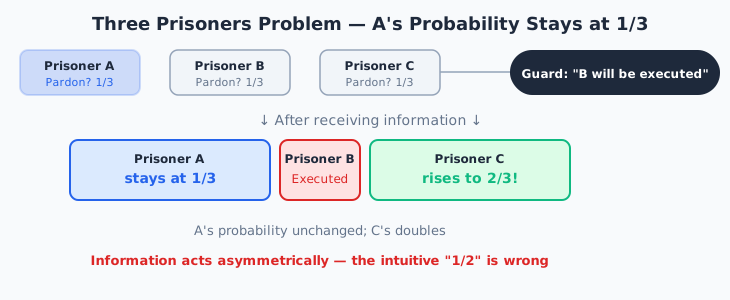
Three prisoners — A, B, and C — have been sentenced to death. However, one of them, chosen at random, will be pardoned and released. The prisoners do not yet know who will be pardoned.
Prisoner A makes a request to the guard: “Of B and C, tell me the name of just one who will be executed. Since at least one of the three must be executed, surely you can share that much?”
The guard replies: “B will be executed.”
Prisoner A now reasons: “My odds of survival were 1/3 to begin with. But now that B is confirmed to be executed, only C or I can survive — so my odds must have risen to 1/2, right?”
Is A’s reasoning correct?
The Intuitive Guess and the Real Answer
A’s reasoning is wrong.
Even after hearing the guard’s information, A’s probability of survival remains 1/3. Meanwhile, C’s probability of survival rises to 2/3.
“Wait — why are A’s and C’s probabilities different?” That is precisely what makes this paradox fascinating.
Why A’s Probability Stays at 1/3
Let’s enumerate all cases. There are three scenarios depending on who receives the pardon.
Case 1: A is pardoned (probability 1/3) The guard may name either B or C. The probability that he says “B will be executed” is 1/2.
Case 2: B is pardoned (probability 1/3) The guard must say “C will be executed.” He cannot say “B will be executed” because B is pardoned.
Case 3: C is pardoned (probability 1/3) The guard says “B will be executed” (since B is being executed).
The cases where the guard says “B will be executed” are Case 1 (probability 1/3 × 1/2 = 1/6) and Case 3 (probability 1/3 × 1 = 1/3).
Given that the guard said “B will be executed,” the probability that A is pardoned is (1/6) ÷ (1/6 + 1/3) = (1/6) ÷ (1/2) = 1/3.
The probability that C is pardoned under the same condition is (1/3) ÷ (1/2) = 2/3.
The Connection to the Monty Hall Problem
You may have noticed that this is structurally identical to the Monty Hall problem.
- Three doors → Three prisoners
- The winning door → The pardoned prisoner
- Your initial choice → Prisoner A himself
- Monty opens a losing door → The guard names someone who will be executed
In the Monty Hall problem, the correct move is to switch doors. In the Three Prisoners Problem, the equivalent conclusion is: C has twice A’s probability of survival.
The guard only told A which one of B or C would be executed. This information does not change A’s probability, but it does shift C’s probability upward. The key insight is that information acts asymmetrically.
How to check it with your hands
Argument alone is hard to be convinced by, so here is a form you can actually try.
Take three playing cards, mark one of them and lay all three face down. The marked card is the pardon. Pick one as your own, then turn over one unmarked card from the remaining two. If neither of them is marked, decide at random which to turn.
Repeat, counting how often your own card turns out to be the marked one. It only happens about one time in three. The remaining unturned card carries the mark twice as often.
A few dozen rounds make the tendency plain, which tends to convince faster than following the reasoning does.
Why so many people answer 1/2
Several tendencies have been identified behind the error.
- Equiprobability bias: when two options remain, they feel like an even split with no reason given
- Forgetting where the information started: the fact that the first pick was made at one in three drops out of mind along the way
- Not looking at how the testimony was selected: no thought is given to what the guard can and cannot say
- An omission in the wording: the rule the guard answers by is never stated, and that goes unnoticed
The first is especially deep-seated. The habit of judging a probability from the number of remaining options alone has been observed across many settings.
Nobody thinks a lottery is a fifty-fifty proposition because “you either win or you don’t”, and yet the same error is easy to fall into when the options drop from three to two. Attention goes to the change, and the fact that the original ratio has been preserved gets missed.
Why Prisoner A Is Wrong
The error A commits is the reasoning: “The candidates went from three to two, so the probability must be 1/2.”
Narrowing the candidates does sometimes change probabilities — but what matters here is that which name the guard says is not random. The guard can never name the pardoned prisoner, so his answer is systematically biased depending on who the pardon belongs to.
Ignoring this bias and simply thinking “two candidates, so 1/2” is exactly where the intuition goes wrong.
Checking it with Bayes’s theorem
Trading intuitions settles nothing, so take it to a calculation with conditional probabilities.
How likely the guard’s testimony is
Lay out how often the guard says “B will be executed” in each world, according to who is pardoned.
| Who is pardoned | Probability | Probability the guard says B | Product |
|---|---|---|---|
| Prisoner A | 1/3 | 1/2 (chosen at random from B and C) | 1/6 |
| Prisoner B | 1/3 | 0 (he cannot name the pardoned one) | 0 |
| Prisoner C | 1/3 | 1 (he has no choice but to say B) | 1/3 |
The probability that the testimony “it is B” occurs at all is 1/6 plus 1/3, which is 1/2.
The share of that taken by the case where A is pardoned is 1/6 divided by 1/2, which is 1/3. The case where C is pardoned is 1/3 divided by 1/2, which is 2/3.
The third row is the key. In the world where C is pardoned, the guard has no option but to name B. That absence of choice is what concentrates the probability on C’s side.
Change how the guard answers and the probability changes
More interesting still, altering the guard’s behaviour alters the answer.
Suppose the guard has the habit of always saying B when both B and C are to be executed.
Now hearing “B will be executed” tells you nothing, because he says B both when A is pardoned and when C is pardoned. Work it through and A’s probability of being pardoned rises to 1/2.
Conversely, if this guard answered “C will be executed”, that can only happen in the world where B is pardoned. A’s chance of survival drops to zero.
| The guard’s policy | A’s probability given “B” | A’s probability given “C” |
|---|---|---|
| Chooses at random from B and C | 1/3 | 1/3 |
| Says B whenever possible | 1/2 | 0 |
Hearing the same words, how much information you get depends entirely on the rule by which the speaker is speaking.
What has to be examined is not the testimony but the process that selected it. The same thinking applies directly to testimony in court and to the numbers a company chooses to publish.
The name and the history
The problem spread after Martin Gardner, well known for popularising mathematical puzzles, took it up in a Scientific American column in 1959.
Gardner introduced it as the “three prisoners problem” and recorded that he received a great many protests from readers at the time. Given that the same commotion repeated itself thirty-one years later over the Monty Hall problem, it says something about how stubborn human intuition is.
Gardner also cited an older form: Bertrand’s “three boxes problem” of 1889. Three boxes hold, respectively, two gold coins, two silver coins, and one of each; draw one coin, find it gold, and the probability that the other coin in that box is also gold is 2/3.
The structure is the same, which makes this a problem that has gone on confounding people in changing forms for more than 130 years.
The point that the probability turns on whether the guard has a choice of answer looks to me like a demonstration of what information is actually worth.
Related paradoxes that defy probabilistic intuition
Related paradoxes where the arithmetic is correct and the answer refuses to sit with intuition.



Summary
This article covered “The Three Prisoners Problem.”
Conditional probability consistently defies intuition. The lesson — that receiving information does not necessarily update probabilities symmetrically — is extremely important whenever you work with statistics.
To return to the full list of paradoxes, follow the link below.
Thank you for reading. We hope to see you in the next article.

Also popular with readers
📚 Series: The World's Paradoxes (27/81)